


US government officials’ high-profile reception of a Taiwanese representative at the Alaska Sustainable Energy Conference indicated the emergence of an Indo-Pacific energy resilience alliance, an academic said.
Presidential Office Secretary-General Pan Men-an (潘孟安) attended the conference in Alaska on Thursday last week at the invitation of the US government.
Pan visited oil and gas facilities with senior US officials, including US Secretary of the Interior Doug Burgum, US Secretary of Energy Chris Wright, Alaska Governor Mike Dunleavy and US Senator Daniel Sullivan.
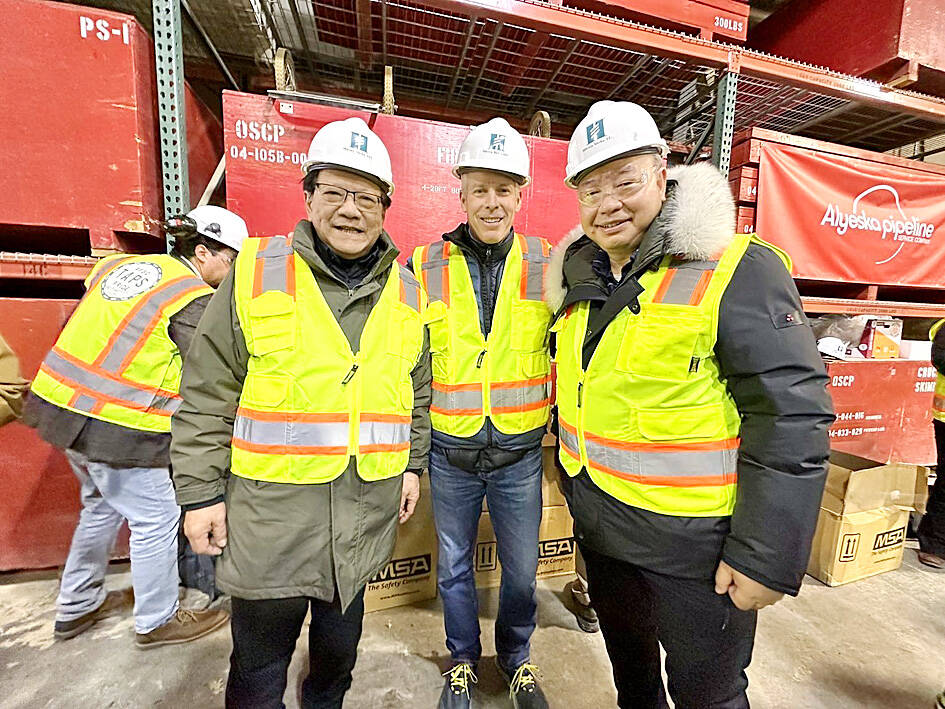
Photo courtesy of the Presidential Office
Pan attending the conference on behalf of President William Lai (賴清德) shows a significant elevation in diplomatic representation, Institute for National Defense and Security Research fellow Su Tzu-yun (蘇紫雲) said on Saturday.
Taiwan should adopt a pragmatic security strategy by having its interests tied with allies via cash and capital, in addition to ensuring deterrence via purchasing arms and ammunition, Su said, adding that Taiwan’s trade surplus with the US being as high as US$70 billion makes such a strategy even more necessary.
Taiwan should prioritize energy security in improving its ties with the US, he said.
Taiwan, Japan and South Korea source their energy mostly from the Middle East, which comes with logistical risks, he said, adding that an energy line coming from Alaska would benefit the three countries.
US President Donald Trump’s administration has adopted a policy of “unleashing US energy” to enhance the nation’s autonomy, and Alaska is one of the richest US states in terms of fossil fuels and liquefied natural gas (LNG) resources, Kuma Academy chief executive officer Ho Cheng-hui (何澄輝) said.
While Alaska is open for external investments, Taiwan is sourcing its gas from Qatar and other Middle Eastern countries, with the sea routes passing through China’s sphere of influence, Ho said.
If Taiwan can source LNG from Alaska, it can ensure faster and safer delivery, he said.
LNG helps Taiwan realize its “nuclear-free homeland” policy, and the supply of the energy source would be critical given the difficulty of its storage, he said.
Alaska is a new and promising energy source for Taiwan, he added.
That US Cabinet officials attended the conference and gave Pan a high-profile reception is not only diplomatically significant, but would influence Taiwan-US tariff negotiations as Trump’s 90-day pause on tariffs would soon expire, Democratic Progressive Party Legislator Wang Ting-yu (王定宇) said.
The government’s negotiation strategies have earned recognition from experts familiar with the matter globally, he said, adding that he was cautiously optimistic about the negotiations’ outcome.
Expanding the extraction of gas and oil in Alaska would help meet local demand and support export markets, and provide electricity to US defense facilities in the state, Burgum said.
Alaska has high geostrategic value, as it is close to China and Russia, and the state links the US to Asia, Ho said.
The Alaska government has suspended energy investments from Chinese companies due to security concerns, he said.
Alaska is the first line of air defense for the US and its significance to the nation’s defense is expected to increase, Su said.
Local energy demand from Alaska could skyrocket if Trump includes high-energy laser or high-power microwave weapons in his “Golden Dome” missile defense system plan, he said.
If Taiwan can collaborate with the US by taking part in the energy investment, it would be a step forward in building mutual trust, as well as in bolstering defense security and economic cooperation, Su said.
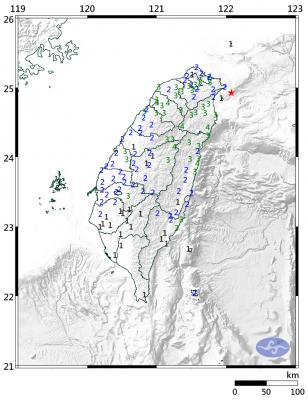
A magnitude 6.1 earthquake struck off the coast of Yilan County at 8:39pm tonight, the Central Weather Administration (CWA) said, with no immediate reports of damage or injuries. The epicenter was 38.7km east-northeast of Yilan County Hall at a focal depth of 98.3km, the CWA’s Seismological Center said. The quake’s maximum intensity, which gauges the actual physical effect of a seismic event, was a level 4 on Taiwan’s 7-tier intensity scale, the center said. That intensity level was recorded in Yilan County’s Nanao Township (南澳), Hsinchu County’s Guansi Township (關西), Nantou County’s Hehuanshan (合歡山) and Hualien County’s Yanliao (鹽寮). An intensity of 3 was
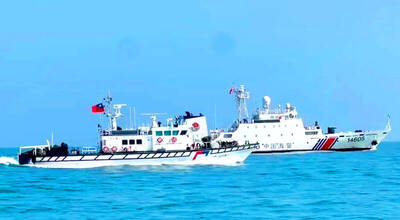
Instead of focusing solely on the threat of a full-scale military invasion, the US and its allies must prepare for a potential Chinese “quarantine” of Taiwan enforced through customs inspections, Stanford University Hoover fellow Eyck Freymann said in a Foreign Affairs article published on Wednesday. China could use various “gray zone” tactics in “reconfiguring the regional and ultimately the global economic order without a war,” said Freymann, who is also a nonresident research fellow at the US Naval War College. China might seize control of Taiwan’s links to the outside world by requiring all flights and ships entering or leaving Taiwan
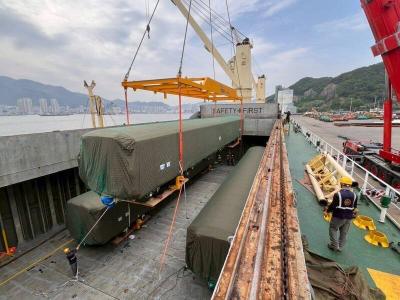
The first of 10 new high-capacity trains purchased from South Korea’s Hyundai Rotem arrived at the Port of Taipei yesterday to meet the demands of an expanding metro network, Taipei Rapid Transit Corp (TRTC) said yesterday. The train completed a three-day, 1,200km voyage from the Port of Masan in South Korea, the company said. Costing NT$590 million (US$18.79 million) each, the new six-carriage trains feature a redesigned interior based on "human-centric" transportation concepts, TRTC said. The design utilizes continuous longitudinal seating to widen the aisles and optimize passenger flow, while also upgrading passenger information displays and driving control systems for a more comfortable
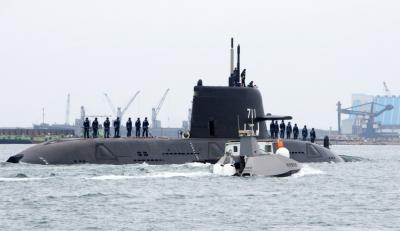
Taiwan's first indigenous defense submarine, the SS-711 Hai Kun (海鯤, or Narwhal), departed for its 13th sea trial at 7am today, marking its seventh submerged test, with delivery to the navy scheduled for July. The outing also marked its first sea deployment since President William Lai (賴清德) boarded the submarine for an inspection on March 19, drawing a crowd of military enthusiasts who gathered to show support. The submarine this morning departed port accompanied by CSBC Corp’s Endeavor Manta (奮進魔鬼魚號) uncrewed surface vessel and a navy M109 assault boat. Amid public interest in key milestones such as torpedo-launching operations and overnight submerged trials,


 RSS
RSS