


The Taiwan People's Party (TPP), with support from the Chinese Nationalist Party (KMT), proposed a constitutional amendment to abolish the Control Yuan.
TPP Chairman Huang Kuo-chang (黃國昌) and KMT Legislator Lo Chih-chiang (羅智強) proposed amendments to articles 3, 4 and 7 of the Additional Articles of the Constitution of the Republic of China (中華民國憲法增修條文).
The amendments would abolish the Control Yuan and transfer its audit power to the Legislative Yuan, including giving the latter oversight of the Executive Yuan’s annual accounting and finances.
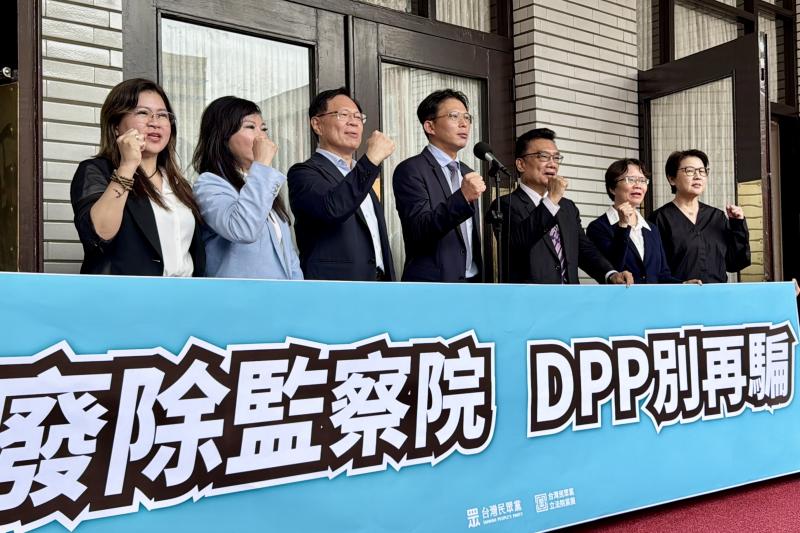
Photo: Tsung Chang-chin, Taipei Times
At a news conference this morning prior to the final tally, Huang said he was confident his party would reach the 25 percent threshold necessary to formally submit the amendment.
Abolishing the Control Yuan has been a long-term goal of the party, one that former TPP chairman Ko Wen-je (柯文哲) also campaigned on in his presidential run last year, but it did not have enough seats in the Legislative Yuan to make it a reality, Huang said.
Now that the proposal has passed the threshold, Huang would ask Legislative Speaker Han Kuo-yu (韓國瑜) to assemble a constitutional amendment committee, he said.
“The public has had enough of this committee of 'big baby' supervisors,” Huang said.
They abuse their power, violate the law and only work on behalf of their own party, he added.
After the threshold had been reached, Huang on Facebook thanked fellow opposition lawmakers for their support.
The TPP also proposed extending the legislative session until Aug. 31, with KMT caucus secretary-general Wang Hung-wei (王鴻薇) expressing support.
The KMT previously proposed extending the session until July 31, which led to criticism from the Democratic Progressive Party (DPP), which accused it of seeking to dodge accountability.
DPP caucus chief executive Rosalia Wu (吳思瑤) said that opposition lawmakers are seeking to “maintain their immunity” and have used the Legislative Yuan to obstruct justice.
By extending the legislative session, the opposition can continue to try and “buy votes” against the recall movement through populist bills such as a military pay increase and a proposed NT$10,000 (US$337.10) cash payment, Wu said.
Chinese-language media have reported that each extra day of a legislative session would cost NT$10 million, Wu said, adding that this is a waste of taxpayer money and does not benefit the country.
The DPP has proposed abolishing the Control Yuan, including in the prior Legislative Yuan, but not as an act of political revenge, Wu said.
The DPP is willing to work with opposition lawmakers to promote constitutional reform and improve the system, she added.
The additional articles of the Constitution require that a constitutional amendment be proposed by at least one-quarter of the Legislative Yuan and passed by three-fourths of the members at a meeting with a quorum of three-fourths of all members.
The proposal has 31 supporters of the legislature's 113 lawmakers.
If the proposal is passed, it must be voted on by eligible voters within the free area of the Republic of China, with “yes” votes needing to exceed half of the total number of eligible voters.
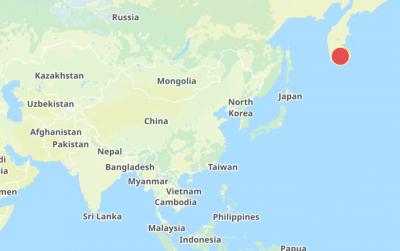
The Central Weather Administration (CWA) today issued a "tsunami watch" alert after a magnitude 8.7 earthquake struck off the Kamchatka Peninsula in northeastern Russia earlier in the morning. The quake struck off the east coast of the Kamchatka Peninsula at 7:25am (Taiwan time) at a depth of about 19km, the CWA said, citing figures from the Pacific Tsunami Warning Center. The CWA's Seismological Center said preliminary assessments indicate that a tsunami could reach Taiwan's coastal areas by 1:18pm today. The CWA urged residents along the coast to stay alert and take necessary precautions as waves as high as 1m could hit the southeastern
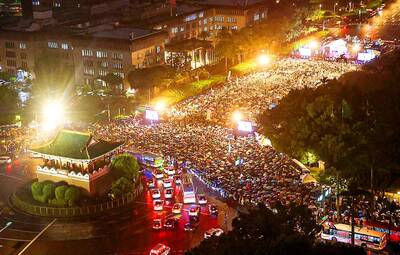
FINAL COUNTDOWN: About 50,000 attended a pro-recall rally yesterday, while the KMT and the TPP plan to rally against the recall votes today Democracy activists, together with arts and education representatives, yesterday organized a motorcade, while thousands gathered on Ketagalan Boulevard in Taipei in the evening in support of tomorrow’s recall votes. Recall votes for 24 Chinese Nationalist Party (KMT) lawmakers and suspended Hsinchu City mayor Ann Kao (高虹安) are to be held tomorrow, while recall votes for seven other KMT lawmakers are scheduled for Aug. 23. The afternoon motorcade was led by the Spring Breeze Culture and Arts Foundation, the Tyzen Hsiao Foundation and the Friends of Lee Teng-hui Association, and was joined by delegates from the Taiwan Statebuilding Party and the Taiwan Solidarity

Instead of threatening tariffs on Taiwan-made chips, the US should try to reinforce cooperation with Taiwan on semiconductor development to take on challenges from the People’s Republic of China (PRC), a Taiwanese think tank said. The administration of US President Donald Trump has threatened to impose across-the-board import duties of 32 percent on Taiwan-made goods and levy a separate tariff on semiconductors, which Taiwan is hoping to avoid. The Research Institute for Democracy, Society, and Emerging Technology (DSET), a National Science and Technology Council think tank, said that US efforts should focus on containing China’s semiconductor rise rather than impairing Taiwan. “Without

The National Museum of Taiwan Literature is next month to hold an exhibition in Osaka, Japan, showcasing the rich and unique history of Taiwanese folklore and literature. The exhibition, which is to run from Aug. 10 to Aug. 20 at the city’s Central Public Hall, is part of the “We Taiwan” at Expo 2025 series, highlighting Taiwan’s cultural ties with the international community, National Museum of Taiwan Literature director Chen Ying-fang (陳瑩芳) said. Folklore and literature, among Taiwan’s richest cultural heritages, naturally deserve a central place in the global dialogue, Chen said. Taiwan’s folklore would be immediately apparent at the entrance of the


 RSS
RSS