


Hsinchu County prosecutors yesterday indicted eight people suspected of working with Chinese criminal groups to launder money and defraud people who believed they were legitimately investing in cryptocurrency.
After receiving tip-offs, prosecutors and police carried out four raids between November last year and last month, targeting Taichung-based Xuhui Huanyu Technology Co (旭輝寰宇科技公司), its offices, staff and the homes of company executives, the Hsinchu County District Prosecutors’ Office said in a statement.
Two Taiwanese, surnamed Chang (張) and Tsai (蔡), allegedly set up the partnership with Xuhui Huanyu owner Wu Kuan-huan (吳冠寰) to create a cryptocurrency platform, said Yeh Tzu-chen (葉子誠), the prosecutor in charge of the case.
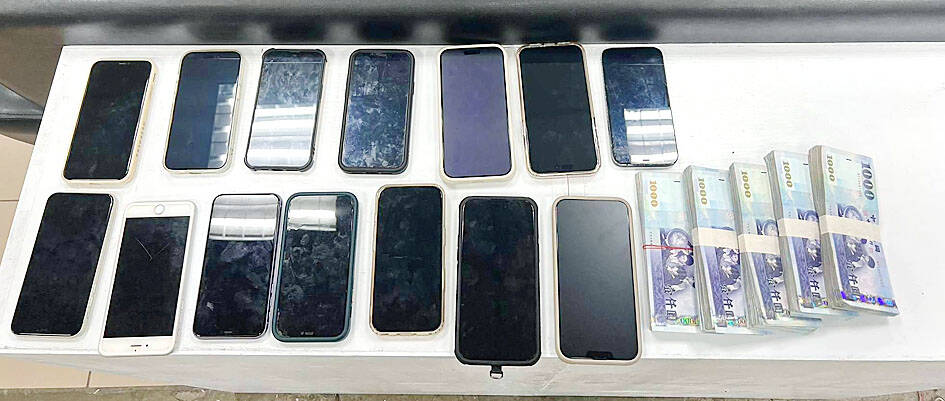
Photo courtesy of the Hsinchu District Prosecutors’ Office
The company would place online advertisements promising profits from investing with them and offering services to convert tether cryptocurrency to New Taiwan dollars, Yeh said.
Chang and Tsai, who had worked in China, allegedly have ties to Chinese criminal groups in Xiamen, China, who are engaged in fraud and investment scams, he said.
An investigation found that 53 Taiwanese had been defrauded of a total of NT$51.69 million (US$1.73 million), the statement said.
Chang, Tsai and Wu were charged with contraventions of0 the Money Laundering Control Act (洗錢防制法) and the Organized Crime Prevention Act (組織犯罪防制條例), Yeh said.
The five other suspects were listed as accomplices, Yeh said.
The operation began in August last year, when Chang returned to Taiwan to work with Wu, whose company focused on computer equipment, software and system services, the prosecutors said.
Together they transformed the Taichung company into a cryptocurrency operation that allegedly laundered money for Chinese criminal organizations, Yeh said.
Along with company staff participating in fraudulent activities, Wu also hired people to communicate with victims, facilitate transactions. and pass on to them forged receipts and accounting statements, the prosecutors said.
The suspects used encrypted messaging apps, such as Telegram and FaceTime, to evade monitoring, making it difficult for judicial investigators to track their actions in real time, the statement said.
Victims were led to believe they could make money using Wu’s firm to buy and trade tether, with Wu providing an e-wallet to register the transaction and providing documents containing the date of transaction and the amount, it said.
That was all part of the fraud, as the amount was transferred to accounts controlled by heads of the criminal ring, while Wu received a 0.6 percent commission, Yeh said.
Wu would in turn pay the people who facilitated the scam directly with the victims receiving a 0.2 percent commission, while other staff involved in collecting money from victims would receive a one-time cash payment of NT$3,000 to NT$5,000, he said.

Considering that most countries issue more than five denominations of banknotes, the central bank has decided to redesign all five denominations, the bank said as it prepares for the first major overhaul of the banknotes in more than 24 years. Central bank Governor Yang Chin-lung (楊金龍) is expected to report to the Legislative Yuan today on the bank’s operations and the redesign’s progress. The bank in a report sent to the legislature ahead of today’s meeting said it had commissioned a survey on the public’s preferences. Survey results showed that NT$100 and NT$1,000 banknotes are the most commonly used, while NT$200 and NT$2,000

The Centers for Disease Control (CDC) yesterday reported the first case of a new COVID-19 subvariant — BA.3.2 — in a 10-year-old Singaporean girl who had a fever upon arrival in Taiwan and tested positive for the disease. The girl left Taiwan on March 20 and the case did not have a direct impact on the local community, it said. The WHO added the BA.3.2 strain to its list of Variants Under Monitoring in December last year, but this was the first imported case of the COVID-19 variant in Taiwan, CDC Deputy Director-General Lin Ming-cheng (林明誠) said. The girl arrived in Taiwan on

South Korea is planning to revise its controversial electronic arrival card, a step Taiwanese officials said prompted them to hold off on planned retaliatory measures, a South Korean media report said yesterday. A Yonhap News Agency report said that the South Korean Ministry of Foreign Affairs is planning to remove the “previous departure place” and “next destination” fields from its e-arrival card system. The plan, reached after interagency consultations, is under review and aims to simplify entry procedures and align the electronic form with the paper version, a South Korean ministry official said. The fields — which appeared only on the electronic form

The Ministry of Foreign Affairs (MOFA) is suspending retaliation measures against South Korea that were set to take effect tomorrow, after Seoul said it is updating its e-arrival system, MOFA said today. The measures were to be a new round of retaliation after Taiwan on March 1 changed South Korea's designation on government-issued alien resident certificates held by South Korean nationals to "South Korea” from the "Republic of Korea," the country’s official name. The move came after months of protests to Seoul over its listing of Taiwan as "China (Taiwan)" in dropdown menus on its new online immigration entry system. MOFA last week


 RSS
RSS