


Academia Sinica yesterday inaugurated the nation’s first quantum chip fabrication and quantum computing test platforms, while also unveiling its research and development (R&D) achievements in quantum computer chip fabrication at its South Campus in Tainan.
The achievements include the production of high-quality superconducting quantum bits (qubits) using 8-inch wafer equipment, the academy said.
Speaking at the unveiling ceremony, Academia Sinica president James Liao (廖俊智) said that quantum science is rapidly developing globally and requires simultaneous investment in advanced fabrication R&D talent as well as cutting-edge hardware.
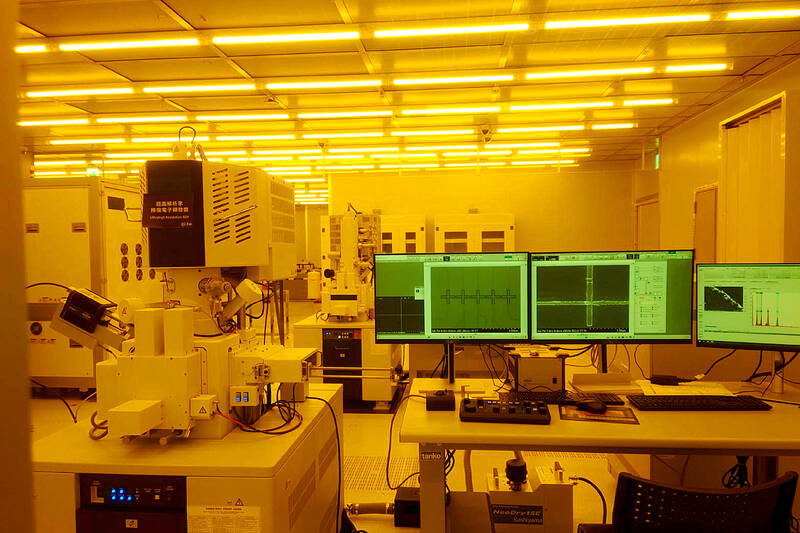
Photo: CNA
One major bottleneck in quantum computing is in process stability and optimization, and the lack of quantifiable, high-quality fabrication processes, Liao said.
Academia Sinica has validated at least three fabrication methods, he said, without elaborating on the them.
The two quantum infrastructure facilities established by Academia Sinica would be open to collaborative use by academic and research institutions nationwide, Liao said.
By integrating resources and sharing platforms, the goal is to promote quantum technology development and attract more talented people to engage in critical quantum research, he added.
Chen Chii-dong (陳啟東), executive officer of the Thematic Center for Quantum Computer at Academia Sinica, said the newly established 8-inch wafer fabrication and quantum computing platforms at the South Campus mark a major milestone in Taiwan’s quantum chip R&D efforts.
The Quantum Chip Fabrication Platform is Taiwan’s first 8-inch process platform facility built specifically for superconducting quantum chip manufacturing, materials provided by Academia Sinica said.
It features complete fabrication capabilities and real-time testing equipment, supporting different types of superconducting qubit processes and R&D for high-quality superconducting quantum chips and parametric amplifiers, they said.
The Quantum Computing Test Platform includes several complete low-temperature measurement systems equipped with high-speed, high-precision instruments and automated controls, they said, adding that the platform enables rapid optimization of quantum logic gate operations, while reducing personnel training costs.
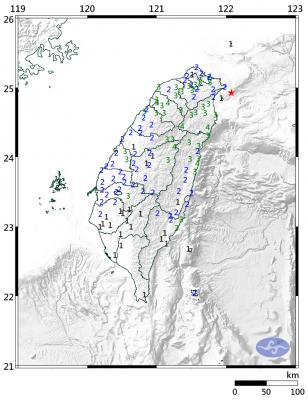
A magnitude 6.1 earthquake struck off the coast of Yilan County at 8:39pm tonight, the Central Weather Administration (CWA) said, with no immediate reports of damage or injuries. The epicenter was 38.7km east-northeast of Yilan County Hall at a focal depth of 98.3km, the CWA’s Seismological Center said. The quake’s maximum intensity, which gauges the actual physical effect of a seismic event, was a level 4 on Taiwan’s 7-tier intensity scale, the center said. That intensity level was recorded in Yilan County’s Nanao Township (南澳), Hsinchu County’s Guansi Township (關西), Nantou County’s Hehuanshan (合歡山) and Hualien County’s Yanliao (鹽寮). An intensity of 3 was

Instead of focusing solely on the threat of a full-scale military invasion, the US and its allies must prepare for a potential Chinese “quarantine” of Taiwan enforced through customs inspections, Stanford University Hoover fellow Eyck Freymann said in a Foreign Affairs article published on Wednesday. China could use various “gray zone” tactics in “reconfiguring the regional and ultimately the global economic order without a war,” said Freymann, who is also a nonresident research fellow at the US Naval War College. China might seize control of Taiwan’s links to the outside world by requiring all flights and ships entering or leaving Taiwan
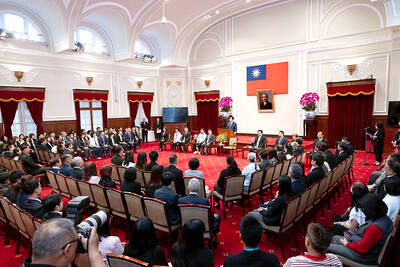
The next minimum wage hike is expected to exceed NT$30,000, President William Lai (賴清德) said yesterday during an award ceremony honoring “model workers,” including migrant workers, at the Presidential Office ahead of Workers’ Day today. Lai said he wished to thank the awardees on behalf of the nation and extend his most sincere respect for their hard work, on which Taiwan’s prosperity has been built. Lai specifically thanked 10 migrant workers selected for the award, saying that although they left their home countries to further their own goals, their efforts have benefited Taiwan as well. The nation’s industrial sector and small businesses lay
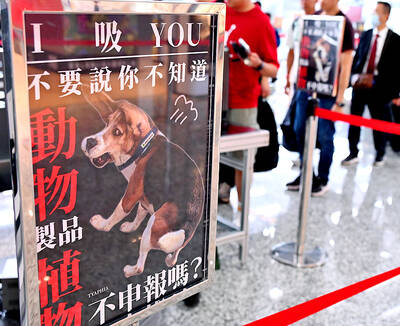
Quarantine awareness posters at Taiwan Taoyuan International Airport have gone viral for their use of wordplay. Issued by the airport branch of the Animal and Plant Health Inspection Agency, the posters feature sniffer dogs making a range of facial expressions, paired with advisory messages built around homophones. “We update the messages for holidays and campaign needs, periodically refreshing materials to attract people’s attention,” quarantine officials said. “The aim is to use the dogs’ appeal to draw focus to quarantine regulations.” A Japanese traveler visiting Taiwan has posted a photo on X of a poster showing a quarantine dog with a


 RSS
RSS