

The latest phone conversation between US President Donald Trump and his Chinese counterpart Xi Jinping (習近平) focused on easing bilateral trade tensions and is unlikely to lead to a major shift in Washington’s Taiwan policy, analysts said.
Former American Institute in Taiwan (AIT) chairman Richard Bush said via e-mail that the talks on Thursday were primarily aimed at preventing US-China relations from getting worse, particularly after Washington imposed export controls shortly after the “Geneva understanding.”
Bush, a nonresident senior fellow at the Washington-based Brookings Institution think tank, said both sides were trying to “get back to where things were at the end of Geneva” through the call.
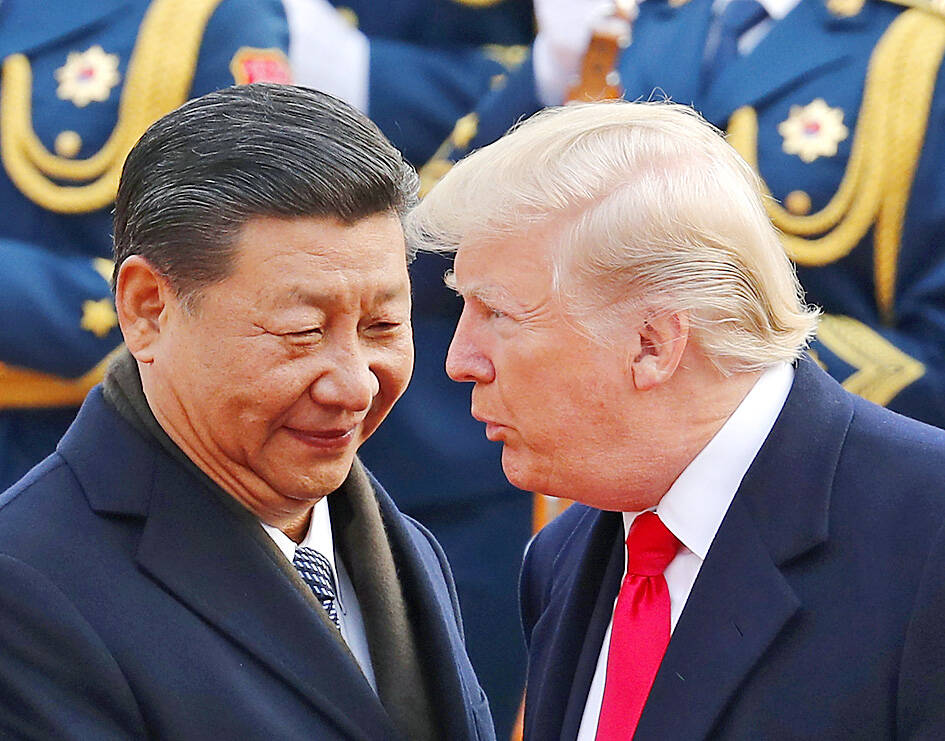
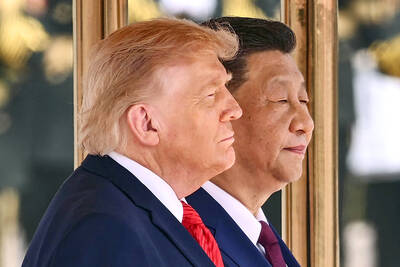
Photo: AP
Washington and Beijing last month reached a temporary deal during talks in Geneva, Switzerland, which led to a 90-day truce on sweeping tariffs they had previously imposed on each other.
China later said the US breached the deal by banning semiconductor sales to Huawei while Washington continued to complain about Beijing’s export controls on rare earth minerals and magnets.
As for Taiwan, Bush said Xi routinely brought up Taiwan in conversations with US presidents, but that segment was likely brief in the latest call, given that the two had a host of pressing trade issues to address.
Ryan Hass, another analyst at Brookings, said he “do[es] not expect that the presidential phone call will result in any major shifts in American policy toward Taiwan.”
Hass served as the director for China, Taiwan and Mongolia affairs at the US National Security Council from 2013 to 2017.
He pointed to the transcript of the call issued by Beijing and said Trump’s response to Xi’s concern over Taiwan “signaled continuity in longstanding American policy.”
The transcript said Xi urged the US to “handle the Taiwan question with prudence” and prevent “Taiwan independence” forces from “drag[ging] China and America into the dangerous terrain of confrontation and even conflict.”
The transcript cited Trump as saying that “he has great respect for President Xi ... The US will honor the one-China policy.”
Commenting on the call, the first between the two leaders since Trump began his second term in January, the Presidential Office in a brief statement on Friday said that it welcomed any “efforts that help stabilize the regional situation and curb authoritarian expansion.”
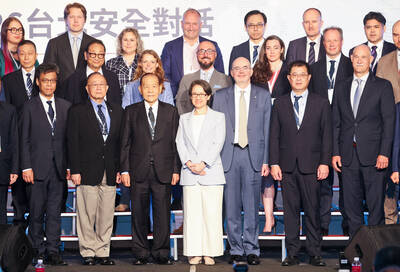
Taiwan’s growing defense preparations might be sending a stronger signal to the US than to Beijing, highlighting the need for Taipei to tailor its deterrence efforts to different audiences, a US security academic said yesterday. Stanford University Freeman Spogli Institute for International Studies fellow Oriana Skylar Mastro made the comment during a Taipei Security Dialogue panel examining lessons Taiwan could draw from the wars in Ukraine and the Middle East. Mastro said she was impressed by Taiwan’s increased defense spending, emphasis on asymmetric capabilities and efforts to prepare society for conflict, but questioned whom those initiatives were influencing. She said when she asked
A total of 400 foreign “high- level” professionals have been naturalized as Republic of China (Taiwan) citizens over the past decade as the government has eased nationality rules to attract talent from a wider range of fields, the Ministry of the Interior said yesterday. The 400th high-level professional, who works in the electronics industry, was approved for ROC citizenship on Aug. 26, the MOI said. The MOI quoted the newly naturalized citizen as saying that Taiwan is a leader in fields such as semiconductors, electronics manufacturing, artificial intelligence development and energy technology. He also said
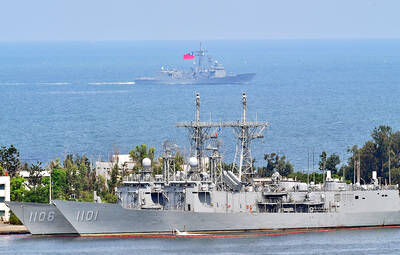
SIZE MATTERS: Large ships are politically attractive as visible symbols of national defense, but small surface combatants are more likely to survive an initial strike Taiwan needs to restructure its naval fleet from focusing on large warships, which are “sitting ducks” for China’s advanced tracking technology, to smaller, stealthy corvettes that are harder to detect but retain sufficient firepower to deter a Chinese invasion, a Taiwanese academic and a former US military commander said in an article published on Friday in the journal Foreign Affairs. Taiwan does not need a fleet capable of competing with the Chinese navy for traditional control of the Taiwan Strait, but rather “sea denial” capabilities that would prevent China from freely using the waterway, Taiwanese aerospace and security expert Holmes Liao
China has warned that it could cancel a planned US-China leaders’ summit if Washington approves new arms sales to Taiwan, a Japanese media outlet quoted sources as saying yesterday. US President Donald Trump, “apparently eager to showcase some diplomatic achievements ahead of November’s midterm congressional elections, places great importance on holding the summit with Chinese President Xi Jinping (習近平),” Japan’s Kyodo News reported. “While preparing for Xi’s upcoming trip, China has restated its position that the Taiwan issue is a ‘red line’ in bilateral relations,” the report said. The report said that when Xi met with Trump in Beijing in May, Xi said


 RSS
RSS