


Chinese Nationalist Party (KMT) Legislator Hsu Yu-chen (許宇甄) yesterday said that the Presidential Office is the greatest remaining symbol of the former authoritarian regime and suggested that President William Lai (賴清德) relocate.
The comments came as the Ministry of the Interior drafted proposals to rename roads that symbolize authoritarianism, such as Zhongzheng or Jhongjheng Road (中正), named after Chiang Kai-shek (蔣介石).
The Presidential Office was built during the Japanese colonial period to house the Office of the Governor-General of Taiwan.
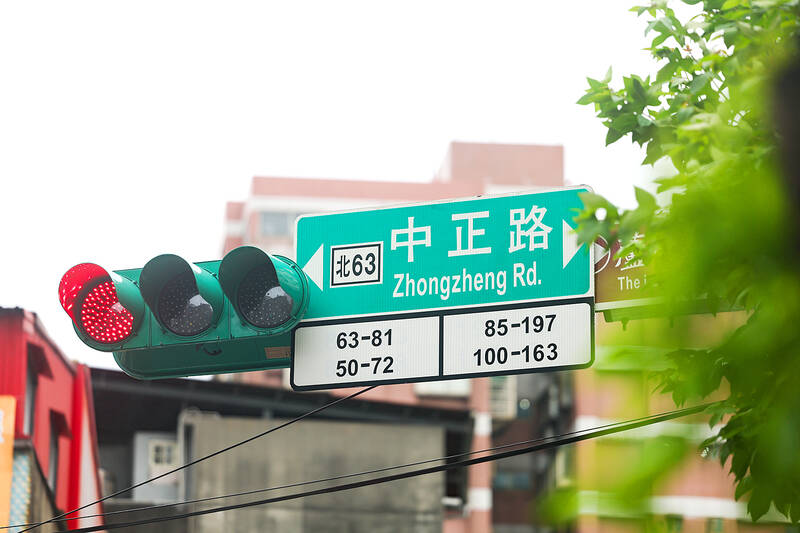
Photo: CNA
Hsu asked why large sums of money should be spent on renaming roads.
Minister of the Interior Liu Shyh-fang (劉世芳) said that the Act on Promoting Transitional Justice (促進轉型正義條例), promulgated in 2017, states that symbols appearing in public buildings or places that commemorate or express nostalgia for authoritarian rulers shall be removed or renamed.
“We are acting according to the law. The ministry is not pushing [the renaming] initiative without just cause,” she said.
Moreover, transitional justice is a human rights issue and a matter of values, she added.
The initiative would require changing personal addresses, business registrations and placards outside buildings, Hsu said.
It would additionally entail replacing tens of thousands of street signs, land deeds, personal identification cards, household registrations and National Health Insurance cards, she added.
The measures would affect four special municipalities, 38 administrative districts and 410,000 people, with a preliminary estimated cost of almost NT$100 million (US$3.34 million), excluding personal costs for those affected, she said.
Roads or alleys named “Jhongjheng” total 311, while 29 are named Jieshou (介壽), a term wishing longevity for Chiang, and nine are named Jingguo, to honor former president Chiang Ching-kuo (蔣經國), Liu said.
The current total stands at 349, although further data are still being collected, she added.
The subsidy for renaming streets or moving statues is capped at NT$100,000.
However, this sum is only the budget for the Department of Civil Affairs, and funding from the Transitional Justice Fund might be allocated to local governments if needed, Liu said.
The central government has not yet released a list of names that represent authoritarianism and need replacing, leaving local governments unsure how to proceed and raising suspicions of selective enforcement, KMT Legislator Chang Chih-lun (張智倫) said.
While the ministry is the competent authority on local governance, local governments remain the implementing bodies, Liu said.
Budgeting is a statutory responsibility, and allocations can vary based on local circumstances, she added.

FUKUOKA SITUATION: Japanese media reported that the pathogen is expected to be identified by the summer, while the CDC downplayed the idea that it was hMPV A “mysterious cold-like illness” reported in Japan’s Fukuoka Prefecture does not seem to be a new disease, but Japanese authorities have been asked about the situation, the Centers for Disease Control (CDC) said yesterday. The Fukuoka Prefectural Medical Association on Wednesday told a news conference that a “mystery cold” that has become a hot topic on social media is “highly likely to be caused by some kind of viral infection,” Japan’s KBC News reported. “Many people are experiencing symptoms starting with a sore throat, followed by a runny nose, phlegm and a severe cough,” KBC News reported, citing association officials. Health authorities are

Nvidia Corp CEO Jensen Huang (黃仁勳) arrived in Taiwan yesterday ahead of upcoming AI and technology events, saying he plans to meet with clients and Taiwan Semiconductor Manufacturing Co Chairman C.C. Wei (魏哲家) during his visit. After landing at Taipei Songshan Airport, Huang posed for photos with fans and handed out Yakult drinks to reporters and supporters waiting at the scene, saying he has “a lot to do” during the trip. Asked about reports that Nvidia’s planned headquarters site in Taipei’s Beitou Shilin Technology Park could break ground on May 27, Huang said that if the company holds an event, he would

The Ministry of Finance this afternoon announced the winning numbers for the March-April uniform invoice lottery. The winning number for the NT$10 million (US$318,060) special prize is 19531471, and the winning number for the NT$2 million grand prize is 85941329. Three numbers were drawn for the NT$200,000 first prize: 07225810, 20231230 and 83518781. Those with receipts matching the last seven digits of any of the first-prize numbers will win the NT$40,000 second prize, while those matching the last six digits will win the NT$10,000 third prize. Those whose receipts match the last five digits of the first-prize numbers can claim the NT$4,000 fourth prize,
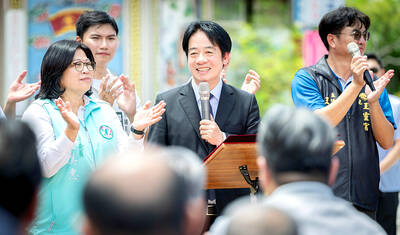
SIX SUBSIDIES: The monthly allowance for older farmers is to increase to NT$10,000, and NT$5,000 is to be given to homemakers under the national pension system, Lai said The government is to implement major welfare policies for disadvantaged groups, including raising the monthly allowance for older farmers to NT$10,000 and providing homemakers with NT$5,000 per month, President William Lai (賴清德) said yesterday. Lai made the remarks during a visit to Wangling Temple in Chiayi County, saying that the planned increases were being introduced amid economic growth and an increase in tax revenue. Touting a policy, in which the government plans to provide a monthly allowance of NT$5,000 for every child under the age of 18 in a bid to address Taiwan’s low birthrate, Lai said that if received for the


 RSS
RSS