


The Taiwan Alliance to Promote Civil Partnership Rights (TAPCPR) yesterday said that it is to participate in the upcoming Tokyo Pride Parade for the fifth time, showcasing the diversity of LGBTQI+ people in Taiwan.
The Tokyo Pride Festival is set to take place on Saturday and Sunday, with the parade starting on Sunday at noon.
TAPCPR said it would have a float and participate in the parade as “Team Taiwan” with the theme “diversity in everyday life,” emphasizing that LGBTQI+ people are a diverse and beautiful part of society.

Photo: AFP
Japan is an important partner on the road to equal rights, TAPCPR cofounder Victoria Hsu (許秀雯) said.
LGBTQI+ rights have improved in Japan, although it has not yet achieved the “final victory,” and the far right has been trying to roll back equality, Hsu said.
By participating in the parade, TAPCPR hopes to deepen the friendship between Taiwan and Japan, and strengthen equal rights, she said.
Although Taiwan passed marriage equality six years ago, important work remains to create social equality, Hsu said.
She said she believes that this year’s Tokyo Pride would be meaningful and increase the international visibility of Taiwan’s efforts toward equality.
TAPCPR’s outfits for the parade are designed by the Taiwanese fashion designer and founder of the Wangliling brand Wang Li-ling (汪俐伶).
Wang said that her eight designs for the parade would represent diverse identities, including senior people, couples, those with disabilities and queer people.
Following the theme “diversity in everyday life,” the designs could all be worn in everyday life and incorporate technological concepts, Wang said.
The most special aspect of the design is that although the clothes use black as their base color, they reflect red when light shines on them, she said.
The design for Taiwan’s float is inspired by the nation’s highest mountain, Yushan (Jade Mountain, 玉山), and incorporates semiconductor patterns, symbolizing the nation’s democratic resilience and diversity, TAPCPR said.
Team Taiwan carries the pride of being the first country in Asia to achieve marriage equality and would showcase the diversity of LGBTQI+ communities, it said.
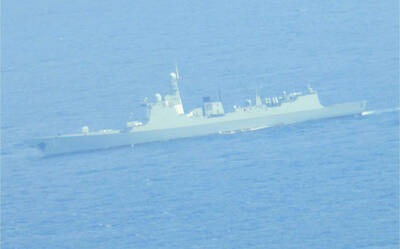
The military has spotted two Chinese warships operating in waters near Penghu County in the Taiwan Strait and sent its own naval and air forces to monitor the vessels, the Ministry of National Defense (MND) said. Beijing sends warships and warplanes into the waters and skies around Taiwan on an almost daily basis, drawing condemnation from Taipei. While the ministry offers daily updates on the locations of Chinese military aircraft, it only rarely gives details of where Chinese warships are operating, generally only when it detects aircraft carriers, as happened last week. A Chinese destroyer and a frigate entered waters to the southwest

A magnitude 6.1 earthquake struck off the coast of Yilan County at 8:39pm tonight, the Central Weather Administration (CWA) said, with no immediate reports of damage or injuries. The epicenter was 38.7km east-northeast of Yilan County Hall at a focal depth of 98.3km, the CWA’s Seismological Center said. The quake’s maximum intensity, which gauges the actual physical effect of a seismic event, was a level 4 on Taiwan’s 7-tier intensity scale, the center said. That intensity level was recorded in Yilan County’s Nanao Township (南澳), Hsinchu County’s Guansi Township (關西), Nantou County’s Hehuanshan (合歡山) and Hualien County’s Yanliao (鹽寮). An intensity of 3 was

Japanese Prime Minister Sanae Takaichi’s comment last year on Tokyo’s potential reaction to a Taiwan-China conflict has forced Beijing to rewrite its invasion plans, a retired Japanese general said. Takaichi told the Diet on Nov. 7 last year that a Chinese naval blockade or military attack on Taiwan could constitute a “survival-threatening situation” for Japan, potentially allowing Tokyo to exercise its right to collective self-defense. Former Japan Ground Self-Defense Force general Kiyofumi Ogawa said in a recent speech that the remark has been interpreted as meaning Japan could intervene in the early stages of a Taiwan Strait conflict, undermining China’s previous assumptions
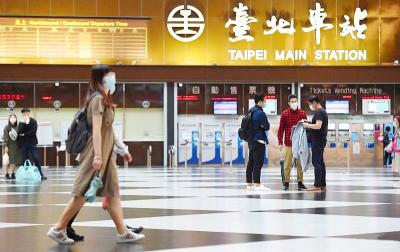
Taiwan Railways Corp (TRC) today announced that Shin Kong Mitsukoshi has been selected as the preferred bidder to operate the Taipei Railway Station shopping mall, replacing the current operator, Breeze Development Co Ltd. Among eight qualified firms that delivered presentations and were evaluated by a review committee, Shin Kong Mitsukoshi was ranked first, while Breeze was named the runner-up, the rail company said in a statement. Contract negotiations are to proceed in accordance with regulations, it said, adding that if negotiations with the top bidder fail, it could invite the second-ranked applicant to enter talks. Breeze in a statement today expressed doubts over


 RSS
RSS