


Attempts to rename roads named “Jhongjheng” (中正) would have to follow regulations around transitional justice and a 2023 Legislative Yuan resolution, Minister of the Interior Liu Shyh-fang (劉世芳) said today.
The ministry has researched renaming roads named Jhongjheng (also known as Zhongzheng in Hanyu pinyin) as well as drafted potential policy proposals, Liu said.
“Jhongjheng” is the adopted name of former president Chiang Kai-shek (蔣介石).
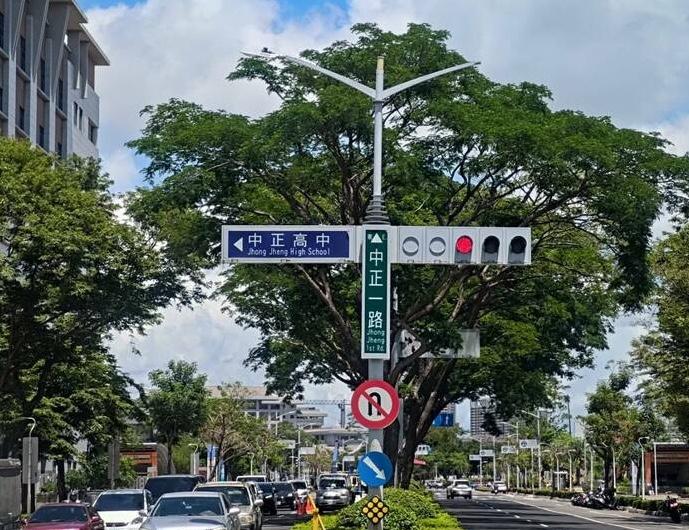
Photo: Wang Jung-hsiang, Taipei Times
The proposal has led to criticism from opposition parties, which say the government is claiming to have no money, but has the funds to subsidize renaming streets.
The subsidy for renaming cases or moving statues is capped at NT$100,000, Liu said, adding that neither the central nor local governments should view transitional justice through the lens of money.
The ministry has handled renaming cases in accordance with the Act on Promoting Transitional Justice (促進轉型正義條例) and a 2023 Legislative Yuan resolution requiring the ministry to consult local governments, Liu said.
When there are disagreements or issues in promoting transitional justice, experts and academics suggest that it should be handled “from the bottom up” with a focus on local autonomy, Liu said.
This is how the ministry handles any issues, she added.
As for the budget, each case the ministry handled in the last two or three years was capped at NT$100,000, Liu said.
Hundreds of cases have been subsidized under the current policy, Liu added.
Transitional justice is a human rights issue and must be taken seriously, she said.
The government cannot pretend to only look at transitional justice when there is money to do so, as that attitude does not reflect Taiwan’s democracy and rule of law, Liu said.
As for whether “Jingguo” (經國) roads, named after Chiang Ching-kuo (蔣經國), would be renamed, Liu said that while the law allows for them to be renamed, it can only proceed when there is consensus between the central government, local officials and residents.
Taiwan’s values of freedom, democracy and rule of law require that procedural justice be respected when promoting transitional justice, Liu added.
A 2021 survey conducted by the ministry found 316 roads named “Jhongjheng” and 11 named “Jingguo.”

Yangmingshan National Park authorities yesterday urged visitors to respect public spaces and obey the law after a couple was caught on a camera livestream having sex at the park’s Qingtiangang (擎天崗) earlier in the day. The Shilin Police Precinct in Taipei said it has identified a suspect and his vehicle registration number, and would summon him for questioning. The case would be handled in accordance with public indecency charges, it added. The couple entered the park at about 11pm on Thursday and began fooling around by 1am yesterday, the police said, adding that the two were unaware of the park’s all-day live
Fast food chain McDonald's is to raise prices by up to NT$5 on some products at its restaurants across Taiwan, starting on Wednesday next week, the company announced today. The prices of all extra value meals and sharing boxes are to increase by NT$5, while breakfast combos and creamy corn soup would go up by NT$3, the company said in a statement. The price of the main items of those meals, if ordered individually, would remain the same. Meanwhile, the price of a medium-sized lemon iced tea and hot cappuccino would rise by NT$3, extra dipping sauces for chicken nuggets would go up

Yangmingshan National Park’s Qingtiangang (擎天崗) nature area has gone viral after a park livestream camera observed a couple in the throes of intimate congress, which was broadcast live on YouTube, drawing large late-night crowds and sparking a backlash over noise, bright lights and disruption to wildlife habitat. The area’s livestream footage appeared to show a couple engaging in sexual activity on a picnic table in the park on Friday last week, with the uncensored footage streamed publicly online. The footage quickly spread across social media, prompting a tide of visitors to travel to the site to “check in” and recreate the

Minister of Digital Affairs Lin Yi-ching (林宜敬) yesterday cited regulatory issues and national security concerns as an expert said that Taiwan is among the few Asian regions without Starlink. Lin made the remarks on Facebook after funP Innovation Group chief executive officer Nathan Chiu (邱繼弘) on Friday said Taiwan and four other countries in Asia — China, North Korea, Afghanistan and Syria — have no access to Starlink. Starlink has become available in 166 countries worldwide, including Ukraine, Malaysia, the Philippines and Vietnam, in the six years since it became commercial, he said. While China and North Korea block Starlink, Syria is not


 RSS
RSS