


Thirty US state legislatures have passed pro-Taiwan resolutions this year, demonstrating strong and growing bipartisan momentum in support of Taiwan, the Ministry of Foreign Affairs (MOFA) said.
The Illinois House of Representatives adopted its latest resolution on Taiwan on Tuesday, reaffirming its support for Taiwan and strengthening its sister-state relationship. It marks the fifth consecutive year that Illinois has passed Taiwan-friendly resolutions.
This year’s resolution affirms support for the Taiwan Relations Act, encourages Illinois businesses to refer to Taiwan by its official name and backs Taiwan’s efforts to secure economic agreements with the US, including a bilateral free trade agreement, an avoidance of double taxation agreement and Taiwan’s participation in the Indo-Pacific Economic Framework.
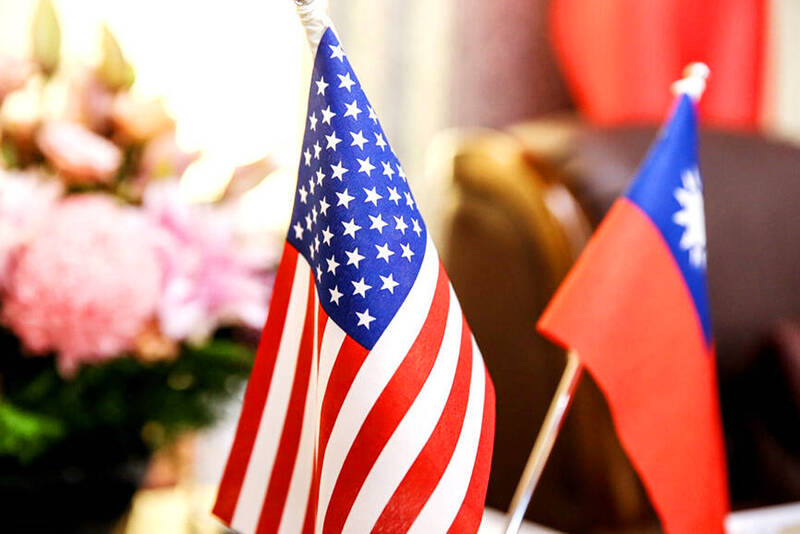
Photo: I-Hwa Cheng, Bloomberg
Illinois supports “the further strengthening of a closer economic and trade partnership between Illinois and Taiwan with multiple possible approaches, including signing an economic and trade memorandum of understanding, exploring the possibility of establishing an Illinois Office in Taiwan and sending Illinois high-level officials to visit Taiwan,” the resolution says.
The resolution supports Taiwan’s participation in international organizations, including the UN, the WHO, the International Civil Aviation Organization, the UN Framework Convention on Climate Change and Interpol — citing the importance of such inclusion for the health, safety and well-being of the peoples of Taiwan, Illinois, the US and the world.
The resolution also opposes any distortion or misuse of UN General Assembly Resolution 2758 as a means to block Taiwan’s efforts to contribute to the international community.
In response, the ministry expressed appreciation for the state legislature’s support, citing how the resolution not only affirms the Taiwan Relations Act and Taiwan’s policy of integrated diplomacy, but also clearly opposes the distortion or misuse of UN Resolution 2758.
Since January, 30 US states have passed Taiwan-friendly resolutions, with provisions supporting stronger bilateral economic and trade ties, addressing the issue of double taxation, advocating for Taiwan’s meaningful participation in international organizations and rejecting the distortion of UN Resolution 2758, the ministry said, adding that they reflect the growing momentum of support for Taiwan across the US, it added.
The ministry expressed its gratitude to the state legislatures for their ongoing support, it said, adding that Taiwan’s representative offices in the US would continue to strengthen friendships with state legislatures and deepen cross-sector Taiwan-US cooperation at the local level.

Considering that most countries issue more than five denominations of banknotes, the central bank has decided to redesign all five denominations, the bank said as it prepares for the first major overhaul of the banknotes in more than 24 years. Central bank Governor Yang Chin-lung (楊金龍) is expected to report to the Legislative Yuan today on the bank’s operations and the redesign’s progress. The bank in a report sent to the legislature ahead of today’s meeting said it had commissioned a survey on the public’s preferences. Survey results showed that NT$100 and NT$1,000 banknotes are the most commonly used, while NT$200 and NT$2,000

The Centers for Disease Control (CDC) yesterday reported the first case of a new COVID-19 subvariant — BA.3.2 — in a 10-year-old Singaporean girl who had a fever upon arrival in Taiwan and tested positive for the disease. The girl left Taiwan on March 20 and the case did not have a direct impact on the local community, it said. The WHO added the BA.3.2 strain to its list of Variants Under Monitoring in December last year, but this was the first imported case of the COVID-19 variant in Taiwan, CDC Deputy Director-General Lin Ming-cheng (林明誠) said. The girl arrived in Taiwan on

South Korea is planning to revise its controversial electronic arrival card, a step Taiwanese officials said prompted them to hold off on planned retaliatory measures, a South Korean media report said yesterday. A Yonhap News Agency report said that the South Korean Ministry of Foreign Affairs is planning to remove the “previous departure place” and “next destination” fields from its e-arrival card system. The plan, reached after interagency consultations, is under review and aims to simplify entry procedures and align the electronic form with the paper version, a South Korean ministry official said. The fields — which appeared only on the electronic form

The Ministry of Foreign Affairs (MOFA) is suspending retaliation measures against South Korea that were set to take effect tomorrow, after Seoul said it is updating its e-arrival system, MOFA said today. The measures were to be a new round of retaliation after Taiwan on March 1 changed South Korea's designation on government-issued alien resident certificates held by South Korean nationals to "South Korea” from the "Republic of Korea," the country’s official name. The move came after months of protests to Seoul over its listing of Taiwan as "China (Taiwan)" in dropdown menus on its new online immigration entry system. MOFA last week


 RSS
RSS