

The government has begun the second phase of investigations into civil servants and teachers at local levels, identifying those holding Chinese identity documents, a source said yesterday.
Government officials yesterday issued a statement urging public servants to disclose whether they hold Chinese ID cards, residence permits or household registrations, saying that failure to comply could result in the loss of Taiwanese citizenship, the source said.
The first phase of investigations into military personnel and civil servants was completed at the end of last month, finding that two people held Chinese ID cards, one of whom has since had their Taiwanese citizenship canceled, they said.

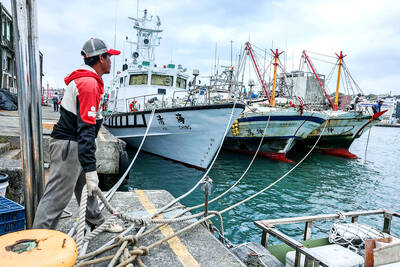
Photo: Bloomberg
“One of them, a sailor in the navy’s 168th Fleet, had held a Chinese ID card for 10 years, previously unknown to him, as his China-born mother had applied for the card on his behalf,” they said.
“Because he voluntarily reported the issue after learning about the card, he received special assistance to retain his Taiwanese nationality,” they said.
The investigation also found 75 people who had Chinese residence permits, all of whom have now had their Taiwanese ID documents canceled, they said.
The second phase of investigations is to focus on public officials at county and city government levels, as well as teachers in public universities, high schools, junior-high schools and elementary schools.
“These people exercise public authority and are therefore required to remain loyal to the state,” they said. “As part of that expectation of loyalty, public servants are prohibited from holding Chinese identity cards, household registration, residence permits or passports.”
Only a small number of people refused to comply with the investigations during the first phase, and they have been flagged for further investigation, the source said, adding that government agencies would re-examine their eligibility for employment.
“At the very least, those who refuse to submit the declaration would have incomplete personnel files, which could obstruct future appointments or promotions,” they said.
“The records of such people would be specially marked, which could cause them trouble in the future,” they said.
If people come forward and renounce their Chinese residency or family registration on their own initiative, the government would assist in canceling their Chinese documents, they said.
“However, if someone refuses to declare their Chinese documents, submits false information, or conceals facts, and is later discovered to hold Chinese identity documents after the June deadline, they will have their Taiwanese citizenship revoked,” they said.
The government urges all military and public service personnel to comply with the law, they added.
Responding to rumors that some teachers were being asked to submit declarations seven times, the source said that such claims were “completely false.”
“Even if administrative staff at schools repeatedly forward related notices, the declaration is only required once,” they said, adding that “some public servants are trying to have it both ways by holding dual identities, but the government will strictly enforce its single household registration policy.”

Starbucks Taiwan’s decision to charge for drink customization, which had been free, has sparked consumer backlash, highlighting the challenge of raising prices without making customers feel they are losing value, experts said. Since Oct. 12, customers who order drinks with less or no ice and ask to have the volume topped up with milk or other liquid have been charged an additional NT$15. Topping off drinks without ice was previously free, and disgruntled customers posted photos on social media showing that iced drinks ordered without ice were only half full if the extra NT$15 was not paid. The posts drew tens of thousands

EXPLANATION: Tsai said he attended events featuring various interviewees to observe them firsthand as part of his interview research Television host Kevin Tsai (蔡康永) last night broke his silence over a controversy surrounding his appearance at a campaign event for Democratic Progressive Party Taipei mayoral candidate Puma Shen (沈伯洋), saying he had never supported Taiwan independence. “I have always hoped for friendly cross-strait relations. I have never supported Taiwan independence,” Tsai wrote in a post on the Chinese social media platform Sina Weibo. Tsai, who has hosted television shows in China, attended the opening of Shen’s campaign headquarters on Oct. 4, drawing criticism from Chinese social media users and prompting some Chinese companies to distance themselves from him. China’s Taiwan Affairs Office

Major department stores across Taiwan, including Taipei 101, Shin Kong Mitsukoshi, Far Eastern SOGO, Breeze and Honhui Plaza, are closed today due to Typhoon Champi, while major supermarkets remain open. Taipei 101 said its shopping mall, observatory and restaurants on higher floors are closed for the day, with future hours to be adjusted based on the storm's status. Shin Kong Mitsukoshi has closed all 16 of its branches nationwide, as well as its Taipei Railway Station mall and SKM Park Outlets in Kaohsiung. Far Eastern SOGO said it has closed all of its branches nationwide, including Garden City in Taipei, citing the safety
DOUBLE-CHECK: Mandarin Airlines said that it would adjust its schedule according to weather conditions, while high-speed rail services are to remain undisrupted Airlines, ferry services, railways and national parks announced cancelations and closures yesterday, as Typhoon Champi bore down on Taiwan. The Central Weather Administration yesterday issued land warnings for most of Taiwan proper, as Champi is forecast to come closest to the nation today. Taiwan Railway Corp (TRC) has canceled all express trains on its western and eastern trunk lines today, while the high-speed rail system would continue to operate normally. For non-reserved TRC services, trains on the Coast Line, Chengzhui Line, Yilan Line and North Link Line are fully suspended. Services between Hualien and Taitung counties, as well as other unsuspended routes, would operate


 RSS
RSS