


A Taiwanese business delegation has signed two memorandums of understanding (MOUs) with Estonia to facilitate collaboration between the aerospace and defense industries on the two sides, the Taipei Mission in the Republic of Latvia said.
The office in a statement issued on Wednesday said that the Taiwanese delegation signed the MOUs on Monday with the Estonian Defence and Aerospace Industry Association and the Estonia Aviation Cluster in Tallinn, Estonia’s capital.
The MOUs open a new chapter of collaboration between the two nations on drones, aerospace and related industries, the statement said.
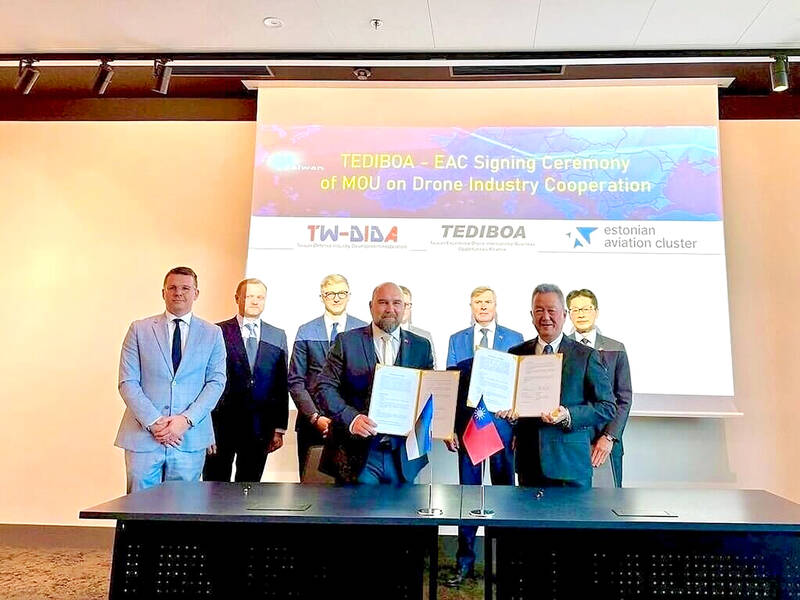
Photo courtesy of the Taipei Mission in the Republic of Latvia via CNA
The leader of the Taiwanese delegation, Hu Kai-hung (胡開宏), who heads the Taiwan Excellence Drone International Business Opportunities Alliance, said at the signing ceremony that the idea for the bilateral collaboration arose from a discussion he had in November last year with a representative from the Estonian Ministry of Defense, it said.
Hu last year led a delegation on a visit to Latvia to explore business opportunities between Taiwan, Latvia and Estonia, the statement said.
Estonian lawmaker Kristo Enn Vaga, chair of the Estonia-Taiwan Support Group in the Estonian parliament, in February led a delegation to Taiwan in a follow-up to the meeting, with the aim of deepening the partnership between Taiwan and Estonia, he was cited as saying in the statement.
Representative to Estonia Andrew H.C. Lee (李憲章) said that the signing of the MOUs was an important step for collaboration between the two nations.
Taiwan and Estonia are like-minded nations with well-regulated economies that have access to major markets in the Indo-Pacific region and the EU, Lee said.
There is great potential for collaboration between the two sides, given their highly complementary economic and industrial structures, he said.
Amid Russia’s ongoing war with Ukraine and China’s growing military threats against Taiwan, the MOUs also have the potential to help build new industrial chains that promote regional stability and global safety, he added.
Estonian Defence and Aerospace Industry Association chief executive Kalev Koidumae said at the signing ceremony that he was part of the Estonian delegation that visited Taiwan in February and that he was anticipating an acceleration of collaboration plans between the two sides.
Estonia Aviation Cluster director Andy Viikmaa said that Taiwan and Estonia share a similar history and the same ideals.
Expanding collaboration between the two sides is key to building a “non-red supply chain” based on democracy, he said, adding that they are both vibrant and innovative economies.

NATIONAL SECURITY: Authorities are working to confirm the identities of the military personnel involved and investigating possible illegal conduct and regulatory violations Authorities are probing possible national security implications after Kinmen police and immigration officers on Sunday found a Chinese woman allegedly posing as a tourist while engaging in prostitution involving more than 10 military personnel. The woman, surnamed Chen (陳), has since been deported, authorities said, adding that investigators are still working to confirm the identities of those implicated, as the records only listed code names and aliases. The case stemmed from a report received by the Kinmen District Prosecutors’ Office on Friday last week from the Jinhu Precinct of the Kinmen County Police Bureau. On Sunday, police, along with the National Immigration

GLOBALGIVING: ‘ Caving to external pressure is not acceptable for an organization that has cultivated justice reform and human rights for 30 years,’ one NGO said A slew of non-government organizations (NGOs) have withdrawn from the GlobalGiving fundraising platform after it announced it would use “Chinese Taipei” instead of “Taiwan” from next month. The Taiwan Good Rice Association wrote on Facebook on Friday that it was informed on April 28 via a teleconference call of the change, which was made because the platform wanted to operate in China. Taiwan Good Rice is to terminate all cooperative relationships with GlobalGiving in response to the platform’s “unilateral and non-negotiable” decision to remove references to Taiwan, the NGO said. “Taiwan is in the official name of Taiwan Good Rice Association and the

HEAVY WEATHER: Typhoon Jangmi is due to crash straight into the Ryukyus as airlines look to shift flights to larger aircraft or cancel flights to Okinawa entirely Taiwan’s international air carriers announced flight adjustments over the weekend as Typhoon Jangmi is forecast to hit the Ryukyu Islands today and tomorrow. The Central Weather Administration (CWA) upgraded Jangmi from a tropical storm to a typhoon at 8am yesterday, with the eye located 580km south of Naha city. It was moving north at 19kph. Today, China Airlines’ CI-120, CI-121, CI-122 and CI-123 flights between Taoyuan and Naha, Okinawa, have been canceled as well as CI-132 and CI-133 between Kaohsiung and Naha. EVA Air’s BR-112, BR-113, BR-186 and BR-185 flights between Taoyuan and Naha are also canceled. Low-cost carrier Tigerair Taiwan canceled IT-230,

Chinese Nationalist Party (KMT) Chairwoman Cheng Li-wun (鄭麗文) yesterday briefed her party’s Central Standing Committee regarding her scheduled visit to the US between Monday next week and June 16, saying that her purpose would be to persuade the US that the Republic of China (ROC) Constitution was a “one China” constitution that would foster stable and peaceful cross-strait relations. The ROC Constitution is the most important defense for all Taiwanese citizens, as it upholds our democracy and has contributed to our robust economy, which aligns with international and US interests, she said. “We would not be troublemakers and drag the US under,”


 RSS
RSS