

Chinese Nationalist Party (KMT) Chairman Eric Chu (朱立倫) and Taiwan People’s Party (TPP) Chairman Huang Kuo-chang (黃國昌) yesterday held a livestreamed opposition leaders’ summit to discuss major national issues, including political reform, recall campaigns and the economic challenges posed by US President Donald Trump’s “reciprocal” tariffs.
On the issue of whether to push for a no-confidence vote against the Cabinet, Chu said Premier Cho Jung-tai (卓榮泰) is merely a shield and serves at President William Lai’s (賴清德) pleasure, adding that “Lai the dictator” needs to “feel remorse and change.”
The KMT’s stance is that no display of people’s power is off the table, including a vote of no confidence, recall or impeachment, he said.
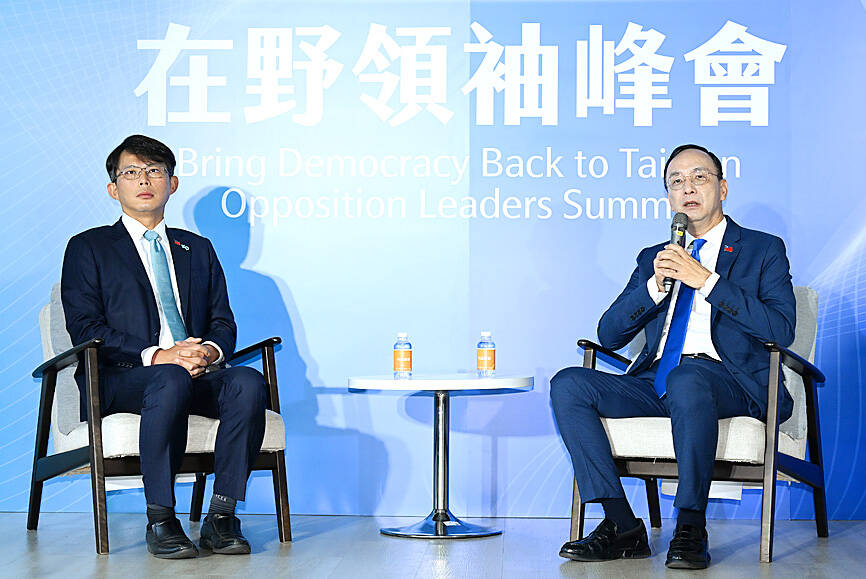
Photo: Liao Chen-huei, Taipei Times
The party has an ordered strategy to remove Lai and is not targeting merely the Cabinet, he added.
Huang said that dismissing the Cabinet “will not save Taiwan,” or stop Lai who “wants to become an autocrat.”
The TPP will support KMT lawmakers facing the threat of recalls, which he said was led by the Democratic Progressive Party (DPP).
It will not allow the DPP to revert the nation to single-party dictatorship through indiscriminate recall campaigns, he added.
The DPP government must be denied a legislative majority since it is “already doing whatever it wants,” despite being a minority in the legislature, he said.
Asked whether the KMT and the TPP share common goals and the extent to which the two parties can cooperate, Chu said the two parties have distinct agenda and policy goals that allow room for collaboration at the legislative and local level.
The two also discussed the economic challenges posed by Trump’s tariffs.
In response to US tariff threats, Lai announced plans to increase investment in the US, and his administration endorsed an additional US$100 billion investment in the US pledged last month by Taiwan Semiconductor Manufacturing Co (TSMC, 台積電), but that has not helped exempt Taiwan from Trump’s tariffs, Chu said.
With big tech companies, including TSMC, Hon Hai Precision Industry Co (鴻海精密) and Wistron Corp (緯創), teaming up with Nvidia to invest US$500 billion to produce artificial intelligence servers, the question for the Lai administration is: “What are we getting in return?” Chu said.
Huang said the DPP has yet to put forward an impact assessment report on the tariffs since Trump announced them.
The opposition would create an impact assessment platform comprising academics, former economic officials, industry representatives and local government heads to gauge the impact of the US tariffs over the next six months, he said.
Government negotiations with the US on tariffs should not result in deals that compare unfavorably with those of Taiwan’s main trade rivals, such as Japan and South Korea, or the ramifications would be “catastrophic” for Taiwan’s industrial sector, he said.
Taiwan should sign a free-trade agreement with the US to mitigate the negative impact of tariffs, he added.
Later yesterday, DPP spokesman Justin Wu (吳崢) accused the opposition of “rumormongering” by implying that the DPP had not adopted a more proactive stance in addressing the tariff issue.
Lai and Cho have held a series of exchanges with representatives from various sectors since Trump announced the tariffs.
It is “regrettable” that the opposition has resorted to a “mudslinging” political stunt in the name of unity and public interest, Wu said.

A Hualien pomelo farmer refused to sell to China after the country announced it would permit more Taiwanese pomelo imports, prompting widespread support from Taiwanese consumers, who rallied to buy his fruit. China’s Taiwan Affairs Office last month said that China’s General Administration of Customs registered an additional 79 Taiwanese pomelo orchards and packing facilities in Hualien County, allowing more Taiwanese producers to export pomelos to China. “I am a Hualien fruit farmer and I refuse to sell to China,” Liu Tzu-hao (劉子豪) from Ruisui Township (瑞穗) said in an online post. Liu is a well-known farmer in the community and has served
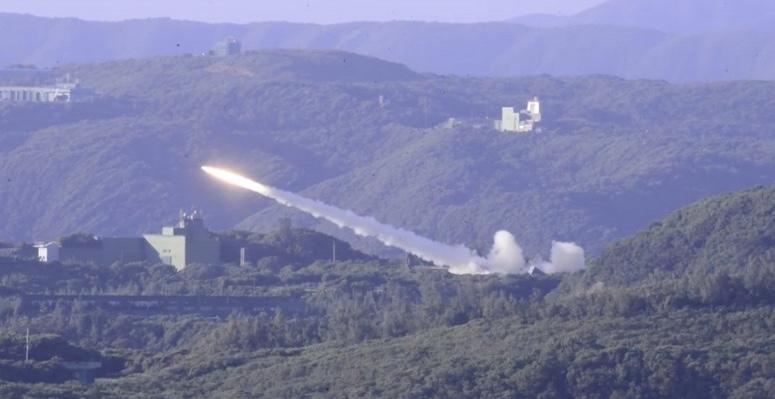
A Chinese military drone was spotted conducting reconnaissance off Taitung County as President William Lai (賴清德) visited Pingtung County this morning to inspect a drill of the armed forces’ precision-strike capabilities, prompting the military to closely monitor its actions. Today was the final day of a three-day military exercise at Jioupeng Base (九鵬基地) to test the joint combat capabilities of the armed forces and coast guard. The exercise began on Wednesday simulating air defense interception and yesterday tested long-range strike capabilities and new air defense weapons. This morning, the military conducted a final exercise involving air defense, anti-ship and drone operations. Military sources said
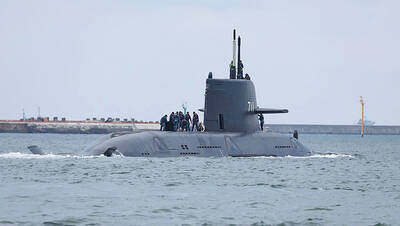
UPDATE: The submarine would need to undergo combined systems testing and crew training for navy personnel before it is ready for mission, an expert said Taiwan’s first domestically built submarine, the Hai Kun (Narwhal, 海鯤), could be delivered to the navy as early as next month, military expert and Taiwan Association for Security and Development chairman Chi Tung-yun (紀東昀) said yesterday. The submarine was yesterday morning observed departing for its 21st sea trial and its 15th submerged test. The vessel missed the initial delivery deadline of November last year due to “testing delays,” its primary contractor, shipbuilder CSBC Corp, Taiwan, said in June. The contractor also cited “political pressure from China” in procuring critical equipment. All testing operations are in the final stages, with the

OCT. 31: The antiviral drugs Tamiflu and Eraflu have been distributed to about 4,000 medical facilities nationwide for people in seven groups who develop flu-like symptoms As the domestic influenza epidemic enters its peak season and continues to escalate, the Centers for Disease Control (CDC) yesterday announced that publicly funded influenza antiviral drugs for seven eligible groups have been extended to Oct. 31, allowing those who develop flu-like symptoms to receive the medication without undergoing a rapid influenza test. The CDC has extended the expanded use of flu antiviral drugs to seven groups: healthcare and influenza-prevention personnel; residents and staff at nursing homes, long-term care facilities and similar institutions; kindergarten and daycare workers and home-based caregivers; students from kindergarten through high school, vocational high school and the


 RSS
RSS