


The Ministry of Agriculture’s Taiwan Seed Improvement and Propagation Station has optimized the automation of its onion seed pelletizing process in collaboration with the Hengchun Township Farmers’ Association, boosting production in Pingtung County, station director Chang Ting-lin (張定霖) told a news conference on Thursday.
The technology was developed mainly to address a shortage workers in the agricultural sector, but there was an issue with the machines being unable to manipulate seeds individually, Chang said.
Open-field seedling production has been replaced with greenhouse seedling production due to the effects of climate change on onion production, he said.
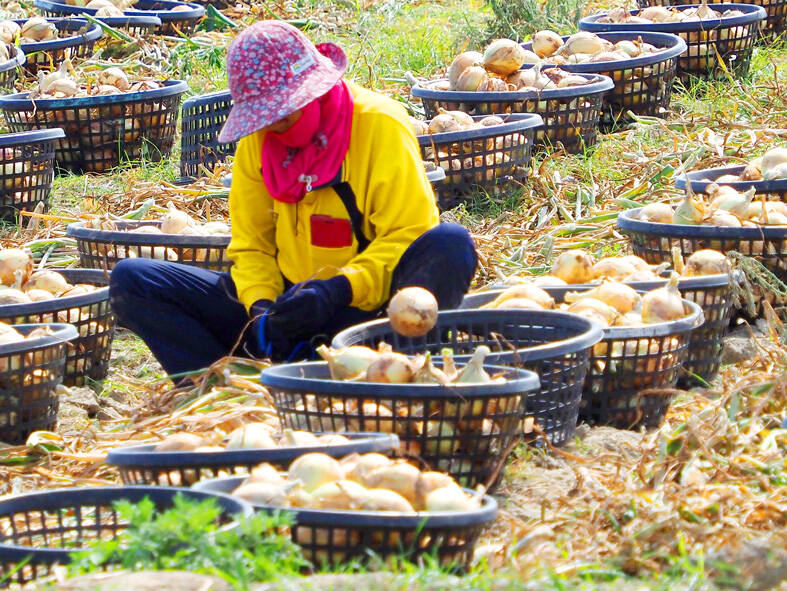
Photo: Tsai Tsung-hsien, Taipei Times
The seedlings are cultivated in plug trays in greenhouses before they are mature enough to be transplanted to a field, he added.
However, sowing machines cannot pick out individual seeds, so they put three to six seeds into each hole in the plug trays, meaning that workers must separate seedlings before they are transplanted, he said.
Stabilization of the automatic system has resolved the issue and cut the amount of work required, Chang said.
Station assistant researcher Tseng Hung-ju (曾泓儒) said that the onion planting area in Pingtung County dropped by about 40 percent to 363 hectares in 2023 from more than 600 hectares in 2019.
To address worker shortages and climate change challenges, the station introduced seed pelletizing technology to mass-produce seeds that are of regular size, shape and firmness, Tseng said.
Such seeds are more easily manipulated by the machines, meaning only one is planted in each hole, he said.
Nutrients, bactericidal agents and microorganisms can also be incorporated into the pelletizing process to help with seedling health, he said.
For example, pelletized seeds can be coated with bactericidal agents to lower production costs by reducing pesticide use, with the process also increasing pest and disease resistance, he said.
Colored coats can be applied to mark seeds according to their varieties, he added.
The technology “reduces the likelihood of sowing machines picking up multiple seeds, thereby enhancing single-seedling transplantation,” Tseng said.
The automated pelletizing process has facilitated production of at least 300,000 seeds per day for growers in Pingtung County and has decreased their work hours, he added.
Tseng Pao-ting (曾寶霆), director of the association’s marketing department, said that onion farming is prone to weather conditions and requires a lot of labor.
An onion farm of nearly 1,000m2 requires 10 people to harvest, he said, adding that planting and harvesting had previously been done manually in Pingtung County, Tseng Pao-ting said.
The association collaborated with the station to develop the pelletizing technology about two years ago and is promoting its efforts to onion growers, with the goal of preventing the onion farming industry from stagnating due to an aging workforce, he said.

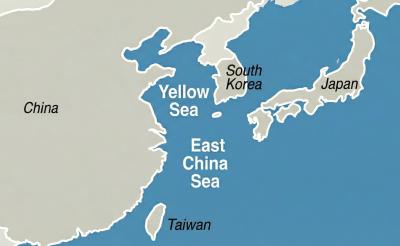
China has reserved offshore airspace in the Yellow Sea and East China Sea from March 27 to May 6, issuing alerts usually used to warn of military exercises, although no such exercises have been announced, the Wall Street Journal (WSJ) reported yesterday. Reserving such a large area for 40 days without explanation is an “unusual step,” as military exercises normally only last a few days, the paper said. These alerts, known as Notice to Air Missions (Notams), “are intended to inform pilots and aviation authorities of temporary airspace hazards or restrictions,” the article said. The airspace reserved in the alert is
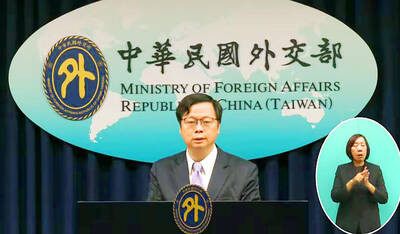
NAMING SPAT: The foreign ministry called on Denmark to propose an acceptable solution to the erroneous nationality used for Taiwanese on residence permits Taiwan has revoked some privileges for Danish diplomatic staff over a Danish permit that lists “Taiwan” as “China,” Eric Huang (黃鈞耀), head of the Ministry of Foreign Affairs’ Department of European Affairs, told a news conference in Taipei yesterday. Reporters asked Huang whether the Danish government had responded to the ministry’s request that it correct the nationality on Danish residence permits of Taiwanese, which has been listed as “China” since 2024. Taiwan’s representative office in Denmark continues to communicate with the Danish government, and the ministry has revoked some privileges previously granted to Danish representatives in Taiwan and would continue to review
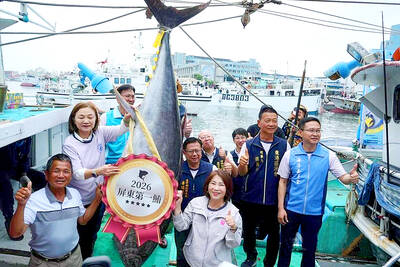
The first bluefin tuna of the season, brought to shore in Pingtung County and weighing 190kg, was yesterday auctioned for NT$10,600 (US$333.5) per kilogram, setting a record high for the local market. The auction was held at the fish market in Donggang Fishing Harbor, where the Siaoliouciou Island-registered fishing vessel Fu Yu Ching No. 2 delivered the “Pingtung First Tuna” it had caught for bidding. Bidding was intense, and the tuna was ultimately jointly purchased by a local restaurant and a local company for NT$10,600 per kilogram — NT$300 ,more than last year — for a total of NT$2.014 million. The 67-year-old skipper

China has reserved offshore airspace over the Yellow Sea and East China Sea from March 27 to May 6, issuing alerts that are usually used to warn of military exercises, although no such exercises have been announced, the Wall Street Journal (WSJ) reported on Sunday. Reserving such a large area for 40 days without explanation is an “unusual step,” as military exercises normally only last a few days, the paper said. The alerts, known as notice to air missions (NOTAMs), “are intended to inform pilots and aviation authorities of temporary airspace hazards or restrictions,” the article said. The airspace reserved in the alert


 RSS
RSS