


The opposition yesterday urged prosecutors to identify all Democratic Progressive Party (DPP) members who are colluding with the Chinese Communist Party (CCP).
Ho Jen-chieh (何仁傑), a former assistant of National Security Council Secretary-General Joseph Wu (吳釗燮) when he was minister of foreign affairs, was yesterday detained in connection with a spying case.
Several other DPP members have been accused of being involved in national security breaches, including Presidential Office consultant Wu Shang-yu (吳尚雨), former DPP staff member Chiu Shih-yuan (邱世元) and councilor assistant Huang Chu-jing (黃取榮), who were detained in February.

Photo: Reuters
Chinese Nationalist Party (KMT) Chairman Eric Chu (朱立倫) yesterday called on the governing DPP to investigate and penalize anyone spying for China, regardless of their political party.
Colluding with the CCP and betraying Taiwan is an severe matter, Chu said.
“The KMT undoubtedly loves Taiwan and would strive for the Republic of China’s benefits,” he added.
The Taiwan People’s Party (TPP) caucus yesterday wrote on Facebook that the DPP government is always advocating for the takedown of the CCP’s accomplices, but appears to be a “national team of Chinese spies.”
It also alleged that the CCP has infiltrated the government, from the Presidential Office to the national security and foreign affairs agencies.
DPP legislators call on the public to recall opposition lawmakers, but it allegedly has many spies, it said, adding that it was turning the nation into a single-party regime like China.
President William Lai (賴清德), who doubles as DPP chairman, should investigate how long the party has been infiltrated and how many DPP members have been secretly spying for China during his tenure, it said.
Meanwhile, KMT Legislator Hsu Chiao-hsin (徐巧芯), who on Wednesday falsely accused a National Security Council senior specialist of spying for China and later apologized for wrongly using his photo, said she was actually referring to another man with the same name who worked as Wu’s assistant when he was foreign minister.
Hsu yesterday said that prosecutors obtained information on Ho Jen-chieh’s alleged espionage activities as early as February, when Huang was detained and held incommunicado.
However, they failed to promptly act on the information, virtually giving him an opportunity to collude with accomplices or escape, she said.
Additional reporting by Liu Wan-lin

The Ministry of Finance this afternoon announced the winning numbers for the March-April uniform invoice lottery. The winning number for the NT$10 million (US$318,060) special prize is 19531471, and the winning number for the NT$2 million grand prize is 85941329. Three numbers were drawn for the NT$200,000 first prize: 07225810, 20231230 and 83518781. Those with receipts matching the last seven digits of any of the first-prize numbers will win the NT$40,000 second prize, while those matching the last six digits will win the NT$10,000 third prize. Those whose receipts match the last five digits of the first-prize numbers can claim the NT$4,000 fourth prize,

SIX SUBSIDIES: The monthly allowance for older farmers is to increase to NT$10,000, and NT$5,000 is to be given to homemakers under the national pension system, Lai said The government is to implement major welfare policies for disadvantaged groups, including raising the monthly allowance for older farmers to NT$10,000 and providing homemakers with NT$5,000 per month, President William Lai (賴清德) said yesterday. Lai made the remarks during a visit to Wangling Temple in Chiayi County, saying that the planned increases were being introduced amid economic growth and an increase in tax revenue. Touting a policy, in which the government plans to provide a monthly allowance of NT$5,000 for every child under the age of 18 in a bid to address Taiwan’s low birthrate, Lai said that if received for the
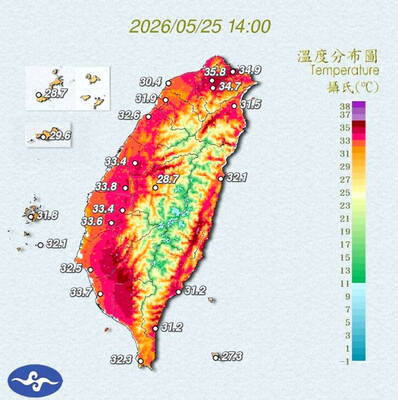
STAY COOL: The HPA recommended that people stay hydrated, use air-conditioning or fans while indoors, wear loose-fitting clothes and walk in the shade while outdoors Employers must implement measures such as installing cooling equipment, and providing drinking water and rest breaks for outdoor workers starting from Monday next week, the Taipei Department of Labor said on Sunday. Employers who fail to comply could face fines of NT$30,000 to NT$300,000 under the Occupational Safety and Health Act (職業安全衛生法), the department said. Businesses in Taipei employing fewer than 100 workers, as well as registered self-employed workers with labor insurance coverage, could receive on-site assessments and guidance from occupational safety consultants to help them apply for central government subsidies to implement or improve heat-protection measures, it said. Under the Ministry of

NATIONAL SECURITY: Authorities are working to confirm the identities of the military personnel involved and investigating possible illegal conduct and regulatory violations Authorities are probing possible national security implications after Kinmen police and immigration officers on Sunday found a Chinese woman allegedly posing as a tourist while engaging in prostitution involving more than 10 military personnel. The woman, surnamed Chen (陳), has since been deported, authorities said, adding that investigators are still working to confirm the identities of those implicated, as the records only listed code names and aliases. The case stemmed from a report received by the Kinmen District Prosecutors’ Office on Friday last week from the Jinhu Precinct of the Kinmen County Police Bureau. On Sunday, police, along with the National Immigration


 RSS
RSS