


Mainland Affairs Council Minister Chiu Chui-cheng (邱垂正) yesterday urged Taiwanese academics and students to be cautious before going on trips to China, after a National Tsing Hua University (NTHU) professor was criticized for taking a group of students to China in an “academic exchange.”
Jou Jwo-huei (周卓煇), a material sciences professor, led a group of 28 students from NTHU and Shu Guang Senior Girls’ High School in Hsinchu City on a five-day trip to Tianjin, China.
The visit, which started on March 29, was advertised as an academic exchange on “light and health,” a person posting online as “Little Woman of Silicon Valley” (矽谷小婦人) wrote.
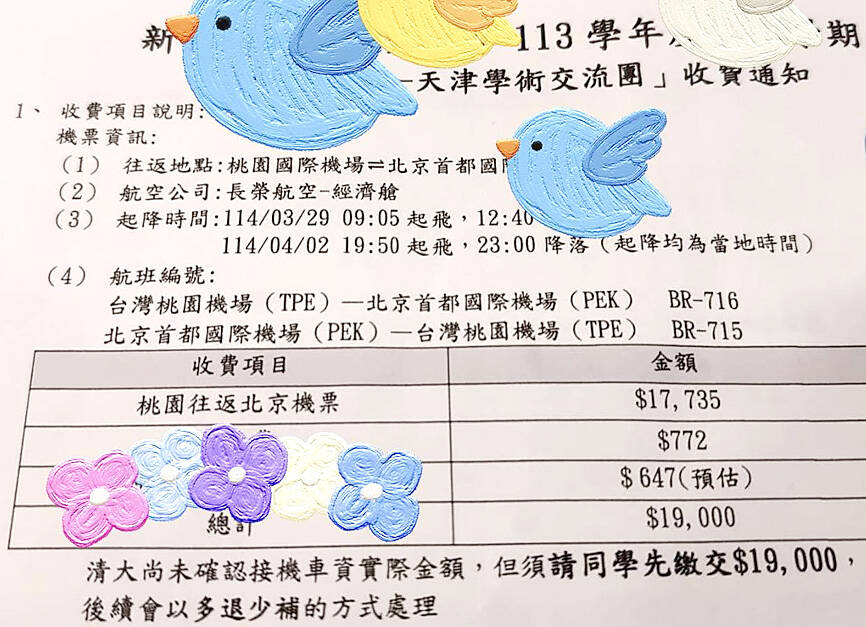
Photo from Facebook
The poster said that a friend, whose daughter attends Shu Guang High School, forwarded her a notice from the school that said students would only have to pay for airfare, while accommodation, meals, transportation and other tour expenses were paid for.
The commenter said the trip appeared to be the kind of “united front” event the Chinese government would fund and disguise as an “academic exchange” to influence Taiwanese academics and students.
“My friend’s daughter is young, yet she went on a trip to China that was likely to brainwash her, by showing the nice parts of China” to make her more susceptible to Chinese political influence, the commenter said.
Jou on Monday defended the trip, saying that students visited tourist sites in Tianjin and that schools did not provide funding for the trip, nor did they in a 2023 academic exchange.
“My research has focused on light and its effects on health for many years,” Jou said.
“This time, the exchange was with an optometry hospital in Tianjin, during which we presented papers at a forum. The high schoolers were all willing to pay their own expenses to join this trip, so they could participate in the forum to present their research,” he said.
Speaking on the sidelines of a Legislative Yuan session yesterday, Chiu said that China’s past friendliness to Taiwan does not apply to the present, and that academics and students should be cautious about trips to China.
People involved in exchanges with China should be mindful to preserve their dignity, maintain healthy and orderly cross-strait relations, and be aware of the image their event would project at home and abroad, he said.
Universities should register academic exchanges or events abroad on the Ministry of Education’s platform to protect the safety of students and faculty, he said.
Additional reporting by Lin Che-yuan

Considering that most countries issue more than five denominations of banknotes, the central bank has decided to redesign all five denominations, the bank said as it prepares for the first major overhaul of the banknotes in more than 24 years. Central bank Governor Yang Chin-lung (楊金龍) is expected to report to the Legislative Yuan today on the bank’s operations and the redesign’s progress. The bank in a report sent to the legislature ahead of today’s meeting said it had commissioned a survey on the public’s preferences. Survey results showed that NT$100 and NT$1,000 banknotes are the most commonly used, while NT$200 and NT$2,000

The Centers for Disease Control (CDC) yesterday reported the first case of a new COVID-19 subvariant — BA.3.2 — in a 10-year-old Singaporean girl who had a fever upon arrival in Taiwan and tested positive for the disease. The girl left Taiwan on March 20 and the case did not have a direct impact on the local community, it said. The WHO added the BA.3.2 strain to its list of Variants Under Monitoring in December last year, but this was the first imported case of the COVID-19 variant in Taiwan, CDC Deputy Director-General Lin Ming-cheng (林明誠) said. The girl arrived in Taiwan on

South Korea is planning to revise its controversial electronic arrival card, a step Taiwanese officials said prompted them to hold off on planned retaliatory measures, a South Korean media report said yesterday. A Yonhap News Agency report said that the South Korean Ministry of Foreign Affairs is planning to remove the “previous departure place” and “next destination” fields from its e-arrival card system. The plan, reached after interagency consultations, is under review and aims to simplify entry procedures and align the electronic form with the paper version, a South Korean ministry official said. The fields — which appeared only on the electronic form

The Ministry of Foreign Affairs (MOFA) is suspending retaliation measures against South Korea that were set to take effect tomorrow, after Seoul said it is updating its e-arrival system, MOFA said today. The measures were to be a new round of retaliation after Taiwan on March 1 changed South Korea's designation on government-issued alien resident certificates held by South Korean nationals to "South Korea” from the "Republic of Korea," the country’s official name. The move came after months of protests to Seoul over its listing of Taiwan as "China (Taiwan)" in dropdown menus on its new online immigration entry system. MOFA last week


 RSS
RSS