


Advocates seeking to recall a group of Chinese Nationalist Party (KMT) legislators yesterday said the expulsion of a woman who had advocated for China to take Taiwan by force was not a free speech issue, but a national security matter.
At a news conference in Taipei, the groups urged Taiwanese to participate in the second phase of a signature drive to oust 35 KMT legislators, who campaigners said were pro-China.
“China has conducted military drills around Taiwan in the past few days, while KMT and Taiwan People’s Party members continue to create political havoc by introducing all sorts of bills and cut the fiscal budget to incapacitate the central government,” Taiwan Society chairman Weng Ming-jang (翁銘章) said.
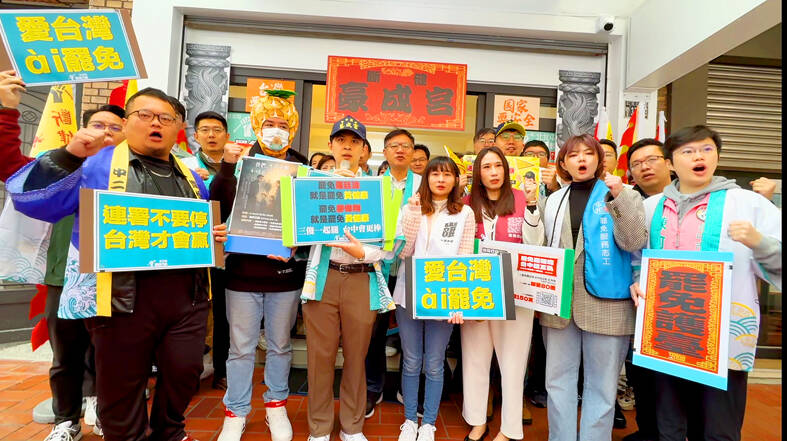
Photo: Tsai Shu-yuan, Taipei Times
“Our only weapon to counter them [the legislators] is our right to recall unsuited politicians,” Wang said, urging people to stand up to pro-China legislators.
Taiwan is facing a national security crisis, due to the pervasive infiltration of agents and proxies working for China in government, the military and private sectors, Union of Taiwanese Teachers vice president Pan Wei-you (潘威佑) said.
“In the past few days, immigration officials issued deportation orders to three Chinese spouses who made videos advocating that China use military force to take over Taiwan,” Pan said. “They are abusing our freedom and democracy.”
“This situation is no longer a free speech issue, it is a national security issue. Yet we have KMT legislators, 75 so-called ‘academics’ and other figures who condemn our government for contravening free speech,” Pan said.
Meanwhile, a Chinese court sentenced Taiwan-based publisher Li Yanhe (李延賀) to three years in jail on sedition charges, he said.
Li, who was born in China and writes under the pen name Fucha (富察), worked as editor-in-chief of Taiwan-based Gusa Press (八旗文化).
KMT legislators and party officials have been silent on Li’s case since his arrest and detention in 2023 while visiting Shanghai, Pan said.
China has escalated its infiltration efforts, Democratic Progressive Party (DPP) Legislator Michelle Lin (林楚茵) said.
“On Tuesday, Beijing announced military exercises aimed at Taiwan, but the KMT still only blames its own government for the drills,” Lin said. “It is outrageous that China seeks to militarily intimidate Taiwan, yet KMT party leaders are mostly silent, and even has KMT officials visiting China right now, while in legislative sessions, they impeded enhanced national security bills proposed by the DPP,” she said.
Separately, a group of retired military officers on Tuesday joined tech tycoon Robert Tsao (曹興誠) at a news conference in Taipei, where they called on all active or retired military personnel to support recalling the KMT legislators to safeguard Taiwan and repel hostile actions by China.
The event sought to help recall campaigners gather enough signatures to reach the threshold for the second stage of the recall drive.
“Today we are here to defend Taiwan, and to fight against a military invasion by China, as our president has declared the Chinese regime a ‘foreign enemy force,’ so we must remain alert and bolster our civilian defense to prepare for any contingency,” said Tsao, who was accompanied by military personnel, including two retired major generals, Chiu Wei-pang (丘衛邦) and Yu Chung-chi (余宗基).
“The KMT has become subservient lap dogs to the Chinese Communist Party. It is time to oust pro-China legislators and clean up the Legislative Yuan,” Chiu said.
Tsao and citizen groups also announced a series of outdoor events to promote the recall, including a 5km walk or run at Hualien City’s Pacific Park at 9am tomorrow.
The event’s sponsors — the Kuma Academy, Taipei Trust in Democracy Association and other groups — are also sponsoring the two-day “Black Bear Forest Festival” (黑熊森遊會) at the Hualien City Creative Culture Park at the weekend.
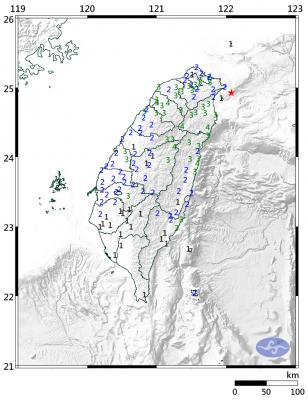
A magnitude 6.1 earthquake struck off the coast of Yilan County at 8:39pm tonight, the Central Weather Administration (CWA) said, with no immediate reports of damage or injuries. The epicenter was 38.7km east-northeast of Yilan County Hall at a focal depth of 98.3km, the CWA’s Seismological Center said. The quake’s maximum intensity, which gauges the actual physical effect of a seismic event, was a level 4 on Taiwan’s 7-tier intensity scale, the center said. That intensity level was recorded in Yilan County’s Nanao Township (南澳), Hsinchu County’s Guansi Township (關西), Nantou County’s Hehuanshan (合歡山) and Hualien County’s Yanliao (鹽寮). An intensity of 3 was

Instead of focusing solely on the threat of a full-scale military invasion, the US and its allies must prepare for a potential Chinese “quarantine” of Taiwan enforced through customs inspections, Stanford University Hoover fellow Eyck Freymann said in a Foreign Affairs article published on Wednesday. China could use various “gray zone” tactics in “reconfiguring the regional and ultimately the global economic order without a war,” said Freymann, who is also a nonresident research fellow at the US Naval War College. China might seize control of Taiwan’s links to the outside world by requiring all flights and ships entering or leaving Taiwan
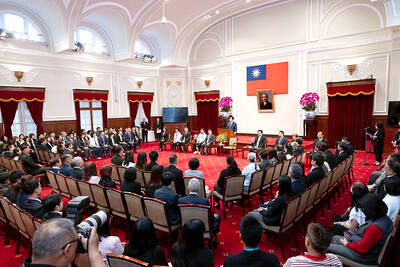
The next minimum wage hike is expected to exceed NT$30,000, President William Lai (賴清德) said yesterday during an award ceremony honoring “model workers,” including migrant workers, at the Presidential Office ahead of Workers’ Day today. Lai said he wished to thank the awardees on behalf of the nation and extend his most sincere respect for their hard work, on which Taiwan’s prosperity has been built. Lai specifically thanked 10 migrant workers selected for the award, saying that although they left their home countries to further their own goals, their efforts have benefited Taiwan as well. The nation’s industrial sector and small businesses lay
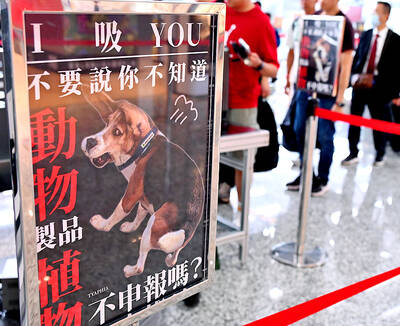
Quarantine awareness posters at Taiwan Taoyuan International Airport have gone viral for their use of wordplay. Issued by the airport branch of the Animal and Plant Health Inspection Agency, the posters feature sniffer dogs making a range of facial expressions, paired with advisory messages built around homophones. “We update the messages for holidays and campaign needs, periodically refreshing materials to attract people’s attention,” quarantine officials said. “The aim is to use the dogs’ appeal to draw focus to quarantine regulations.” A Japanese traveler visiting Taiwan has posted a photo on X of a poster showing a quarantine dog with a


 RSS
RSS