


The Taipei First Girls High School (TFG) has banned its teachers from participating in interviews with Chinese state media after one instructor sparked an outcry by criticizing President William Lai (賴清德) on China Central Television (CCTV).
In an announcement to staff and students Monday, Principal Chen Chih-yuan (陳智源) said TFG maintains a "free and democratic" campus environment, tolerating and respecting a diverse range of viewpoints as long as they don’t violate school rules.
"However, in light of the current cross-strait tensions, and to avoid creating unnecessary troubles, [TFG] will prohibit teachers from accepting interviews with state media of the People’s Republic of China (such as CCTV) with immediate effect," the statement said.
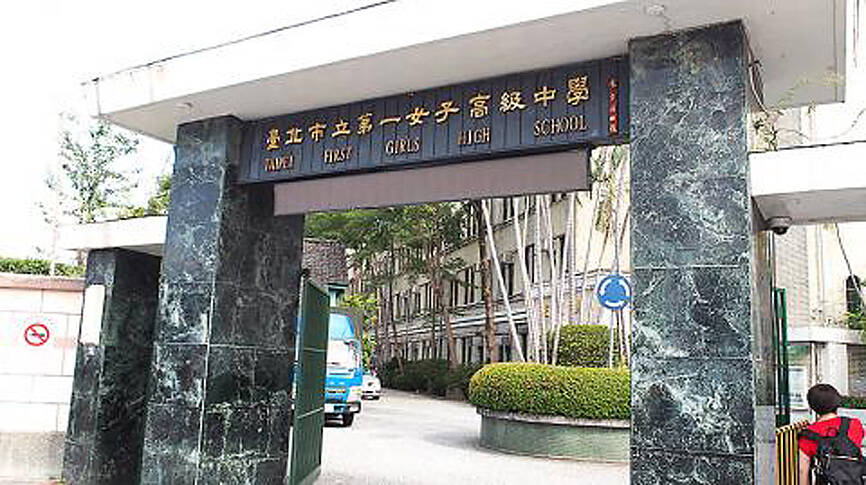
Photo: Tsai Ya-hua, Taipei Times
As of last night, Chen had also set his Facebook account to private, and a TFG official said the school did not wish to comment on the issue.
The controversy arose last week after the Taipei Department of Education received complaints about comments that TFG teacher Ou Kui-chih (區桂芝) made during an appearance on Chinese national broadcaster CCTV.
During an interview, Ou criticized Lai’s move to designate China as a "hostile foreign force," saying she didn’t know how she could face her Chinese relatives.
Ou, who teaches Chinese literature, previously made headlines in 2023 when she slammed new government curriculum guidelines that cut the number of classical Chinese texts as politically motivated "desinicization" and "a crime deserving more than 10,000 deaths."
Following Ou’s comments, the Taipei Department of Education said it would allow the school to handle the matter internally, adding that it respects teachers’ professional autonomy and freedom of speech as long as they uphold the principle of educational neutrality.
Minister of Education Cheng Ying-yao (鄭英耀) said last week that while he respects teachers’ freedom of expression, they should also maintain a clear sense of national consciousness and identity.

Yangmingshan National Park authorities yesterday urged visitors to respect public spaces and obey the law after a couple was caught on a camera livestream having sex at the park’s Qingtiangang (擎天崗) earlier in the day. The Shilin Police Precinct in Taipei said it has identified a suspect and his vehicle registration number, and would summon him for questioning. The case would be handled in accordance with public indecency charges, it added. The couple entered the park at about 11pm on Thursday and began fooling around by 1am yesterday, the police said, adding that the two were unaware of the park’s all-day live

Fast food chain McDonald's is to raise prices by up to NT$5 on some products at its restaurants across Taiwan, starting on Wednesday next week, the company announced today. The prices of all extra value meals and sharing boxes are to increase by NT$5, while breakfast combos and creamy corn soup would go up by NT$3, the company said in a statement. The price of the main items of those meals, if ordered individually, would remain the same. Meanwhile, the price of a medium-sized lemon iced tea and hot cappuccino would rise by NT$3, extra dipping sauces for chicken nuggets would go up
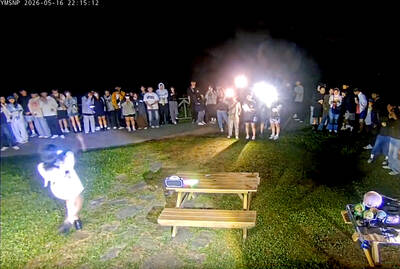
Yangmingshan National Park’s Qingtiangang (擎天崗) nature area has gone viral after a park livestream camera observed a couple in the throes of intimate congress, which was broadcast live on YouTube, drawing large late-night crowds and sparking a backlash over noise, bright lights and disruption to wildlife habitat. The area’s livestream footage appeared to show a couple engaging in sexual activity on a picnic table in the park on Friday last week, with the uncensored footage streamed publicly online. The footage quickly spread across social media, prompting a tide of visitors to travel to the site to “check in” and recreate the

Minister of Digital Affairs Lin Yi-ching (林宜敬) yesterday cited regulatory issues and national security concerns as an expert said that Taiwan is among the few Asian regions without Starlink. Lin made the remarks on Facebook after funP Innovation Group chief executive officer Nathan Chiu (邱繼弘) on Friday said Taiwan and four other countries in Asia — China, North Korea, Afghanistan and Syria — have no access to Starlink. Starlink has become available in 166 countries worldwide, including Ukraine, Malaysia, the Philippines and Vietnam, in the six years since it became commercial, he said. While China and North Korea block Starlink, Syria is not


 RSS
RSS