


Taiwan-based publisher Li Yanhe (李延賀) has been sentenced to three years in prison, fined 50,000 yuan (US$6,890) in personal assets and deprived political rights for one year for “inciting secession” in China, China's Taiwan Affairs Office spokesman Chen Binhua (陳斌華) said today.
The Shanghai First Intermediate People’s Court announced the verdict on Feb. 17, Chen said.
The trial was conducted lawfully, and in an open and fair manner, he said, adding that the verdict has since come into legal effect.

Photo: Screen grab from Facebook
The defendant reportedly admitted guilt and would appeal within the statutory appeal period, he said, adding that the defendant and his family have been clearly informed about the sentence.
During the execution of the sentence, the relevant authorities are to ensure that the rights of the defendant and his family are protected in accordance with the law, Chen said.
He said that as a spokesman, he is unwilling to disclose further details.
Chen also accused the Democratic Progressive Party of repeatedly bringing up this judicial case in an attempt to slander and discredit China’s judicial system.
Li, also known by the pen name Fucha (富察), worked as editor-in-chief of Taiwan-based Gusa Press (八旗文化).
Li was born in China’s Liaoning Province and obtained Taiwanese citizenship after living in Taiwan for many years.
He returned to Shanghai in March 2023 to cancel his household registration, but was arrested by police, most likely because Gusa Press has published books that are critical of China’s autocratic regime.
In April 2023, Beijing confirmed that Li had been detained “on suspicion of engaging in activities endangering national security.”
Since then, China has never publicly announced the progress of Li’s trial, apart from announcing on Tuesday last week that he had been convicted in a “public sentencing.”

NATIONAL SECURITY: Authorities are working to confirm the identities of the military personnel involved and investigating possible illegal conduct and regulatory violations Authorities are probing possible national security implications after Kinmen police and immigration officers on Sunday found a Chinese woman allegedly posing as a tourist while engaging in prostitution involving more than 10 military personnel. The woman, surnamed Chen (陳), has since been deported, authorities said, adding that investigators are still working to confirm the identities of those implicated, as the records only listed code names and aliases. The case stemmed from a report received by the Kinmen District Prosecutors’ Office on Friday last week from the Jinhu Precinct of the Kinmen County Police Bureau. On Sunday, police, along with the National Immigration
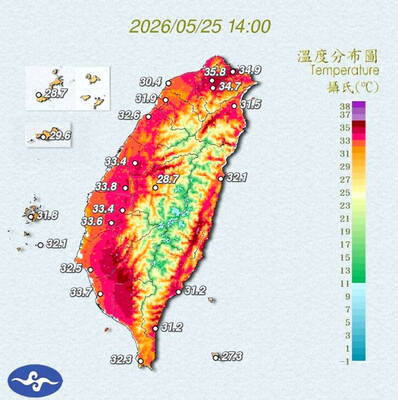
STAY COOL: The HPA recommended that people stay hydrated, use air-conditioning or fans while indoors, wear loose-fitting clothes and walk in the shade while outdoors Employers must implement measures such as installing cooling equipment, and providing drinking water and rest breaks for outdoor workers starting from Monday next week, the Taipei Department of Labor said on Sunday. Employers who fail to comply could face fines of NT$30,000 to NT$300,000 under the Occupational Safety and Health Act (職業安全衛生法), the department said. Businesses in Taipei employing fewer than 100 workers, as well as registered self-employed workers with labor insurance coverage, could receive on-site assessments and guidance from occupational safety consultants to help them apply for central government subsidies to implement or improve heat-protection measures, it said. Under the Ministry of

GLOBALGIVING: ‘ Caving to external pressure is not acceptable for an organization that has cultivated justice reform and human rights for 30 years,’ one NGO said A slew of non-government organizations (NGOs) have withdrawn from the GlobalGiving fundraising platform after it announced it would use “Chinese Taipei” instead of “Taiwan” from next month. The Taiwan Good Rice Association wrote on Facebook on Friday that it was informed on April 28 via a teleconference call of the change, which was made because the platform wanted to operate in China. Taiwan Good Rice is to terminate all cooperative relationships with GlobalGiving in response to the platform’s “unilateral and non-negotiable” decision to remove references to Taiwan, the NGO said. “Taiwan is in the official name of Taiwan Good Rice Association and the

Chinese Nationalist Party (KMT) Chairwoman Cheng Li-wun (鄭麗文) yesterday briefed her party’s Central Standing Committee regarding her scheduled visit to the US between Monday next week and June 16, saying that her purpose would be to persuade the US that the Republic of China (ROC) Constitution was a “one China” constitution that would foster stable and peaceful cross-strait relations. The ROC Constitution is the most important defense for all Taiwanese citizens, as it upholds our democracy and has contributed to our robust economy, which aligns with international and US interests, she said. “We would not be troublemakers and drag the US under,”


 RSS
RSS