


The Executive Yuan yesterday confirmed that it has appointed Shigeru Iwasaki, former chief of staff of the joint staff of the Japan Self-Defense Forces, as a consultant for one year, saying it welcomes any advice that could benefit Taiwan.
The Japanese-language Asahi Shimbun reported that Iwasaki is well-known and influential in Japan’s military and political spheres.
His appointment as a consultant represents Taiwan’s attempt to bolster security ties with Japan, the paper said, adding that the move could further stir China’s ire.
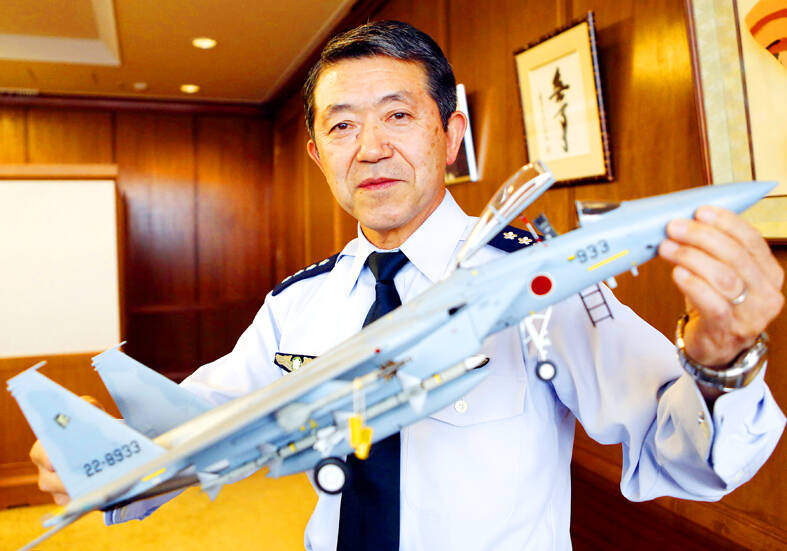
Photo: Toru Hanai, Reuters
Former Sankei Shimbun Taipei bureau chief Akio Yaita on Thursday wrote online that Iwasaki was visiting Taiwan at the Executive Yuan’s invitation and was hired as a consultant by Premier Cho Jung-tai (卓榮泰).
Yaita said he was unaware of any former Japanese military servicemembers serving as a consultant to Taiwan, adding that Iwasaki outranked Naosuke Tomita and Hiroshi Nemoto, the two highest-ranking former Japanese military officials to consult for Taiwan.
Tomita and Nemoto were part of the White Group, a team of Japanese military advisers to the Chinese Nationalist Party (KMT) from 1949 to 1969.
The group, initially taking the name of Tomita’s chosen Chinese name, Pai Hung-liang (白鴻亮), was later condensed to just the word “Pai,” or “white,” to highlight the group’s role in assisting the Republic of China in fighting the Chinese Communist Party, which like other communist countries, favors the color red.
Iwasaki retired as a four-star general. Given his post as chief of staff of the joint staff, he was a top-ranking official in the Japanese military.
Tomita was a retired major general and Nemoto was a lieutenant general.
Yaita said the hiring of Iwasaki underscored unprecedentedly close Taiwan-Japan ties.
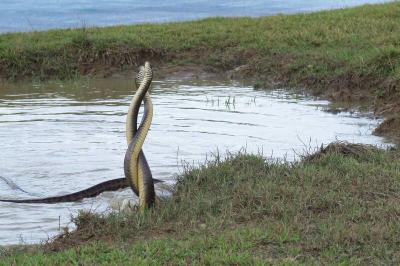
Kenting National Park service technician Yang Jien-fon (楊政峰) won a silver award in World Grand Prix Photography Awards Spring Season for his photograph of two male rat snakes intertwined in combat. Yang’s colleagues at Kenting National Park said he is a master of nature photography who has been held back by his job in civil service. The awards accept entries in all four seasons across six categories: architectural and urban photography, black-and-white and fine art photography, commercial and fashion photography, documentary and people photography, nature and experimental photography, and mobile photography. Awards are ranked according to scores and divided into platinum, gold and
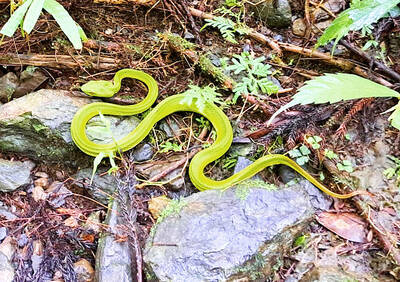
More than half of the bamboo vipers captured in Tainan in the past few years were found in the city’s Sinhua District (新化), while other districts had smaller catches or none at all. Every year, Tainan captures about 6,000 snakes which have made their way into people’s homes. Of the six major venomous snakes in Taiwan, the cobra, the many-banded krait, the brown-spotted pit viper and the bamboo viper are the most frequently captured. The high concentration of bamboo vipers captured in Sinhua District is puzzling. Tainan Agriculture Bureau Forestry and Nature Conservation Division head Chu Chien-ming (朱健明) earlier this week said that the

The Chinese Nationalist Party (KMT) caucus yesterday said it opposes the introduction of migrant workers from India until a mechanism is in place to prevent workers from absconding. Minister of Labor Hung Sun-han (洪申翰) on Thursday told the Legislative Yuan that the first group of migrant workers from India could be introduced as early as this year, as part of a government program. The caucus’ opposition to the policy is based on the assessment that “the risk is too high,” KMT caucus secretary-general Lin Pei-hsiang (林沛祥) said. Taiwan has a serious and long-standing problem of migrant workers absconding from their contracts, indicating that
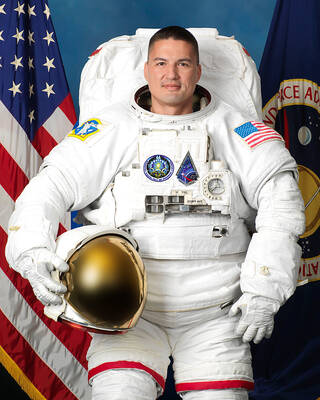
SPACE VETERAN: Kjell N. Lindgren, who helps lead NASA’s human spaceflight missions, has been on two expeditions on the ISS and has spent 311 days in space Taiwan-born US astronaut Kjell N. Lindgren is to visit Taiwan to promote technological partnerships through one of the programs organized by the US for its 250th national anniversary. Lindgren would be in Taiwan from Tuesday to Saturday next week as part of the US Bureau of Educational and Cultural Affairs’ US Speaker Program, organized to celebrate the 250th anniversary of the signing of the Declaration of Independence, the American Institute in Taiwan (AIT) said in a statement yesterday. Lindgren plans to engage with key leaders across the nation “to advance cutting-edge technological partnerships and inspire the next generation of scientists and engineers,”


 RSS
RSS