


Taiwan Water Corp (Taiwater) is considering increasing water prices to counter mounting financial losses and plans to submit a pricing review report to the Ministry of Economic Affairs by the end of this month.
Taiwater said it aims to secure financial support or adjust its pricing while minimizing the impact on residential customers.
The company incurs a loss of NT$2.45 per cubic meter of water (m3) sold, the report said.
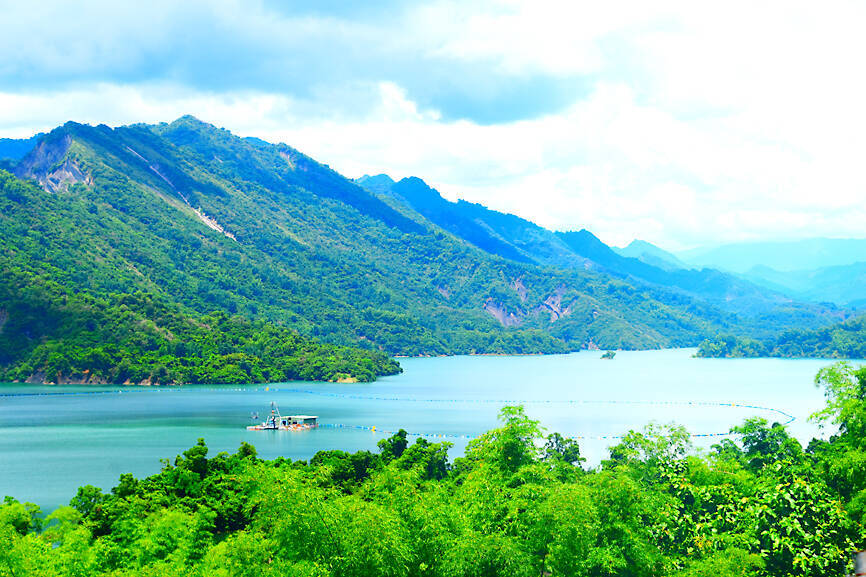
Photo: Su Fu-nan, Taipei Times
Taiwan’s water rates have remained unchanged for 31 years. The pricing structure has four tiers: NT$7.35/m3 for up to 10m3 of water, NT$9.45 for 11m3 to 30m3, NT$11.55 for 31m3 to 50m3 and NT$12.075 for any consumption exceeding 50m3.
The preliminary proposal suggests keeping the first-tier rate unchanged, applying moderate increases to the second and third tiers, and introducing larger hikes and additional brackets for the fourth tier.
Initial estimates show that at least 60 percent of consumers would not be affected, the report said.
The final decision on any changes would be made by the Executive Yuan, the report added.
Taiwater last year posted a post-tax loss of NT$3.94 billion (US$119.56 million), with losses expected to grow to NT$5.93 billion this year. The company cited rising costs, including depreciation, interest payments and ongoing efforts to reduce water leakage, as a key financial pressure.
Premier Cho Jung-tai (卓榮泰) in January urged the public to accept “fair” water pricing, while Minister of Economic Affairs J.W. Kuo (郭智輝) instructed Taiwater to submit its pricing adjustment review by the end of this month.
An initiative under consideration is a water quality-based pricing model, which would introduce premium pricing for higher-quality drinking water, creating an additional revenue stream for Taiwater.
The proposal involves installing water purification equipment at the consumer level, allowing households and businesses direct access to certified purified water from Taiwater, sources familiar with the matter said, adding that Taiwater’s in-house water quality testing capabilities would ensure compliance with drinking water standards.
However, the feasibility of the system and its effect on the overall water distribution network require further evaluation, they said.


An essay competition jointly organized by a local writing society and a publisher affiliated with the Chinese Communist Party (CCP) might have contravened the Act Governing Relations Between the People of the Taiwan Area and the Mainland Area (臺灣地區與大陸地區人民關係條例), the Mainland Affairs Council (MAC) said on Thursday. “In this case, the partner organization is clearly an agency under the CCP’s Fujian Provincial Committee,” MAC Deputy Minister and spokesperson Liang Wen-chieh (梁文傑) said at a news briefing in Taipei. “It also involves bringing Taiwanese students to China with all-expenses-paid arrangements to attend award ceremonies and camps,” Liang said. Those two “characteristics” are typically sufficient
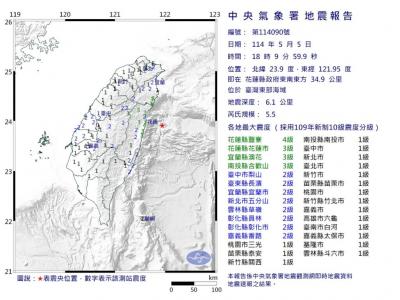
A magnitude 5.9 earthquake that struck about 33km off the coast of Hualien City was the "main shock" in a series of quakes in the area, with aftershocks expected over the next three days, the Central Weather Administration (CWA) said yesterday. Prior to the magnitude 5.9 quake shaking most of Taiwan at 6:53pm yesterday, six other earthquakes stronger than a magnitude of 4, starting with a magnitude 5.5 quake at 6:09pm, occurred in the area. CWA Seismological Center Director Wu Chien-fu (吳健富) confirmed that the quakes were all part of the same series and that the magnitude 5.5 temblor was

The brilliant blue waters, thick foliage and bucolic atmosphere on this seemingly idyllic archipelago deep in the Pacific Ocean belie the key role it now plays in a titanic geopolitical struggle. Palau is again on the front line as China, and the US and its allies prepare their forces in an intensifying contest for control over the Asia-Pacific region. The democratic nation of just 17,000 people hosts US-controlled airstrips and soon-to-be-completed radar installations that the US military describes as “critical” to monitoring vast swathes of water and airspace. It is also a key piece of the second island chain, a string of
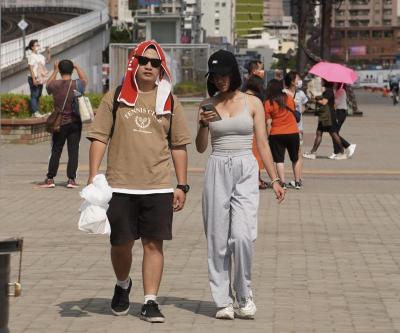
The Central Weather Administration has issued a heat alert for southeastern Taiwan, warning of temperatures as high as 36°C today, while alerting some coastal areas of strong winds later in the day. Kaohsiung’s Neimen District (內門) and Pingtung County’s Neipu Township (內埔) are under an orange heat alert, which warns of temperatures as high as 36°C for three consecutive days, the CWA said, citing southwest winds. The heat would also extend to Tainan’s Nansi (楠西) and Yujing (玉井) districts, as well as Pingtung’s Gaoshu (高樹), Yanpu (鹽埔) and Majia (瑪家) townships, it said, forecasting highs of up to 36°C in those areas


 RSS
RSS