


The Ministry of Foreign Affairs (MOFA) yesterday rejected claims by China’s foreign ministry that Beijing would “exert utmost efforts to realize ‘peaceful reunification’ with Taiwan,” and condemned Beijing for again distorting UN Resolution 2758.
On the sidelines of China’s “two sessions” annual policy-setting meeting, Chinese Minister of Foreign Affairs Wang Yi (王毅) told reporters that “the only reference to the Taiwan region in the UN is Taiwan, Province of China.”
“Taiwan is never a country, not in the past, and never in the future. To clamor for Taiwanese independence is to split the country, to support Taiwanese independence is to interfere in China’s internal affairs,” he said.
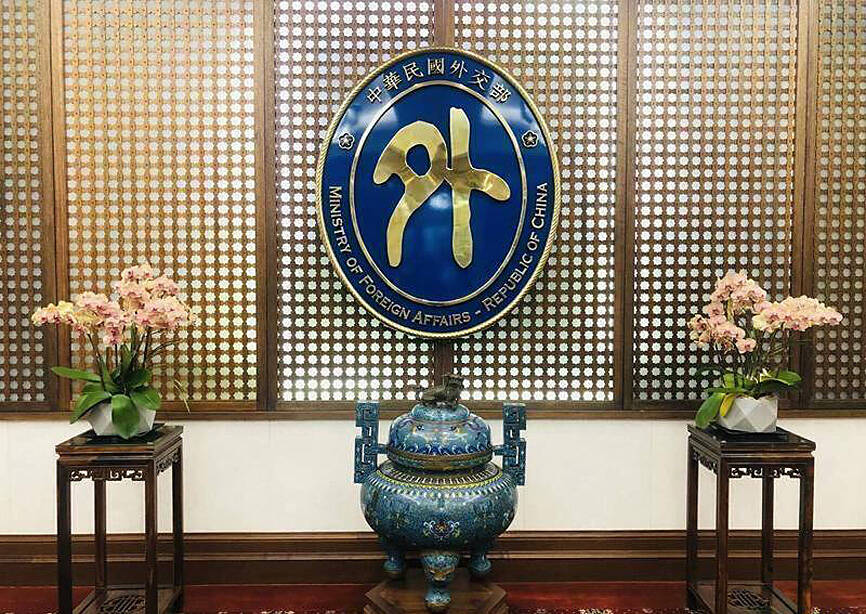
Photo: Taipei Times
Chinese Ministry of Foreign Affairs spokeswoman Mao Ning (毛寧) on Monday said that UN Resolution 2758 adopted in 1971 “made it clear that there is only one China, Taiwan is not a country and it is part of China.”
“China’s position is consistent and clear. We stay committed to the ‘one China’ principle and the ‘1992 consensus.’ We stand ready to work with the greatest sincerity and exert utmost efforts to achieve peaceful reunification,” she said.
The so-called “1992 consensus,” a term former Mainland Affairs Council chairman Su Chi (蘇起) in 2006 admitted making up in 2000, refers to a tacit understanding between the Chinese Nationalist Party (KMT) and the Chinese government that both sides of the Strait acknowledge there is “one China,” with each side having its own interpretation of what “China” means.
MOFA yesterday rejected China’s claims, saying that “the Republic of China (ROC) and the People’s Republic of China (PRC) are not subordinate to each other, and Taiwan has never been ruled by the PRC.”
“Any claim that misrepresents Taiwan’s sovereign status cannot change the internationally recognized status quo in the Taiwan Strait,” it added.
The ministry also reiterated that UN Resolution 2758 only decided the representation of China in the UN and did not mention Taiwan.
The resolution “did not recognize Taiwan as part of the PRC, nor did it authorize the PRC to represent Taiwan in the UN,” it said.
“The MOFA sternly informs China to recognize the fact that the ROC, Taiwan, is an independent sovereign country. Taiwan has never been a part of the PRC, and the status quo is that the two sides are not subordinate to each other, which is also the objective fact accepted by the international community,” it said.
The ministry urged members of the international community to see through what it called China’s distortion of the UN Resolution 2758, intended to mislead them to believe the Taiwan issue is China’s internal affair.
The ministry also urged them to explicitly express their opposition toward China’s repeated misinterpretation of the resolution, which it said is intended to maliciously change the “status quo.”
The Ministry of Education (MOE) is to launch a new program to encourage international students to stay in Taiwan and explore job opportunities here after graduation, Deputy Minister of Education Yeh Ping-cheng (葉丙成) said on Friday. The government would provide full scholarships for international students to further their studies for two years in Taiwan, so those who want to pursue a master’s degree can consider applying for the program, he said. The fields included are science, technology, engineering, mathematics, semiconductors and finance, Yeh added. The program, called “Intense 2+2,” would also assist international students who completed the two years of further studies in
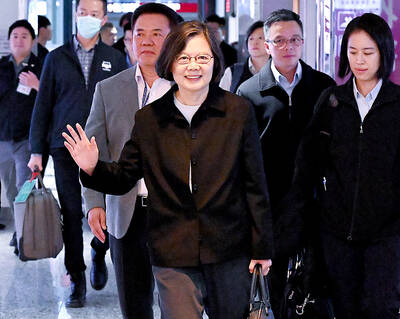
Former president Tsai Ing-wen (蔡英文) departed for Europe on Friday night, with planned stops in Lithuania and Denmark. Tsai arrived at Taiwan Taoyuan International Airport on Friday night, but did not speak to reporters before departing. Tsai wrote on social media later that the purpose of the trip was to reaffirm the commitment of Taiwanese to working with democratic allies to promote regional security and stability, upholding freedom and democracy, and defending their homeland. She also expressed hope that through joint efforts, Taiwan and Europe would continue to be partners building up economic resilience on the global stage. The former president was to first
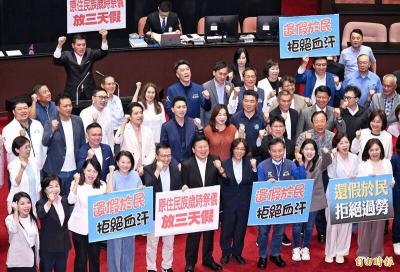
Taiwan will now have four additional national holidays after the Legislative Yuan passed an amendment today, which also made Labor Day a national holiday for all sectors. The Chinese Nationalist Party (KMT) and Taiwan People’s Party (TPP) used their majority in the Legislative Yuan to pass the amendment to the Act on Implementing Memorial Days and State Holidays (紀念日及節日實施辦法), which the parties jointly proposed, in its third and final reading today. The legislature passed the bill to amend the act, which is currently enforced administratively, raising it to the legal level. The new legislation recognizes Confucius’ birthday on Sept. 28, the
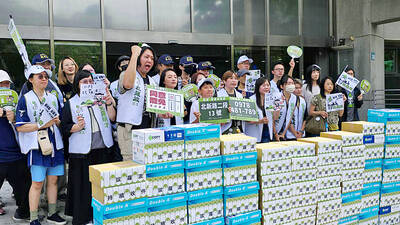
MORE NEEDED: Recall drives against legislators in Miaoli’s two districts and Hsinchu’s second district were still a few thousand signatures short of the second-stage threshold Campaigners aiming to recall Chinese Nationalist Party (KMT) legislators yesterday said they expect success in 30 out of 35 districts where drives have passed the second-stage threshold, which would mark a record number of recall votes held at once. Hsinchu County recall campaigners yesterday announced that they reached the second-stage threshold in the recall effort against Legislator Lin Szu-ming (林思銘). A total of 26,414 signatures have been gathered over the past two months, surpassing the 10 percent threshold of 23,287 in Hsinchu County’s second electoral district, chief campaigner Hsieh Ting-ting (謝婷婷) said. “Our target is to gather an additional 1,500 signatures to reach


 RSS
RSS