


A pygmy hippopotamus named Thabo, originally from Singapore, has been confirmed dead by the Taipei Zoo due to what the zoo said was malnutrition and infection.
In a statement yesterday, the Taipei Zoo, which was home to Thabo, confirmed that the 2-year-old hippo from Singapore’s Mandai Wildlife Group passed away sometime after 4 am, despite efforts to treat it over the past month.
Taipei Zoo spokesperson Tsao Hsien-shao (曹先紹) said caring for large animals is difficult, as they cannot be easily given injections or IV drops or be tube-fed.
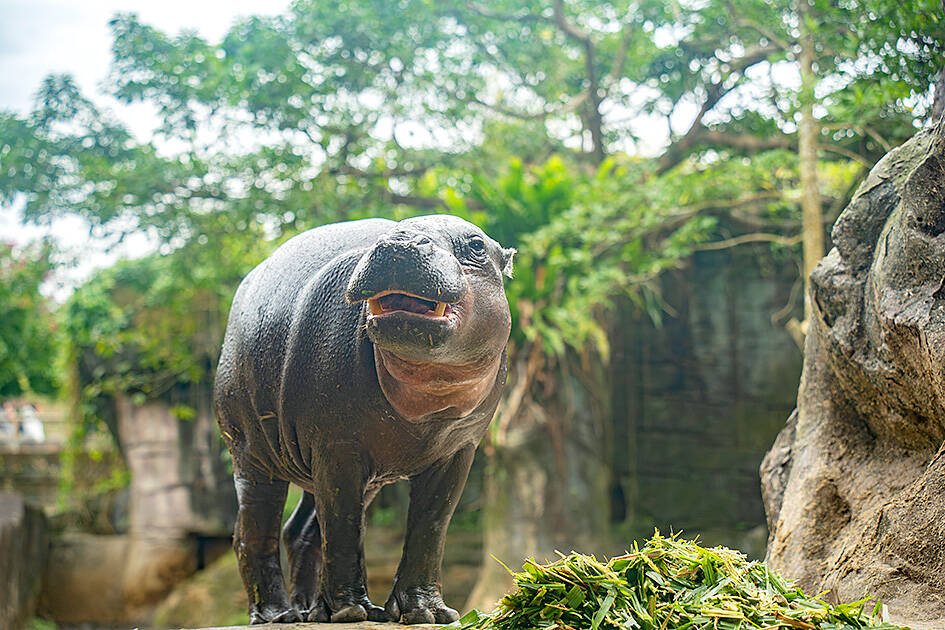
Photo courtesy of Taipei Zoo via CNA
Tsao also mentioned Thabo’s shyness as a factor in its care. The zoo’s team tried hiding medication in its feed, but the hippo refused to take it, Tsao said.
Pygmy hippos, which live in forests, savannas, and wetlands, are listed as “endangered” by the International Union for Conservation of Nature (IUCN). This status indicates that the number of mature individuals has decreased to between 2,000 and 2,499 worldwide.
According to the zoo’s statement, Thabo arrived at the Taipei Zoo in mid-November 2024 and was first seen by the public in January 2025.
On Feb. 11, a zookeeper noticed a wound on Thabo’s right foot and began treating it with oral medication and daily cleaning. The hippo refused the medication, however, and kept avoiding the zookeepers, making treatment difficult.
As Thabo developed more lumps on its body, the condition worsened due to the cold air mass and drastic temperature fluctuations between day and night, as Thabo was accustomed to the stable, warm weather of Singapore.
On Sunday, the care team set up an emergency unit to provide round-the-clock care, but Thabo’s white blood cell count, muscle index, and other indicators related to liver and kidney function continued to rise before the animal’s death.
An autopsy performed by a veterinary team from National Taiwan University later confirmed that Thabo suffered from malnutrition and infection, the zoo said.
Tsao said the zoo will continue to investigate the causes of Thabo’s death to determine whether the zoo’s environment posed any risk to other animals, while also reflecting on how care procedures might be improved.

LOUD AND PROUD Taiwan might have taken a drubbing against Australia and Japan, but you might not know it from the enthusiasm and numbers of the fans Taiwan might not be expected to win the World Baseball Classic (WBC) but their fans are making their presence felt in Tokyo, with tens of thousands decked out in the team’s blue, blowing horns and singing songs. Taiwanese fans have packed out the Tokyo Dome for all three of their games so far and even threatened to drown out home team supporters when their team played Japan on Friday. They blew trumpets, chanted for their favorite players and had their own cheerleading squad who dance on a stage during the game. The team struggled to match that exuberance on the field, with
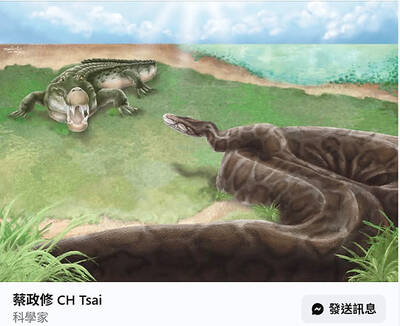
Taiwanese paleontologists have discovered fossil evidence that pythons up to 4m long inhabited Taiwan during the Pleistocene epoch, reporting their findings in the international scientific journal Historical Biology. National Taiwan University (NTU) Institute of Ecology and Evolutionary Biology associate professor Tsai Cheng-hsiu (蔡政修) led the team that discovered the largest snake fossil ever found in Taiwan. The single trunk vertebra was discovered in Tainan at the Chiting Formation, dated to between 400,000 and 800,000 years ago in the Middle Pleistocene, the paper said. The area also produced Taiwan’s first avian fossil, as well as crocodile, mammoth, saber-toothed cat and rhinoceros fossils, it said. Discoveries

Taiwanese paleontologists have discovered fossil evidence that pythons up to 4m long inhabited Taiwan during the Pleistocene epoch, reporting their findings in the international scientific journal Historical Biology. National Taiwan University (NTU) Institute of Ecology and Evolutionary Biology associate professor Tsai Cheng-hsiu (蔡政修) led the team that discovered the largest snake fossil ever found in Taiwan. A single trunk vertebra was discovered in Tainan at the Chiting Formation, dated to between 800,000 to 400,000 years ago in the Middle Pleistocene, the paper said. The area also produced Taiwan’s first avian fossil, as well as crocodile, mammoth, sabre-toothed cat and rhinoceros fossils, it said. Discoveries

Whether Japan would help defend Taiwan in case of a cross-strait conflict would depend on the US and the extent to which Japan would be allowed to act under the US-Japan Security Treaty, former Japanese minister of defense Satoshi Morimoto said. As China has not given up on the idea of invading Taiwan by force, to what extent Japan could support US military action would hinge on Washington’s intention and its negotiation with Tokyo, Morimoto said in an interview with the Liberty Times (sister paper of the Taipei Times) yesterday. There has to be sufficient mutual recognition of how Japan could provide


 RSS
RSS