


CPBL president Tsai Chi-chang (蔡其昌) has pledged to reflect on the national team’s rule violations during the World Baseball Classic (WBC) qualifiers last month, which resulted in a US$20,000 fine.
Tsai made the statement on Tuesday, one day after he confirmed that the league had received a notification of the fine from the MLB, the tournament organizer, for bringing electronic devices into the dugout and allowing unauthorized personnel to enter restricted areas.
Speaking to reporters, Tsai, whose league assembled the national team, admitted the mistakes, but emphasized that he was not in the dugout during the qualifier series at the Taipei Dome late last month.
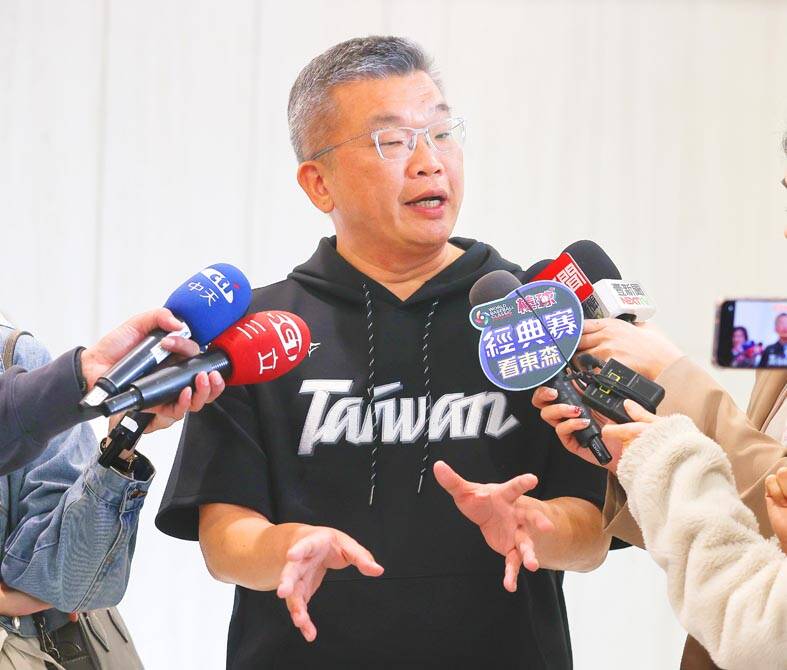
Photo: CNA
“I wasn’t there, [but] I asked our league’s staff, and they told me the items were there,” Tsai said, declining to comment on whether the league had misunderstood the rules.
Saying “I have nothing to say [about this],” Tsai added. “We accept the fine in accordance with the rules.”
Each team was allocated 39 official credentials allowing access to the dugout during games, with 28 for players and the remaining 11 distributed at the team’s discretion.
Apart from breaking the ban on electronic devices, Taiwan was also found to have exceeded the personnel limit.
The CPBL on Monday acknowledged that the team violated the electronics rule during their opening game against Spain on Feb. 21.
It also admitted to breaking another regulation by allowing unlisted staff into the team locker room.
Tournament officials reported that more individuals were present in Taiwan’s locker room than the 39 credentialed by organizers.
The unauthorized personnel, including medical staff and equipment managers, were warned not to enter the area again.
However, according to sources familiar with the matter, MLB staff discovered electronic devices in the dugout again the following day before the game against South Africa.
This prompted a warning from WBC president Jim Small, who said the team could face disqualification if it violates the rules again, including the use of electronic devices.
When asked whether the team deliberately took in and used the devices, Tsai reiterated that, due to his absence, he had little knowledge of the situation.
“All I can tell you is what I learned from MLB. If the MLB said we did it intentionally, then I would let you know,” he said.
Tsai noted that tournament organizers enforced the rules and regulations “extremely strictly” this time, compared with the 2023 WBC Pool A games held in central Taiwan.
He added that the league took immediate corrective action to ensure there is no repetition of the violations.

Considering that most countries issue more than five denominations of banknotes, the central bank has decided to redesign all five denominations, the bank said as it prepares for the first major overhaul of the banknotes in more than 24 years. Central bank Governor Yang Chin-lung (楊金龍) is expected to report to the Legislative Yuan today on the bank’s operations and the redesign’s progress. The bank in a report sent to the legislature ahead of today’s meeting said it had commissioned a survey on the public’s preferences. Survey results showed that NT$100 and NT$1,000 banknotes are the most commonly used, while NT$200 and NT$2,000

The Centers for Disease Control (CDC) yesterday reported the first case of a new COVID-19 subvariant — BA.3.2 — in a 10-year-old Singaporean girl who had a fever upon arrival in Taiwan and tested positive for the disease. The girl left Taiwan on March 20 and the case did not have a direct impact on the local community, it said. The WHO added the BA.3.2 strain to its list of Variants Under Monitoring in December last year, but this was the first imported case of the COVID-19 variant in Taiwan, CDC Deputy Director-General Lin Ming-cheng (林明誠) said. The girl arrived in Taiwan on

South Korea is planning to revise its controversial electronic arrival card, a step Taiwanese officials said prompted them to hold off on planned retaliatory measures, a South Korean media report said yesterday. A Yonhap News Agency report said that the South Korean Ministry of Foreign Affairs is planning to remove the “previous departure place” and “next destination” fields from its e-arrival card system. The plan, reached after interagency consultations, is under review and aims to simplify entry procedures and align the electronic form with the paper version, a South Korean ministry official said. The fields — which appeared only on the electronic form

The Ministry of Foreign Affairs (MOFA) is suspending retaliation measures against South Korea that were set to take effect tomorrow, after Seoul said it is updating its e-arrival system, MOFA said today. The measures were to be a new round of retaliation after Taiwan on March 1 changed South Korea's designation on government-issued alien resident certificates held by South Korean nationals to "South Korea” from the "Republic of Korea," the country’s official name. The move came after months of protests to Seoul over its listing of Taiwan as "China (Taiwan)" in dropdown menus on its new online immigration entry system. MOFA last week


 RSS
RSS