


Lin Pei-ju (林珮如), director of Chiayi County Livestock Disease Control Center, on Saturday unfurled a “Taiwan, Asia No. 1” banner upon reaching the peak of Mount Kinabalu in Sabah, Malaysia, to promote Taiwan’s success in animal disease prevention.
Lin said she climbed the peak to promote Taiwan becoming a leader in Asia for eradicating infectious diseases affecting livestock, such as African swine fever, foot-and-mouth disease and classical swine fever.
The county official said she aimed to complete the “Asian Trilogy Peak Challenge” of Taiwan’s Yushan (玉山, 3,952m), Mount Kinabalu (4,095m) and Japan’s Mount Fuji (3,776 m), to promote Taiwan’s success in livestock disease control.
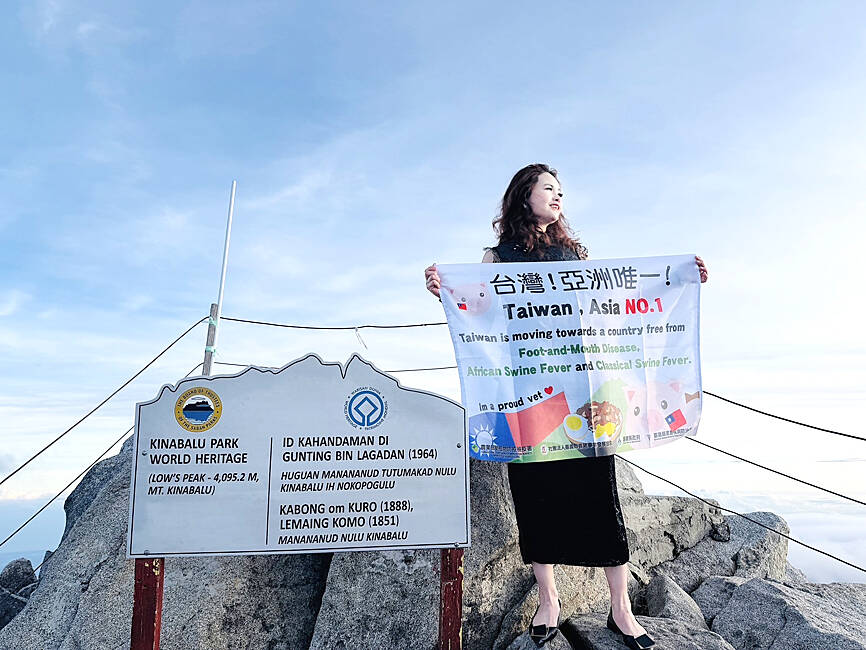
Photo courtesy of Lin Pei-ju
The climb up Kinabalu was much more difficult than her summit of Yushan three years ago, she said.
“We began on Friday at the starting point, the Timpohon Gate at 1,866m, climbing to Laban Rata Resthouse at 3,273m. So we covered about 6km of the trail, taking us six hours, going up 1,400m in elevation,” Lin said.
She said they awoke at 2:30am the next day to hike the final 2.5km, climbing about 820m to reach the peak. They then returned to the rest house to eat brunch before climbing down the same route.
From the peak to the starting gate, was a descent of about 2,200m on the 8.5km trail, she said.
“Climbing the trail to go up in the dark was quite exhausting, but God had blessed us. The weather forecast had it as a cloudy and rainy day, but when we reached the summit, the sky opened and the sun came out. So despite being exhausted and breathing quite heavily, we were able to change outfits and unfurl the banner,” she said.
Taking the photograph with the banner at the peak was her way of promoting the success of Taiwanese health authorities, industry and academics in preventing livestock diseases, Lin said.
“This year we are aiming for international recognition of Taiwan as a country free of the three major swine diseases, so it is worthwhile to tout to the world our success,” she said.
In 2022, when outbreaks of African swine fever were reported in many countries, Lin climbed Yushan and displayed a “You and I together to safeguard Taiwan hogs” banner.
Additional reporting by Jason Pan
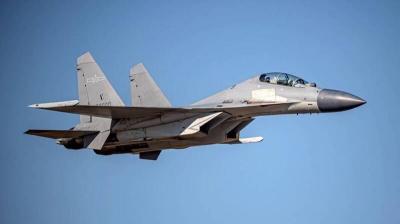
Eight Chinese naval vessels and 24 military aircraft were detected crossing the median line of the Taiwan Strait between 6am yesterday and 6am today, the Ministry of National Defense said this morning. The aircraft entered Taiwan’s northern, central, southwestern and eastern air defense identification zones, the ministry said. The armed forces responded with mission aircraft, naval vessels and shore-based missile systems to closely monitor the situation, it added. Eight naval vessels, one official ship and 36 aircraft sorties were spotted in total, the ministry said.
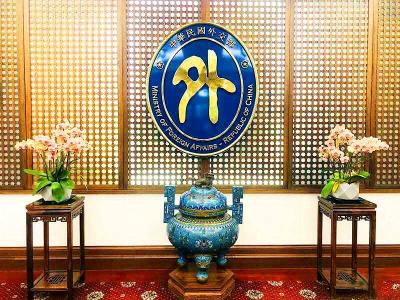
The Ministry of Foreign Affairs (MOFA) today said that if South Korea does not reply appropriately to its request to correct Taiwan’s name on its e-Arrival card system before March 31, it would take corresponding measures to alter how South Korea is labeled on the online Taiwan Arrival Card system. South Korea’s e-Arrival card system lists Taiwan as “China (Taiwan)” in the “point of departure” and “next destination” fields. The ministry said that it changed the nationality for South Koreans on Taiwan’s Alien Resident Certificates from “Korea” to “South Korea” on March 1, in a gesture of goodwill and based on the

Taiwanese officials were shown the first of 66 F-16V fighter jets purchased by Taiwan from the United States, the Ministry of National Defense said yesterday, adding the aircraft has completed an initial flight test and is expected to be delivered later this year. A delegation led by Deputy Minister of National Defense Hsu Szu-chien (徐斯儉) visited Lockheed Martin’s F-16 C/D Block 70 (also known as F-16V) assembly line in South Carolina on March 16 to view the aircraft. The jet will undergo a final acceptance flight in the US before being delivered to Taiwan, the
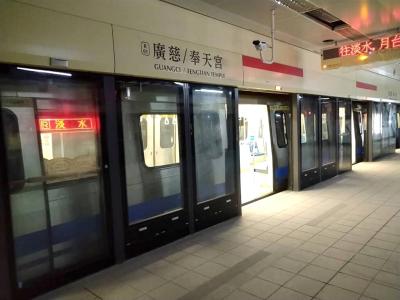
The New Taipei Metro's Sanyin Line and the eastern extension of the Taipei Metro's Tamsui-Xinyi Line (Red Line) are scheduled to begin operations in June, the National Development Council said today. The Red Line, which terminates at Xiangshan Station, would be connected by the 1.4km extension to a new eastern terminal, Guangci/Fengtian Temple Station, while the Sanyin Line would link New Taipei City's Tucheng and Yingge stations via Sanxia District (三峽). The council gave the updates at a council meeting reviewing progress on public construction projects for this year. Taiwan's annual public infrastructure budget would remain at NT$800 billion (US$25.08 billion), with NT$97.3


 RSS
RSS