


Hospital visits for influenza-like illnesses and diarrhea declined last week, the Centers for Disease Control (CDC) said yesterday, adding that expanded use of government-funded flu antiviral drugs would be extended until the end of the month, when the flu epidemic period is expected to end.
CDC Epidemic Intelligence Center Deputy Director Lee Chia-lin (李佳琳) told a news conference in Taipei that hospital visits for flu-like illness fell about 17 percent, from 138,875 in the previous week to 115,182 last week, but remained above the epidemic threshold.
Laboratory data showed that of the respiratory pathogens tests conducted in the past four weeks, flu viruses were the most common pathogen, with the influenza A(H1N1) virus being the dominant strain in local communities, she said.
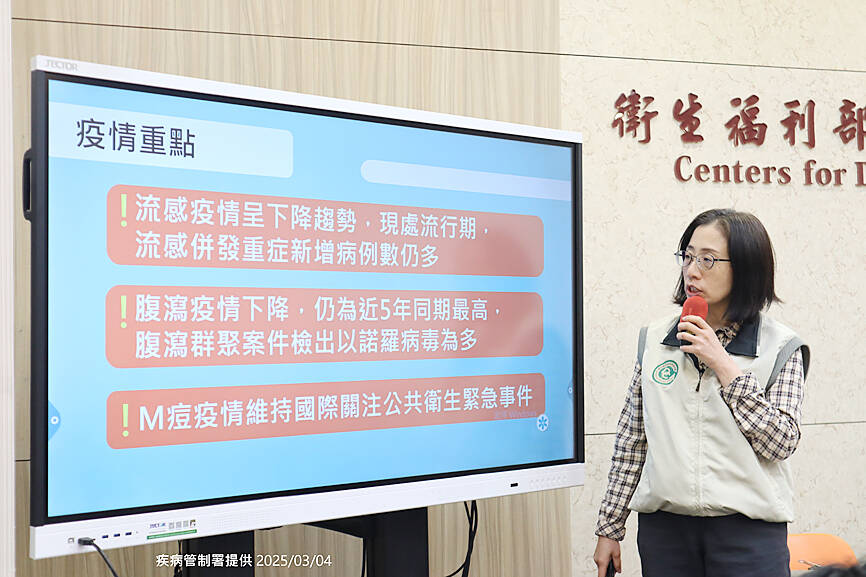
Photo: Lin Chih-yi, Taipei Times
Sixty-four cases with serious flu complications and 13 flu-related deaths were reported last week, for a total of 1,063 serious cases, including 217 deaths, since the flu season began on Oct 1 last year, she said.
A man in his 30s, the youngest death reported last week, had underlying health conditions, including heart disease, and was not vaccinated against the flu this season, CDC physician Lin Yung-ching (林詠青) said.
The man began experiencing cold-like symptoms, including coughing and fatigue, in the middle of last month and sought treatment at a clinic, but was rushed to a hospital about a week later for a fever, shortness of breath, severe cough and general weakness, Lin said.
His condition did not improve after treatment, and he died of flu-induced pneumonia and respiratory failure about a week after being hospitalized, Lin said.
The centers expects flu activity to continue declining, and would likely drop below the epidemic threshold by the middle or end of this month, CDC Deputy Director-General Tseng Shu-hui (曾淑慧) said.
As there is still a risk of contracting the flu or developing serious complications after infection, despite a drop in cases, the CDC would extend the expanded use of government-funded flu antivirals until March 31, she said.
Meanwhile, hospitals last week reported 275,238 visits for diarrhea, about 10 percent fewer than the previous week, but still the highest of the same week in five years, Lee said.
In the past four weeks, there have been 344 reports of cluster diarrhea cases, also the highest for the same period in five years, she said, adding that norovirus was the cause for a great majority of the cluster cases tested for pathogens.
In other illnesses, Tseng said an imported case of mpox was reported last week in an unvaccinated Taiwanese man who returned from Thailand.
A surge in mpox cases that started last year continues to meet the criteria of a public health emergency of international concern, she said, citing a statement from the WHO following the third meeting of the International Health Regulations Emergency Committee on the event, held on Tuesday last week.
The WHO also issued temporary recommendations to countries where there is sustained community transmission of mpox, and where there are clusters of cases or sporadic travel-related cases of MPXV clade Ib, she said.
Lee said that recent mpox cases in Taiwan have been sporadic, with only two local cases and one imported case reported so far this year.
People planning to travel to the Songkran Festival in Thailand next month and are expecting to engage in behaviors with higher risk of infection, or who are eligible for the mpox vaccine, are recommended to get fully vaccinated as soon as possible, Tseng said.
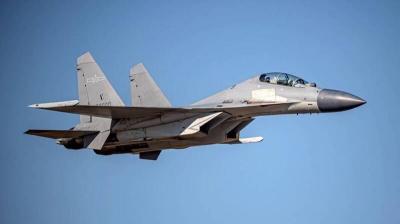
Eight Chinese naval vessels and 24 military aircraft were detected crossing the median line of the Taiwan Strait between 6am yesterday and 6am today, the Ministry of National Defense said this morning. The aircraft entered Taiwan’s northern, central, southwestern and eastern air defense identification zones, the ministry said. The armed forces responded with mission aircraft, naval vessels and shore-based missile systems to closely monitor the situation, it added. Eight naval vessels, one official ship and 36 aircraft sorties were spotted in total, the ministry said.
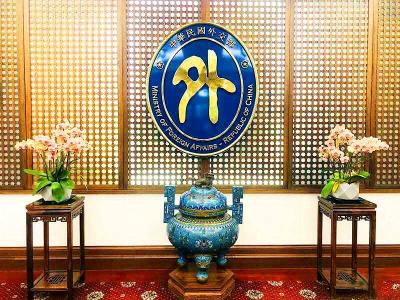
The Ministry of Foreign Affairs (MOFA) today said that if South Korea does not reply appropriately to its request to correct Taiwan’s name on its e-Arrival card system before March 31, it would take corresponding measures to alter how South Korea is labeled on the online Taiwan Arrival Card system. South Korea’s e-Arrival card system lists Taiwan as “China (Taiwan)” in the “point of departure” and “next destination” fields. The ministry said that it changed the nationality for South Koreans on Taiwan’s Alien Resident Certificates from “Korea” to “South Korea” on March 1, in a gesture of goodwill and based on the

Taiwanese officials were shown the first of 66 F-16V fighter jets purchased by Taiwan from the United States, the Ministry of National Defense said yesterday, adding the aircraft has completed an initial flight test and is expected to be delivered later this year. A delegation led by Deputy Minister of National Defense Hsu Szu-chien (徐斯儉) visited Lockheed Martin’s F-16 C/D Block 70 (also known as F-16V) assembly line in South Carolina on March 16 to view the aircraft. The jet will undergo a final acceptance flight in the US before being delivered to Taiwan, the

The New Taipei Metro's Sanyin Line and the eastern extension of the Taipei Metro's Tamsui-Xinyi Line (Red Line) are scheduled to begin operations in June, the National Development Council said today. The Red Line, which terminates at Xiangshan Station, would be connected by the 1.4km extension to a new eastern terminal, Guangci/Fengtian Temple Station, while the Sanyin Line would link New Taipei City's Tucheng and Yingge stations via Sanxia District (三峽). The council gave the updates at a council meeting reviewing progress on public construction projects for this year. Taiwan's annual public infrastructure budget would remain at NT$800 billion (US$25.08 billion), with NT$97.3


 RSS
RSS