


Democratic Progressive Party (DPP) lawmakers have introduced draft amendments to the Nationality Act (國籍法) that would have public servants found to possess dual nationality reimburse the government following their dismissal.
The Ministry of the Interior last month identified five borough chiefs with Chinese citizenship and instructed district offices to handle the issue as stipulated in the Nationality Act and Household Registration Act (戶籍法). The ministry had also dismissed former Nantou County councilor Shi Xueyan (史雪燕) in December last year due to her possession of a Chinese nationality.
Similar issues had occurred in 2008, when then-Chinese Nationalist Party (KMT) legislator and former Taipei councilor Diane Lee (李慶安) was found to have US citizenship.
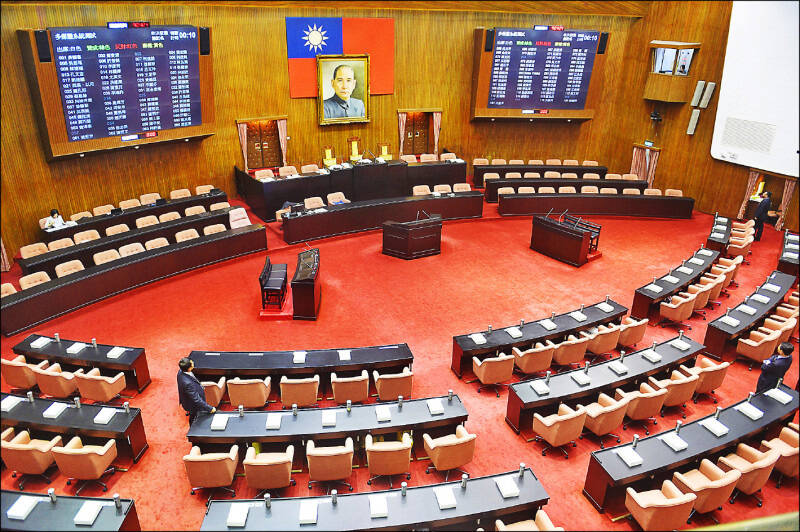
Photo: Taipei Times
The Taipei City Council in 2009 filed a lawsuit against Lee and requested that she return the salary she received as a councilor between 1994 and 1998.
However, the Taipei High Administrative Court ruled that Lee was not required to return the income she earned.
To prevent similar occurrences, DPP legislators Michelle Lin (林楚茵) and Huang Jie (黃捷) proposed draft amendments to Article 20 of the Nationality Act, which would be reviewed by the legislature’s Procedure Committee tomorrow.
The bill stipulates that public servants who fail to renounce non-Taiwanese citizenship and obtain relevant certificates must return the salaries, grants or subsidies they received within their tenure to the government, as required by their employing agency.
The right to a recovery of compensation would become invalid if the employing agency does not make a claim within five years after the misconduct was confirmed, it said.
If the compensation failed to be returned within the due date, compulsory enforcement should be initiated in accordance with the Administrative Execution Act (行政執行法), the proposed amendment says.
If the failure to honor monetary obligations is imputable to the obligator, the compensation should be paid back with statutory interest on a daily basis from the date when a payment notice is sent by the employing agency, it adds.
To ensure public servants’ loyalties to the nation, Huang and DPP Legislator Hsu Chih-chieh (許智傑) also proposed draft amendments to the Public Officials Election and Recall Act (公職人員選舉罷免法), which were reviewed in an Internal Administration Committee meeting at the legislature on Jan. 3.
The bill stipulates that people who fail to renounce their Hong Kong, Macau or China citizenship and provide relevant certificates cannot register as a candidate for public office.
However, the stipulation does not apply to those who are not imputable for the failure to provide certificates for their nationality relinquishment and who have written supporting documentation approved by the Mainland Affairs Council, it says.
The bill also stipulates penalties for candidates of electoral posts for public office who are found to hold dual nationality after the candidate list is announced.
The Central Election Commission must revoke their registration as a candidate if the election has yet to take place, or a lawsuit would be filed to nullify electoral results if they have been elected, it says.

FUKUOKA SITUATION: Japanese media reported that the pathogen is expected to be identified by the summer, while the CDC downplayed the idea that it was hMPV A “mysterious cold-like illness” reported in Japan’s Fukuoka Prefecture does not seem to be a new disease, but Japanese authorities have been asked about the situation, the Centers for Disease Control (CDC) said yesterday. The Fukuoka Prefectural Medical Association on Wednesday told a news conference that a “mystery cold” that has become a hot topic on social media is “highly likely to be caused by some kind of viral infection,” Japan’s KBC News reported. “Many people are experiencing symptoms starting with a sore throat, followed by a runny nose, phlegm and a severe cough,” KBC News reported, citing association officials. Health authorities are

Nvidia Corp CEO Jensen Huang (黃仁勳) arrived in Taiwan yesterday ahead of upcoming AI and technology events, saying he plans to meet with clients and Taiwan Semiconductor Manufacturing Co Chairman C.C. Wei (魏哲家) during his visit. After landing at Taipei Songshan Airport, Huang posed for photos with fans and handed out Yakult drinks to reporters and supporters waiting at the scene, saying he has “a lot to do” during the trip. Asked about reports that Nvidia’s planned headquarters site in Taipei’s Beitou Shilin Technology Park could break ground on May 27, Huang said that if the company holds an event, he would

The Ministry of Finance this afternoon announced the winning numbers for the March-April uniform invoice lottery. The winning number for the NT$10 million (US$318,060) special prize is 19531471, and the winning number for the NT$2 million grand prize is 85941329. Three numbers were drawn for the NT$200,000 first prize: 07225810, 20231230 and 83518781. Those with receipts matching the last seven digits of any of the first-prize numbers will win the NT$40,000 second prize, while those matching the last six digits will win the NT$10,000 third prize. Those whose receipts match the last five digits of the first-prize numbers can claim the NT$4,000 fourth prize,

SIX SUBSIDIES: The monthly allowance for older farmers is to increase to NT$10,000, and NT$5,000 is to be given to homemakers under the national pension system, Lai said The government is to implement major welfare policies for disadvantaged groups, including raising the monthly allowance for older farmers to NT$10,000 and providing homemakers with NT$5,000 per month, President William Lai (賴清德) said yesterday. Lai made the remarks during a visit to Wangling Temple in Chiayi County, saying that the planned increases were being introduced amid economic growth and an increase in tax revenue. Touting a policy, in which the government plans to provide a monthly allowance of NT$5,000 for every child under the age of 18 in a bid to address Taiwan’s low birthrate, Lai said that if received for the


 RSS
RSS