


US senators yesterday introduced the Taiwan Travel and Tourism Coordination Act to strengthen bilateral travel and cooperation.
The bill, proposed by Republican Marsha Blackburn and Democrat Brian Schatz, seeks to establish "robust security screenings for those traveling to the US from Asia, open new markets for American industry, and strengthen the economic partnership between the US and Taiwan," a statement said.
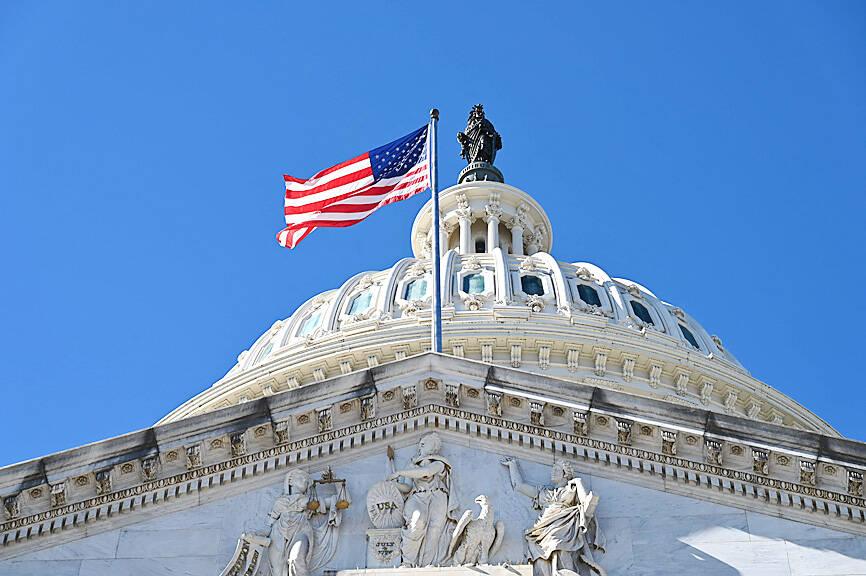
Photo: AFP
"Travel and tourism play a crucial role in a nation's economic security," it said, but added that Taiwan faces "pressure and coercion from the Chinese Communist Party (CCP)" in this sector.
As Taiwan is a "vital trading partner and ally in the Indo-Pacific region," the US must "assist our allies in stabilizing their economies and growing their national industries," the statement said.
Schatz, a member of the Senate Committee on Foreign Relations and representing Hawaii, said the bill would help "unlock more economic opportunities for the people of Taiwan, Hawaii and our entire country."
On the other hand, "the CCP's campaign for global dominance also presents a clear threat to US interests," Blackburn said.
She said the US needs to secure the homeland, and the act would assist in "achieving enhanced security at foreign airports," as it requires the federal government to study the feasibility of establishing a "pre-clearance" facility in Taiwan.
Pre-clearance is the "strategic stationing of [US] Customs and Border Protection personnel at designated foreign airports to inspect travelers prior to boarding US-bound flights," the statement said.
The measure would "enhance security, increase collaboration and streamline travel," the statement said.
The statement also said that there is currently no pre-clearance facility in Asia, despite "an annual average of more than 4 million travelers from the continent."
US lawmakers had pushed for Taiwan's participation in a pre-clearance program in December 2021.
However, then-minister of foreign affairs Joseph Wu (吳釗燮) confirmed in March 2022 that "the US thought Taiwan was too safe, and had to prioritize more dangerous regions."


An essay competition jointly organized by a local writing society and a publisher affiliated with the Chinese Communist Party (CCP) might have contravened the Act Governing Relations Between the People of the Taiwan Area and the Mainland Area (臺灣地區與大陸地區人民關係條例), the Mainland Affairs Council (MAC) said on Thursday. “In this case, the partner organization is clearly an agency under the CCP’s Fujian Provincial Committee,” MAC Deputy Minister and spokesperson Liang Wen-chieh (梁文傑) said at a news briefing in Taipei. “It also involves bringing Taiwanese students to China with all-expenses-paid arrangements to attend award ceremonies and camps,” Liang said. Those two “characteristics” are typically sufficient
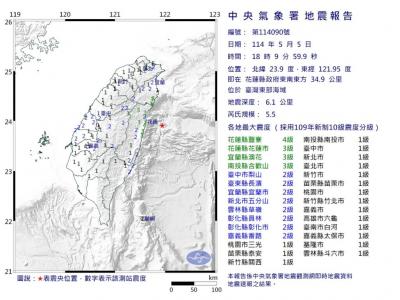
A magnitude 5.9 earthquake that struck about 33km off the coast of Hualien City was the "main shock" in a series of quakes in the area, with aftershocks expected over the next three days, the Central Weather Administration (CWA) said yesterday. Prior to the magnitude 5.9 quake shaking most of Taiwan at 6:53pm yesterday, six other earthquakes stronger than a magnitude of 4, starting with a magnitude 5.5 quake at 6:09pm, occurred in the area. CWA Seismological Center Director Wu Chien-fu (吳健富) confirmed that the quakes were all part of the same series and that the magnitude 5.5 temblor was
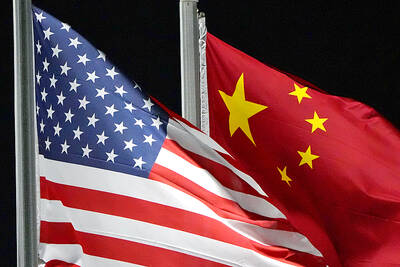
The brilliant blue waters, thick foliage and bucolic atmosphere on this seemingly idyllic archipelago deep in the Pacific Ocean belie the key role it now plays in a titanic geopolitical struggle. Palau is again on the front line as China, and the US and its allies prepare their forces in an intensifying contest for control over the Asia-Pacific region. The democratic nation of just 17,000 people hosts US-controlled airstrips and soon-to-be-completed radar installations that the US military describes as “critical” to monitoring vast swathes of water and airspace. It is also a key piece of the second island chain, a string of
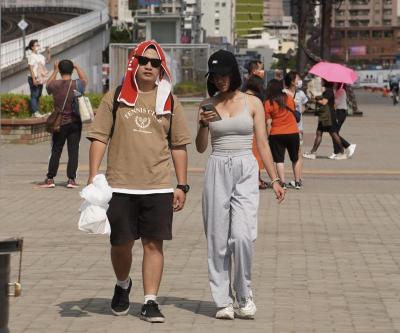
The Central Weather Administration has issued a heat alert for southeastern Taiwan, warning of temperatures as high as 36°C today, while alerting some coastal areas of strong winds later in the day. Kaohsiung’s Neimen District (內門) and Pingtung County’s Neipu Township (內埔) are under an orange heat alert, which warns of temperatures as high as 36°C for three consecutive days, the CWA said, citing southwest winds. The heat would also extend to Tainan’s Nansi (楠西) and Yujing (玉井) districts, as well as Pingtung’s Gaoshu (高樹), Yanpu (鹽埔) and Majia (瑪家) townships, it said, forecasting highs of up to 36°C in those areas


 RSS
RSS