


Prices for group tours to Japan, Europe, the Middle East and North Africa, and New Zealand are expected to rise in the next quarter due to the appreciation of the yen and inflation, a report published yesterday by the Travel Quality Assurance Association (TQAA) showed.
Japan remains the most popular destination for Taiwanese tourists, the association’s Japanese tour specialist Aron Huang (黃清涼) told a news conference in Taipei.
Last year, 6.04 million Taiwanese traveled to Japan, making Taiwan its third-largest source of international tourists, he said.
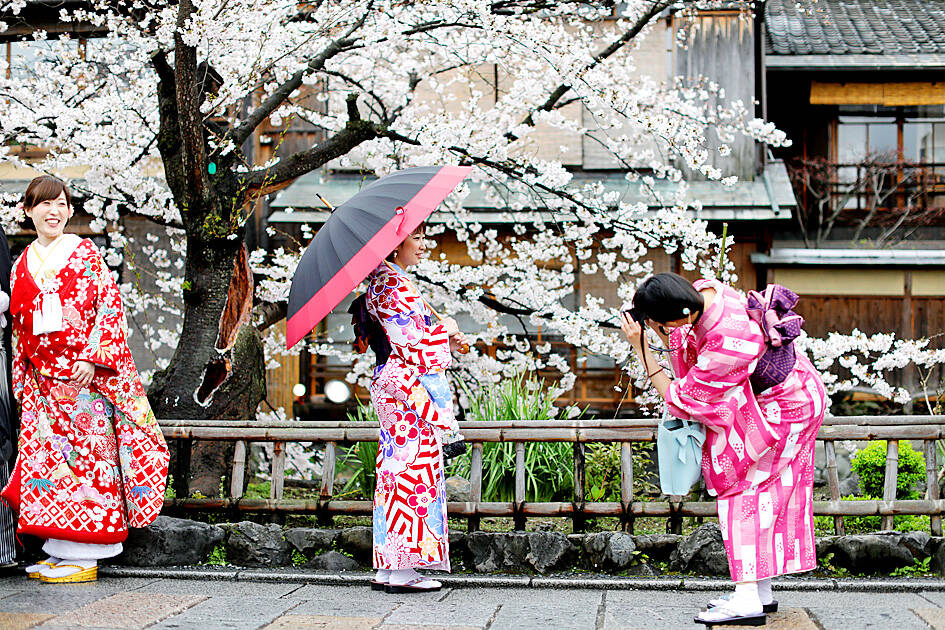
Photo: Reuters
However, tour costs between April and June are expected to rise by about 5 percent compared with the same period last year, after the Bank of Japan on Jan. 24 raised interest rates by 0.25 percentage points to 0.5 percent, Huang said.
Other factors that would push up tour costs include Expo 2025 in Osaka, the cherry blossom season from March 25 to the end of April and the reopening of the Tateyama Kurobe Alpine Route on April 15, he said.
As 25 million tourists from 150 countries are expected to visit the Expo from April 13 to Oct. 13, the cost of tour groups to Osaka and the surrounding area are to rise 10 percent, compared with a 5 percent increase in the rest of the country, he said.
Costs of European tours in the second quarter are expected to rise by 5 to 8 percent due to inflation, an increase in flight ticket prices, a surge in transportation and accommodation costs, and currency changes, TQAA European tour specialist Chen Rong-hsin (陳榮信) said.
However, Europe still has several major events to draw tourists in the next quarter, such as Jubilee 2025 in Rome, tulip season in the Netherlands, the Prague Spring International Music Festival from May 12 to June 3, and lavender season in the south of France and Croatia from mid-June to mid-August, Chen said.
Inflation is also to cause travel costs to the Middle East and North Africa to rise 20 to 30 percent in the second quarter compared with the same period last year, association specialist Chang Wen-wen (張雯雯) said.
Although Turkey has drawn many Taiwanese tourists with direct flights, a pleasant climate, historic sites and relatively lower expenses compared with European countries, inflation in the country was 44.38 percent in December last year, making its consumer price comparable to that of London, she said.
Egypt and other countries have also raised admission fees at tourist destinations, and a staffing shortage in the region has contributed to the rise of costs as well, she added.
Tour costs to New Zealand rose 16 percent, due to increases in airfare and inflation, the association said.
For budget travelers, the report identified Malaysia, Singapore, Thailand, the Philippines and Indonesia as good destinations, as costs to those countries are to rise about 2 percent due to airfare increases, it said, adding that Thailand remains one of Taiwanese tourists favorite destinations, despite reports of scams targeting travelers.
South Korea remains a popular travel destination for Taiwanese, despite the brief implementation of martial law and aviation incidents involving Jeju Air and Air Busan flights, the report said, adding that tour costs would fall 11 percent, as low-cost airlines drop ticket prices.
More Taiwanese are traveling to the US and Canada due to an increase in flights to Seattle, with Yellowstone National Park and the Canadian Rockies expected to be popular this year, it said.
Tour costs to the Americas would rise about 2 to 5 percent due to changes in currency exchange rates, the report said.
Travelers to Canada are advised to visit from April to May, as the G7 Summit is to be held in Alberta’s Kananaskis region from June 15 to June 17, while Calgary is to host the Rotary International Convention from June 22 to June 25, it said.
Travel costs to Australia would fall 2 percent due to relatively lower ticket prices and changes in currency exchange rates, it said.
Domestic travel is also an affordable option, and the World Masters Games in Taipei and New Taipei City from May 17 to May 30 expected to boost the number of international travelers to Taiwan with the participation of 40,000 athletes from 110 countries, the report said.
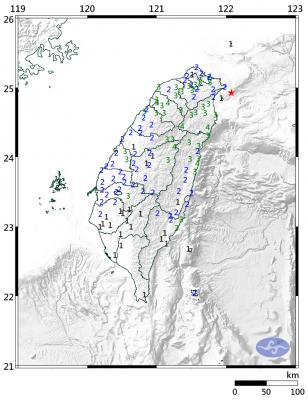
A magnitude 6.1 earthquake struck off the coast of Yilan County at 8:39pm tonight, the Central Weather Administration (CWA) said, with no immediate reports of damage or injuries. The epicenter was 38.7km east-northeast of Yilan County Hall at a focal depth of 98.3km, the CWA’s Seismological Center said. The quake’s maximum intensity, which gauges the actual physical effect of a seismic event, was a level 4 on Taiwan’s 7-tier intensity scale, the center said. That intensity level was recorded in Yilan County’s Nanao Township (南澳), Hsinchu County’s Guansi Township (關西), Nantou County’s Hehuanshan (合歡山) and Hualien County’s Yanliao (鹽寮). An intensity of 3 was
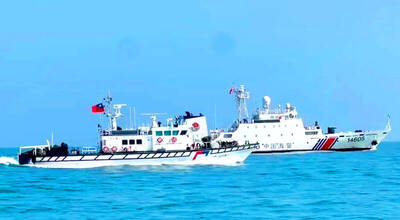
Instead of focusing solely on the threat of a full-scale military invasion, the US and its allies must prepare for a potential Chinese “quarantine” of Taiwan enforced through customs inspections, Stanford University Hoover fellow Eyck Freymann said in a Foreign Affairs article published on Wednesday. China could use various “gray zone” tactics in “reconfiguring the regional and ultimately the global economic order without a war,” said Freymann, who is also a nonresident research fellow at the US Naval War College. China might seize control of Taiwan’s links to the outside world by requiring all flights and ships entering or leaving Taiwan
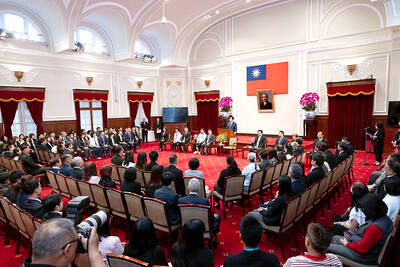
The next minimum wage hike is expected to exceed NT$30,000, President William Lai (賴清德) said yesterday during an award ceremony honoring “model workers,” including migrant workers, at the Presidential Office ahead of Workers’ Day today. Lai said he wished to thank the awardees on behalf of the nation and extend his most sincere respect for their hard work, on which Taiwan’s prosperity has been built. Lai specifically thanked 10 migrant workers selected for the award, saying that although they left their home countries to further their own goals, their efforts have benefited Taiwan as well. The nation’s industrial sector and small businesses lay
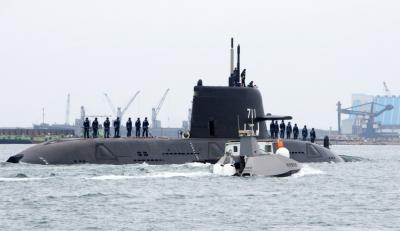
Taiwan's first indigenous defense submarine, the SS-711 Hai Kun (海鯤, or Narwhal), departed for its 13th sea trial at 7am today, marking its seventh submerged test, with delivery to the navy scheduled for July. The outing also marked its first sea deployment since President William Lai (賴清德) boarded the submarine for an inspection on March 19, drawing a crowd of military enthusiasts who gathered to show support. The submarine this morning departed port accompanied by CSBC Corp’s Endeavor Manta (奮進魔鬼魚號) uncrewed surface vessel and a navy M109 assault boat. Amid public interest in key milestones such as torpedo-launching operations and overnight submerged trials,


 RSS
RSS