


For the past 18 years, Rose Tomb (玫瑰墓), an independent band started by an emergency room doctor, has created a unique style of rock music based on real-life stories and struggles.
In response to teenagers struggling with mental health, they performed more than 400 musical lectures in schools in the past four years to positively influence students, and were last year granted the Social Education Contribution Award by the Ministry of Education.
“A ticket to [Taiwanese pop singer] Jay Chou’s (周杰倫) concert can cost NT$6,800 for one night, but the influence of a Rose Tomb performance can last a lifetime,” an audience member said, while another said it was their first time attending a concert where they felt emotional from the first to last song, as the narration and music moved them to tears.
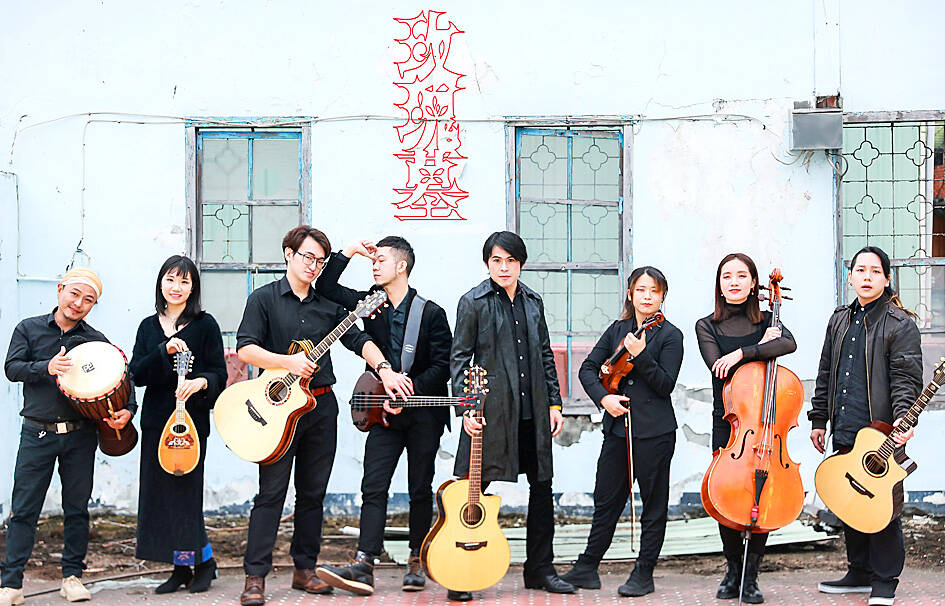
Photo courtesy of Rose Tomb
Other testimonies from audience members include a student who said they overcame a gaming addiction, another who decided not to attempt suicide, and a girl who changed her behavior and sought help from the school counselor.
“The positive and sincere feedback from listeners is what keeps the band going,” said Su Shih-yang (蘇世揚), the band’s lead singer and head of Tainan Municipal Hospital’s emergency department.
Su founded the band more than 18 years ago with five others, combining a diverse set of instruments including acoustic guitars, violins, African drums, piano and more.
Their art combines short stories with music, creating “literary acoustic rock,” Su said, adding that six years ago, the band also published a book that combines prose, poetry and music.
Each of Rose Tomb’s 140 songs is based on a true story, covering real-life topics like aging, illness, child abuse, social issues and anti-drug messaging, he said.
In addition to Su, the band features bassist and vocalist Chou Yi-fan (周逸凡), drummer and vocalist Chao Chia-lin (趙家麟), pianist and violinist Chen Pei-wen (陳沛?), cellist Chuang Chia-yin (莊佳音), guitarist Wang Wei-heng (王偉恒) and guitarist and backing vocalist Chen Hong-dao (陳竑道).
Over the past few years, the performances have expanded to some of Taiwan’s most remote rural areas, all without government funding or official support.
Su said he and his bandmates believe that music is meant to be more than just entertainment, and they hope music can keep hope alive for those who are struggling.
The band’s name is also meaningful.
It is a play on words, with “tomb” in Mandarin Chinese having the same pronunciation as “wood,” so “rosewood tomb” refers to the rosewood used to make the band’s acoustic instruments, Su said.
Second, by using the word “tomb,” the band invokes roses’ short-lived beauty, acknowledging that death is a part of life, he said.
As much of their music addresses topics related to life and death, the band hopes its music encourages people to accept the reality of death and face it without fear, Su said.
In traditional Chinese culture, words related to death can often be taboo to use or say, Su said.
It is necessary to encourage people to look at death’s inevitability with dignity and peace, and to cherish a life lived without regrets, he added.

Fast food chain McDonald's is to raise prices by up to NT$5 on some products at its restaurants across Taiwan, starting on Wednesday next week, the company announced today. The prices of all extra value meals and sharing boxes are to increase by NT$5, while breakfast combos and creamy corn soup would go up by NT$3, the company said in a statement. The price of the main items of those meals, if ordered individually, would remain the same. Meanwhile, the price of a medium-sized lemon iced tea and hot cappuccino would rise by NT$3, extra dipping sauces for chicken nuggets would go up

FUKUOKA SITUATION: Japanese media reported that the pathogen is expected to be identified by the summer, while the CDC downplayed the idea that it was hMPV A “mysterious cold-like illness” reported in Japan’s Fukuoka Prefecture does not seem to be a new disease, but Japanese authorities have been asked about the situation, the Centers for Disease Control (CDC) said yesterday. The Fukuoka Prefectural Medical Association on Wednesday told a news conference that a “mystery cold” that has become a hot topic on social media is “highly likely to be caused by some kind of viral infection,” Japan’s KBC News reported. “Many people are experiencing symptoms starting with a sore throat, followed by a runny nose, phlegm and a severe cough,” KBC News reported, citing association officials. Health authorities are

Nvidia Corp CEO Jensen Huang (黃仁勳) arrived in Taiwan yesterday ahead of upcoming AI and technology events, saying he plans to meet with clients and Taiwan Semiconductor Manufacturing Co Chairman C.C. Wei (魏哲家) during his visit. After landing at Taipei Songshan Airport, Huang posed for photos with fans and handed out Yakult drinks to reporters and supporters waiting at the scene, saying he has “a lot to do” during the trip. Asked about reports that Nvidia’s planned headquarters site in Taipei’s Beitou Shilin Technology Park could break ground on May 27, Huang said that if the company holds an event, he would

Carrefour Taiwan is to begin using a new name from the start of July, but it cannot divulge the name until then, the chairman of the supermarket chain's parent company said today. President Chain Store Co chairman Lo Chih-hsien (羅智先) was asked by reporters after a shareholders' meeting to confirm whether the company has settled on a new name for the supermarket brand. In March, the government-registered name of two Carrefour Taiwan branches was quietly changed to "Le Chia Kang" (樂家康) in Chinese, raising speculation that has been selected as the name. Lo said that because of local regulations and contractual obligations, the


 RSS
RSS