


President William Lai (賴清德) is to hold a meeting of the National Security Council this morning to discuss possible new US tariffs as well as broader relations with the US, two sources familiar with matter said.
The Presidential Office declined to comment, but said it would hold a news conference at 11:30am after a meeting.
The council is made of senior ministers and other officials and is convened to discuss only the most important issues tied to national security.
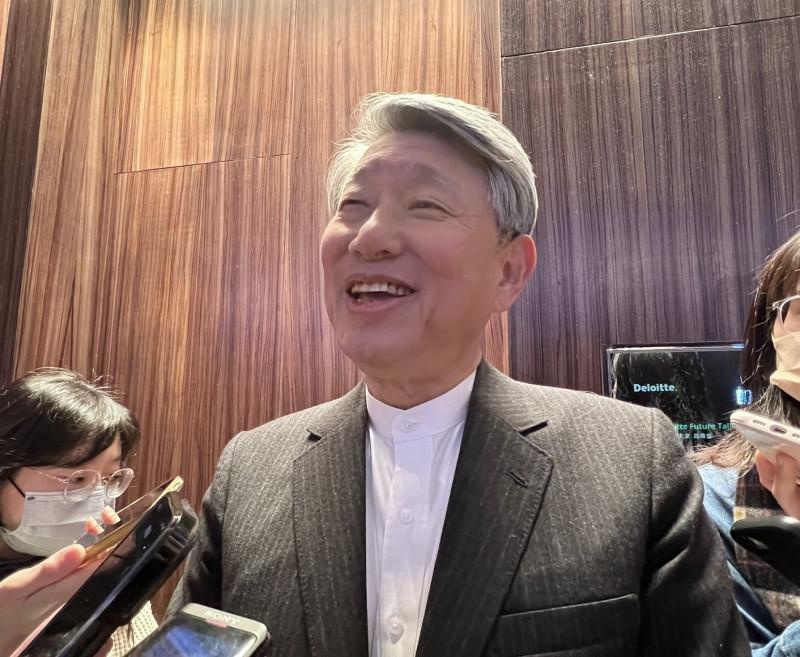
Photo: Lin Ching-hua, Taipei Times
US President Donald Trump spoke critically about Taiwan yesterday, telling reporters at the White House he aimed to restore US manufacturing of semiconductors.
"We have to have chips made in this country. Right now, everything's made in Taiwan practically, almost all of it. A little bit in South Korea," he said.
Trump said US companies had made semiconductors before moving overseas.
"Taiwan took our chip business away," he said. "We had Intel. We have these great companies that did so well and it was taken from us. And we want that business back. We want it back in the US. And if they don't bring it back, we're not going to be very happy."
Minister of Economic Affairs J.W. Kuo (郭智輝) said yesterday that officials from his ministry are currently in Washington on a "routine visit," during which they are to gather information.
With Trump threatening to place a tariff of up to 100 percent on semiconductors produced in Taiwan, Deputy Minister of Economic Affairs Cynthia Kiang (江文若) flew to the US on Tuesday.
Kuo said on Saturday last week that Kiang would meet with Trump's team in an effort to prevent the imposition of tariffs, but did not repeat that claim on Thursday.
Instead, speaking on the sideline of a Taipei forum that day, Kuo told reporters that Kiang has long been responsible for international trade issues and the US trip includes "routine visits" and information-gathering.
Asked if the Ministry of Economic Affairs would communicate with Trump's team to clarify that Taiwan did not "steal the US' chip industry," Kuo did not directly respond, saying only that based on his observation and experience, many people lack an understanding of the history of the semiconductor industry.
Kuo said he would suggest the ministry's International Trade Administration engage more with external parties to enhance their understanding of the chip industry.
Amid uncertainties surrounding US tariff threats, Kuo said that the ministry has established a task force to integrate resources from Taiwan's overseas offices and provide real-time support for Taiwanese businesses abroad.
The ministry also plans to set up an investment and trade service center in the US to assist Taiwanese businesses with supply-chain planning, he added.
In a speech to US Republicans on Jan. 27, Trump said he intended to impose tariffs on Taiwan to bring chip production back to the US.
He claimed that about 98 percent of the chip business went to Taiwan, and "we want them to come back."

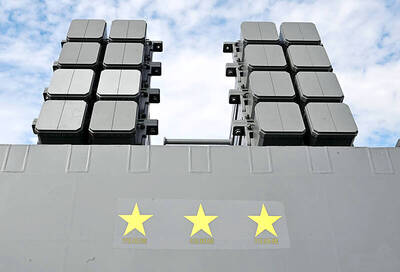
UPGRADE: The Kang Ding-class frigate is replacing its Chaparall missiles with Tien Chien II and Hua Yang VLS, which would provide it with long-range, 360° air defense Taiwan plans to produce 1,200 to 1,376 Hai Chien II missiles (海劍二, Sea Sword II) — also known as TC-2N — to serve as the standard air defense system of the navy’s surface combatant fleet, a source said yesterday. Last week, the Hai Chien II, the naval version of the Tien Kung II missile (天劍二, Sky Sword II), completed a live-fire test in waters off the National Chungshan Institute of Science and Technology’s Jiupeng facility (九鵬) in Pingtung County’s Manjhou Township (滿州). The MIM72 Chaparral and other dated air defense missiles that currently arm Taiwanese ships have inadequate range to combat Chinese

REASONS FOR TRAVEL: An assistant professor said that proposed amendments to penalize drivers if they used drugs overseas would not deter people from traveling People who operate a motor vehicle under the influence of marijuana would have their driver’s license revoked, even if they used the substance while overseas, the Ministry of Transportation and Communications said yesterday, citing proposed amendments to the Road Traffic Management and Penalty Act (道路交通管理處罰條例). The amendments would also authorize the government to revoke the licenses of people determined to have used Category 1 or Category 2 narcotics, even if they were not operating a vehicle while under the influence of drugs, as well as ban them from taking the license test for three years, the ministry said. People aged 18 or
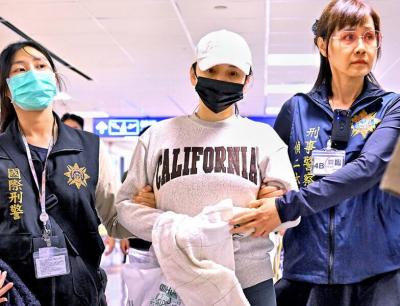
Johanne Liou (劉喬安), a Taiwanese woman who shot to unwanted fame during the Sunflower movement protests in 2014, returned to Taiwan last night after being deported from the US. She is to stand trial in Taiwan for charges involving embezzlement, fraud and drug crimes. The Criminal Investigation Bureau (CIB) said it took her into custody at Taiwan Taoyuan International Airport and would first question her before transferring her to the New Taipei District Prosecutors’ Office. She was arrested upon disembarking a flight from San Francisco that landed shortly before 7pm. Liou absconded to the US in 2019 after jumping bail
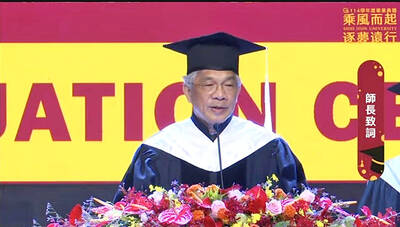
Shih Hsin University President Chen Ching-he (陳清河) yesterday issued a public apology for comments made in his commencement speech last week, stating that he has asked the school to suspend his duties and halt his wages for two months as a show of contrition. At the commencement ceremony on May 30, Chen said, “If you don’t manage your time well, or your own emotions, or your health, then I am telling every one of you — put a quick end to ‘you,’ because the world has no need for ‘you.’” The comments have sparked significant controversy online, and Chen through an open


 RSS
RSS