


A member of the navy’s 168th Fleet was found to have a Chinese ID, sources from the Ministry of Justice Investigation Bureau (MJIB) said yesterday.
The MJIB found that the mother of the serviceman, surnamed Yang (楊), is Chinese, and had applied for Chinese ID cards for him and his elder sister while in China, sources said.
When their ID cards expired in 2022, she applied again and asked him not to tell others, they said.
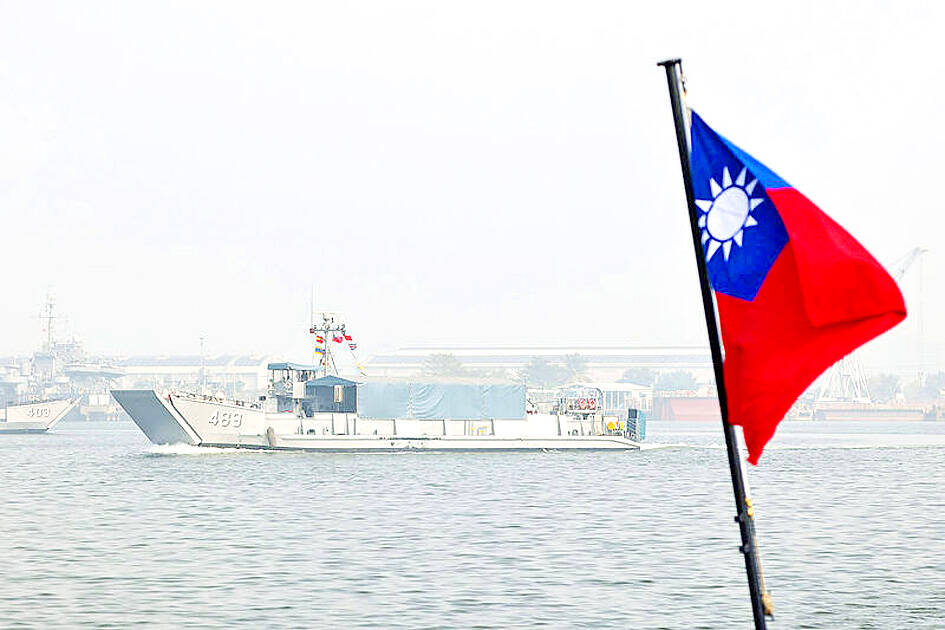
Photo: Ann Wang, Reuters
The MJIB is handling the case in accordance with the Act Governing the Relations Between People of the Taiwan Area and the Mainland Area (台灣地區與大陸地區人民關係條例), they added.
The bureau has asked the National Immigration Agency to investigate the matter.
Holding a Chinese ID card is not only against the law, but also puts national security at risk, the bureau said.
Taiwanese found to have Chinese IDs or household registrations would be investigated by the Ministry of the Interior, it said.
The ministry is investigating more than 30 people for holding Chinese ID cards, Minister of the Interior Liu Shyh-fang (劉世芳) said earlier this month.
A Taiwanese citizen who has a household registration in China or holds a Chinese passport or ID card would have their Taiwanese household registration canceled in accordance with the law.
They would consequently lose their civil rights in Taiwan, including the right to vote and benefits such as National Health Insurance.
A source, who asked to be anonymous, said given that about 150,000 of the more than 380,000 Chinese married to a Taiwanese have obtained Taiwanese IDs, there must have been more who have applied for Chinese IDs for their children.
“A cockroach spotted in the light means more are hiding in the dark,” they said.
The Mainland Affairs Council yesterday said it has asked government agencies to reiterate that active members of the military, education and public services cannot have household registrations in China or apply for Chinese ID cards, permanent residence cards or residence permits.
The government will administer punishment according to the law if they are confirmed to have contravened the law after an investigation, it said.
Asked whether a serviceman suspected of holding a Chinese ID card like Yang would be stripped of his citizenship, the council said the case was disclosed by the news media, but the Ministry of National Defense has yet to carry out an administrative investigation.
The results of the investigation would be discussed with concerned authorities before further steps are taken, it added.
Taiwan Thinktank researcher Wu Se-chih (吳瑟致) said that military personnel who hold Chinese IDs pose a great risk to national security.
The children of Chinese spouses and other family members who are serving in the military or other public services cannot hold Chinese citizenship, as Beijing is an enemy state that wants to invade Taiwan, he said.
If the said serviceman involuntarily possesses a Chinese ID card that was obtained by his family, he should submit documents relinquishing his Chinese citizenship, he said.
The government should thoroughly examine whether Chinese spouses applying for Chinese ID cards is a single case or a widespread problem, as well as their motives, he added.
“Serving soldiers possessing Chinese citizenship is absolutely intolerable,” Wu said.
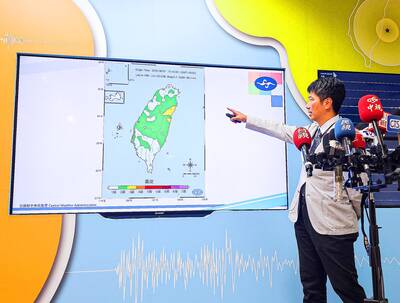
Aftershocks from a magnitude 6.2 earthquake that struck off Yilan County at 3:45pm yesterday could reach a magnitude of 5 to 5.5, the Central Weather Administration (CWA) said. Seismological Center technical officer Chiu Chun-ta (邱俊達) told a news conference that the epicenter of the temblor was more than 100km from Taiwan. Although predicted to measure between magnitude 5 and 5.5, the aftershocks would reach an intensity of 1 on Taiwan’s 7-tier scale, which gauges the actual effect of an earthquake, he said. The earthquake lasted longer in Taipei because the city is in a basin, he said. The quake’s epicenter was about 128.9km east-southeast

The Taipei Summer Festival is to begin tomorrow at Dadaocheng Wharf (大稻埕), featuring four themed firework shows and five live music performances throughout the month, the Taipei Department of Information and Tourism said today. The festival in the city’s Datong District (大同) is to run until Aug. 30, holding firework displays on Wednesdays and the final Saturday of the event. The first show is scheduled for tomorrow, followed by Aug. 13, 20 and 30. To celebrate the 30th anniversary of Disney Pixar's movie Toy Story, the festival has partnered with Walt Disney Co (Taiwan) to host a special themed area on

BE CAREFUL: The virus rarely causes severe illness or death, but newborns, older people and those with medical conditions are at risk of more severe illness As more than 7,000 cases of chikungunya fever have been reported in China’s Guangdong Province this year, including 2,892 new cases last week, the Centers for Disease Control (CDC) yesterday said it is monitoring the situation and considering raising the travel notice level, which might be announced today. The CDC issued a level 1 travel notice, or “watch,” for Guangdong Province on July 22, citing an outbreak in Foshan, a manufacturing hub in the south of the province, that was reported early last month. Between July 27 and Saturday, the province reported 2,892 new cases of chikungunya, reaching a total of 7,716

The New Taipei City Government today warned about the often-overlooked dangers of playing in water, and recommended safe swimming destinations to cool off from the summer heat. The following locations in the city as safe and fun for those looking to enjoy the water: Chienshuiwan (淺水灣), Baishawan (白沙灣), Jhongjiao Bay (中角灣), Fulong Beach Resort (福隆海水浴場) and Sansia District’s (三峽) Dabao River (大豹溪), New Taipei City Tourism and Travel Department Director-General Yang Tsung-min (楊宗珉) said. Outdoor bodies of water have variables outside of human control, such as changing currents, differing elevations and environmental hazards, all of which can lead to accidents, Yang said. Sudden


 RSS
RSS