

Taipei public high schools have not properly implemented a gender-friendly restroom mandate seven years after its promulgation, a coalition of groups said yesterday, urging the Taipei City Government to act.
The Taiwan LGBTQ+ Hotline Association, the Taiwan Gender Equity Education Association and the Taiwan Alliance to Promote Civil Partnership Rights were among the groups who jointly held a news conference at the National Taiwan University in Taipei.
The Taipei Department of Education in 2017 promulgated a pilot program to install gender-friendly restrooms — unisex, gender-neutral facilities — at the schools in its jurisdiction.
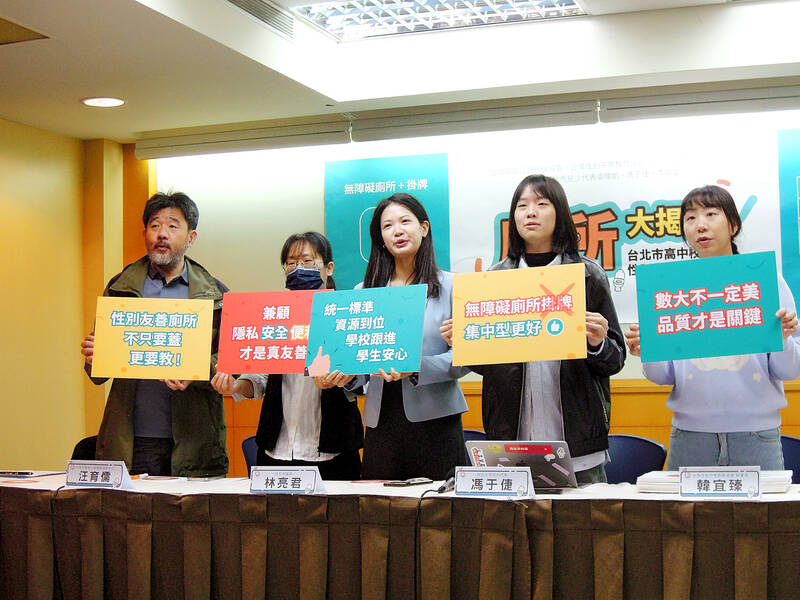
Photo: CNA
Forty-five high schools, or 61.6 percent, claim to have unisex restrooms, short of the goal of one gender-friendly restroom for every school set by the city government, the groups said.
Three out of 11 schools inspected last year by volunteer students claimed to have built unisex restrooms where none existed, they said.
The remaining eight schools had 30 designated gender-friendly restrooms, but only four met the definition of the term, which is being furnished with both sitting or squatting toilets and urinals, the groups said.
The remaining 26 unisex restrooms were reflagged as accessible toilets, inadvertently displacing students with disabilities from the only facility they could use, League for Persons with Disabilities member Wang Yu-ju (汪育儒) said.
Lines would form outside the unisex restroom as students had to use what little time they had between classes to relieve themselves, he said.
The few properly equipped unisex restrooms utilized less-than-ideal designs that offered little privacy, former children and youth representative Fong Yu-chieh (馮于倢) said, citing inadequate barriers between urinals.
Gender-friendly restrooms should be installed in municipal offices as well and related signage should be standardized, Democratic Progressive Party Taipei City Councilor Lin Liang-jyun (林亮君) said.

Minister of Sports Lee Yang (李洋) today said the Chinese Taipei Basketball Association (CTBA) has been urged not to undermine Taiwan’s credibility in international competitions, after a Taiwanese team advanced to the semi-finals of the 45th William Jones Cup over the Philippines last week due to a controversial new rule guaranteeing a semi-final place to the host team. The Republic of China Blue team advanced to the semi-finals after winning just one game in the group round due to a “host guarantee” spot, overtaking the Philippines, who held a 5-1 record ahead of the semi-finals. The Blue team finished the tournament
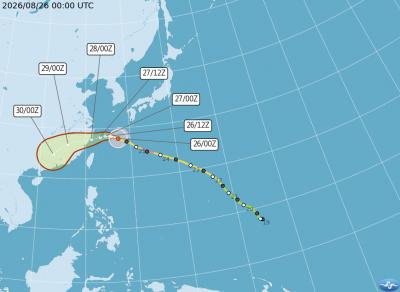
A sea warning for Typhoon Saudel, which has shifted to a more northerly track as it nears Taiwan, is expected early tomorrow, the Central Weather Administration (CWA) said today. As of this morning, Saudel was about 650km east-northeast of Taipei, moving west-northwest at 12kph with maximum sustained winds of 162kph, CWA data showed. Although Saudel remains a moderate typhoon, it has weakened and is expected to weaken further as it nears Taiwan due to unfavorable atmospheric and ocean conditions, CWA forecaster Lin Po-tung (林伯東) said. The storm is forecast to make its closest approach to Taiwan tomorrow and on Friday, Lin added. According to
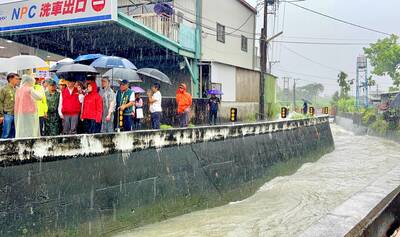
SEA WARNING EXPECTED: As atmospheric conditions are unfavorable for its development, the storm’s intensity is continuing to weaken, a CWA official said Typhoon Saudel is continuing to weaken and shift its path northward, with a sea warning expected to be issued this evening, the Central Weather Administration (CWA) said yesterday. The agency did not rule out issuing a land warning for outlying Lienchiang County (Matsu) tomorrow morning, although all storm warnings could be lifted by Friday night. Saudel is expected to be closest to Taiwan from tomorrow night to Friday, bringing localized heavy rain to northern and southern Taiwan, as well as central mountainous areas, the agency said. As of 2pm yesterday, the center of moderate Typhoon Saudel was about 890km east-northeast
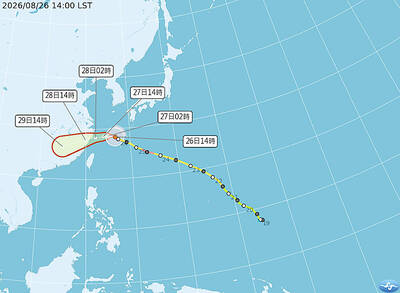
MODERATE TYPHOON: Localized heavy rain is forecast to hit central and southern Taiwan, the CWA said, adding that the storm would likely move away on Saturday A sea warning for Typhoon Saudel, which shifted to a more northerly track as it approached Taiwan, is likely early today, the Central Weather Administration (CWA) said yesterday. As of 2pm yesterday, the center of typhoon was about 630km northeast of Taipei, moving west-northwest at 14kph with maximum wind gusts of up to 162kph, CWA data showed. Saudel is a moderate typhoon and is expected to weaken as it nears Taiwan due to atmospheric and ocean conditions, CWA forecaster Lin Po-tung (林伯東) said. A sea warning indicates hazardous typhoon conditions in waters surrounding Taiwan within 24 hours, Lin said. The storm is forecast to


 RSS
RSS