


The Central Election Commission (CEC) has demanded an explanation from local authorities in Hualien County after personnel from the county’s Household Registration Office allegedly broke the law by visiting the residences of voters who lawfully engaged in recall vote activism.
The CEC said yesterday that the Hualien County Election Committee is empowered to work alongside the county’s Household Registration Office to verify the signatures of individuals who have signed recall vote proposals by post, according to the "Regulations for Collecting and Checking Joint Signatures for the Recall Proposal of Civil Servants."
However, visits by local government personnel to the residences of signatories would be considered illegal, it said.
Photo: Lee Wen-hsin, Taipei Times
The CEC has called on the Hualien County Election Committee to explain how the recall vote proposal list that it sent to the committee was handled.
Fu, a Chinese Nationalist Party (KMT) lawmaker representing Hualien County, may face an election recall vote after campaigners submitted the recall vote proposal -- which includes the names, addresses and signatures of at least 1 percent of voters in Hualien -- to the central election authority in Taipei on Monday.
The campaigners are attempting to oust their representative in the Legislative Yuan through provisions in the Public Officials Election and Recall Act (公職人員選舉罷免法), which states that lawmakers shall be removed from office if more than half of at least 25 percent of eligible voters in their electoral district cast ballots in favor of a recall, and if the ballots in favor of the recall outnumber those opposing he recall.
Hu Jen-shun (胡仁順), a Democratic Progressive Party (DPP) county councilor, said he received complaints from residents who said they had felt intimidated when Household Registration Office personnel came to their homes.
Hu said the office’s actions would represent a "serious infringement of citizens’ rights" and called on civil servants not to "help Fu Kun-chi do anything illegal."
Later yesterday afternoon, the director of the Hualien County Election Committee, Wu Chun-yi (吳俊毅), said the Hualien County Household Registration official who was photographed visiting resident’s houses said she was "investigating household registration information" and not asking about signatures on the recall vote proposal.
According to the CEC website, once the signatures on a recall vote proposal have been validated, campaigners must then collect signatures from at least 10 percent of eligible voters within 60 days before a recall vote may take place.

AGING: While Japan has 22 submarines, Taiwan only operates four, two of which were commissioned by the US in 1945 and 1946, and transferred to Taiwan in 1973 Taiwan would need at least 12 submarines to reach modern fleet capabilities, CSBC Corp, Taiwan chairman Chen Cheng-hung (陳政宏) said in an interview broadcast on Friday, citing a US assessment. CSBC is testing the nation’s first indigenous defense submarine, the Hai Kun (海鯤, Narwhal), which is scheduled to be delivered to the navy next month or in July. The Hai Kun has completed torpedo-firing tests and is scheduled to undergo overnight sea trials, Chen said on an SET TV military affairs program. Taiwan would require at least 12 submarines to establish a modern submarine force after assessing the nation’s operational environment and defense

A white king snake that frightened passengers and caused a stir on a Taipei MRT train on Friday evening has been claimed by its owner, who would be fined, Taipei Rapid Transit Corp (TRTC) said yesterday. A person on Threads posted that he thought he was lucky to find an empty row of seats on Friday after boarding a train on the Bannan (Blue) Line, only to spot a white snake with black stripes after sitting down. Startled, he jumped up, he wrote, describing the encounter as “terrifying.” “Taipei’s rat control plan: Release snakes on the metro,” one person wrote in reply, referring

The coast guard today said that it had disrupted "illegal" operations by a Chinese research ship in waters close to the nation and driven it away, part of what Taipei sees a provocative pattern of China's stepped up maritime activities. The coast guard said that it on Thursday last week detected the Chinese ship Tongji (同濟號), which was commissioned only last year, 29 nautical miles (54km) southeast of the southern tip of Taiwan, although just outside restricted waters. The ship was observed lowering ropes into the water, suspected to be the deployment of scientific instruments for "illegal" survey operations, and the coast
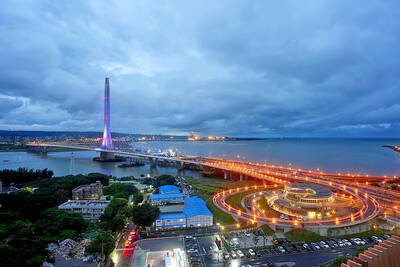
An inauguration ceremony was held yesterday for the Danjiang Bridge, the world’s longest single-mast asymmetric cable-stayed bridge, ahead of its official opening to traffic on Tuesday, marking a major milestone after nearly three decades of planning and construction. At the ceremony in New Taipei City attended by President William Lai (賴清德), Premier Cho Jung-tai (卓榮泰), Minister of Transportation and Communications Chen Shih-kai (陳世凱) and New Taipei City Mayor Hou Yu-ih (侯友宜), the bridge was hailed as both an engineering landmark and a long-awaited regional transport link connecting Tamsui (淡水) and Bali (八里)


 RSS
RSS