


The Kaohsiung City Fire Department’s Special Search and Rescue Team rescue dog Roger is to retire and become a “dog drillmaster” to teach canine recruits how to climb stairs and bark.
Roger has brought recognition to the team with his performance in search-and-rescue efforts following the Hualien earthquake on April 3 last year. He is also featured in the department’s monthly calendar for this year.
The department said that dogs aged 18 months or older that have passed the International Search and Rescue Dog Organisation’s intermediate-level test are eligible to work as a rescue dog.

Photo courtesy of the Kaohsiung City Fire Department
Most rescue dogs are trained from two or three months old to become socialized and learn to follow commands, it said.
They must become familiar with search-and-rescue scenarios and receive training on search, obedience and agility, it added.
Training rescue dogs takes years, with most dogs passing the test when they are three to four years old, it said.
Dogs with an appetite for play and food are usually selected, as they can be guided to complete tasks using such incentives, Kaohsiung Rescue Dog Training Center team leader Chen Chih-san (陳志三) said.
Dogs who are independent, adventurous and not shy of strangers also have the potential to be rescue dogs, he said, adding that breeds with high learning aptitude such as Labrador Retrievers or German Shepherds are usually prioritized.
Each rescue dog has their own handler to manage the training and care for them, Chen said.
“Dog drillmasters” play a key role in training, as young recruits can learn faster from senior rescue dogs, he said.
In Kaohsiung, Roger, Danpachi and Zoe are all veterans qualified as dog drillmasters, he said.
Other animals such as chickens, ducks, geese, pigs or cows are also indispensable “teaching assistants,” which can function as interference that rescue dogs must learn to tolerate and recognize, he said.
They must distinguish between the smells of humans and those of wild animals when working in natural environments or disaster sites, Chen said.
The center’s dog handler, Su Kuan-ming (蘇冠銘), said that handlers break search-and-rescue skills and other duties down into small tasks for rescue dogs to cultivate in daily life.
For example, they must follow commands to retrieve meals, and can learn to run, search for missing objects, or move along unusual terrain such as tunnels, unstable ground, horizontal ladders, swaying platforms and single-log bridges while playing games, he said.
The most important thing for rescue dogs to do is to bark loudly when locating a target object, he said, adding that dog drillmasters can guide rookies in learning such skills.
To help rescue dogs adapt to sounds and unexpected situations, handlers fire air pistols or make noises from afar during training, Su said.
Rescue dogs also go on field trips to traditional markets to learn to ignore smells unrelated to their tasks, he added.

Actor Darren Wang (王大陸) was sentenced to six months in prison, commutable to a fine, by the New Taipei District Court today for contravening the Personal Data Protection Act (個人資料保護法) in a case linked to an alleged draft-dodging scheme. Wang allegedly paid NT$3.6 million (US$114,380) to an illegal group to help him evade mandatory military service through falsified medical documents, prosecutors said. He transferred the funds to Chen Chih-ming (陳志明), the alleged mastermind of a draft-evasion ring, although he lost contact with him as he was already in detention on fraud charges, they said. Chen is accused of helping a

SECURITY: Starlink owner Elon Musk has taken pro-Beijing positions, and allowing pro-China companies to control Taiwan’s critical infrastructure is risky, a legislator said Starlink was reluctant to offer services in Taiwan because of the nation’s extremely high penetration rates in 4G and 5G services, the Ministry of Digital Affairs said yesterday. The ministry made the comments at a meeting of the legislature’s Transportation Committee, which reviewed amendments to Article 36 of the Telecommunications Management Act (電信管理法). Article 36 bans foreigners from holding more than 49 percent of shares in public telecommunications networks, while shares foreigners directly and indirectly hold are also capped at 60 percent of the total, unless specified otherwise by law. The amendments, sponsored by Chinese Nationalist Party (KMT) Legislator Ko

The eastern extension of the Taipei MRT Red Line could begin operations as early as late June, the Taipei Department of Rapid Transit Systems said yesterday. Taipei Rapid Transit Corp said it is considering offering one month of free rides on the new section to mark its opening. Construction progress on the 1.4km extension, which is to run from the current terminal Xiangshan Station to a new eastern terminal, Guangci/Fengtian Temple Station, was 90.6 percent complete by the end of last month, the department said in a report to the Taipei City Council's Transportation Committee. While construction began in October 2016 with an
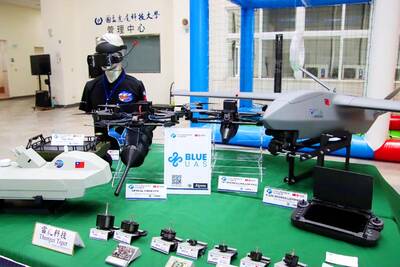
NON-RED SUPPLY: Boosting the nation’s drone industry is becoming increasingly urgent as China’s UAV dominance could become an issue in a crisis, an analyst said Taiwan’s drone exports to Europe grew 41.7-fold from 2024 to last year, with demand from Ukraine’s fight against Russian aggression the most likely driver of growth, a study showed. The Institute for Democracy, Society and Emerging Technology (DSET) in a statement on Wednesday said it found that many of Taiwan’s uncrewed aerial vehicle (UAV) sales were from Poland and the Czech Republic. These countries likely transferred the drones to Ukraine to aid it in its fight against the Russian invasion that started in 2022, it said. Despite the gains, Taiwan is not the dominant drone exporter to these markets, ranking second and fourth


 RSS
RSS