


Three people have had their citizenship revoked after authorities confirmed that they hold Chinese ID cards, Mainland Affairs Council (MAC) Deputy Minister and spokesman Liang Wen-chieh (梁文傑) said yesterday.
Two of the three people were featured in a recent video about Beijing’s “united front” tactics by YouTuber Pa Chiung (八炯) and Taiwanese rapper Chen Po-yuan (陳柏源), including Su Shi-en (蘇士恩), who displayed a Chinese ID card in the video, and taekwondo athlete Lee Tung-hsien (李東憲), who mentioned he had obtained a Chinese ID card in a telephone call with Chen, Liang told the council’s weekly news conference.
Lee, who reportedly worked in China for a long time and joined the Chinese Communist Party (CCP) on July 1, 2022, displayed a Chinese flag after winning a bronze medal at the Asia-Pacific Masters Games in South Korea in 2023, saying that he was proud to be Chinese.
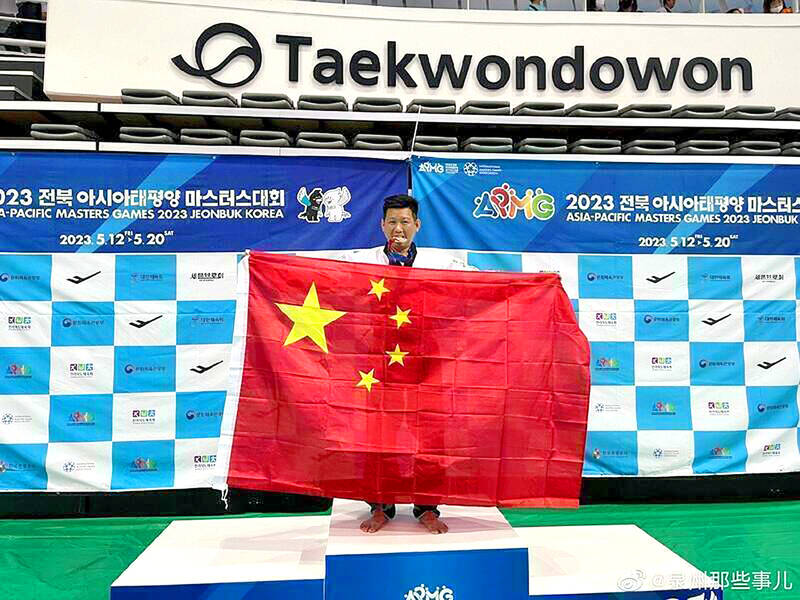
Photo: Screen grab from Weibo
The council did not reveal the identity of the third person.
More than 10 people have been reported for obtaining a Chinese ID card, Liang said, adding that the public should contact the authorities if they have information.
Taiwanese would be treated as Chinese nationals if their citizenship is revoked, Liang said, adding that they would have to apply for a permit if they want to come back to Taiwan and would not be allowed to use the National Health Insurance.
Article 9-1 of the Act Governing Relations Between the People of the Taiwan Area and the Mainland Area (兩岸人民關係條例) bans Taiwanese from having Chinese passports or a registered household in China. Anyone who contravenes this act would have their Taiwanese household registration, ID card and passport invalidated.
Over the past 10 years, 679 Taiwanese have had their paperwork invalidated after they obtained a Chinese passport or household registration, MAC Minister Chiu Chui-cheng (邱垂正) said previously.
Meanwhile, Liang said that a nearly 40 percent reduction in the agency’s budget would mean that the hotline for travelers to China, Hong Kong and Macau would no longer be be available around the clock.
Promotional efforts for citizens visiting China to register themselves under the government’s emergency aid program would also be halted, Liang said.
The budget cuts would reduce travel subsidies and make it difficult for council officials to visit Taiwan’s Hong Kong Office or bring employees to Taiwan for further training, Liang said.
The cuts would also mean that assistance for democracy supporters overseas would also diminish, Liang said.
According to Liang, the council’s administrative fees were already on the meager side, with a budget totaling NT$280 million (US$8.54 million).
Additional cuts by the Legislative Yuan’s Internal Administration Committee of NT$32 million, after earlier cuts of NT$88.31 million, have wiped out nearly 40 percent of the agency’s administrative budget, Liang said.
The council often compiles reports on the economy and the CCP’s political situation, and conducts seminars, forums and polls, he said.
These activities would be significantly reduced, Liang said.
Subsidies for the children of Taiwanese in China to return to Taiwan during summer and winter vacations would also be rolled back, he added.
Additional reporting by Lee Wen-hsin,
Sam Garcia and Shelley Shan
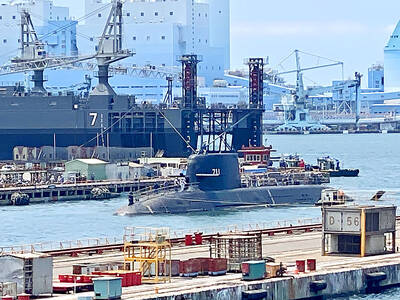
AGING: While Japan has 22 submarines, Taiwan only operates four, two of which were commissioned by the US in 1945 and 1946, and transferred to Taiwan in 1973 Taiwan would need at least 12 submarines to reach modern fleet capabilities, CSBC Corp, Taiwan chairman Chen Cheng-hung (陳政宏) said in an interview broadcast on Friday, citing a US assessment. CSBC is testing the nation’s first indigenous defense submarine, the Hai Kun (海鯤, Narwhal), which is scheduled to be delivered to the navy next month or in July. The Hai Kun has completed torpedo-firing tests and is scheduled to undergo overnight sea trials, Chen said on an SET TV military affairs program. Taiwan would require at least 12 submarines to establish a modern submarine force after assessing the nation’s operational environment and defense

Yangmingshan National Park authorities yesterday urged visitors to respect public spaces and obey the law after a couple was caught on a camera livestream having sex at the park’s Qingtiangang (擎天崗) earlier in the day. The Shilin Police Precinct in Taipei said it has identified a suspect and his vehicle registration number, and would summon him for questioning. The case would be handled in accordance with public indecency charges, it added. The couple entered the park at about 11pm on Thursday and began fooling around by 1am yesterday, the police said, adding that the two were unaware of the park’s all-day live
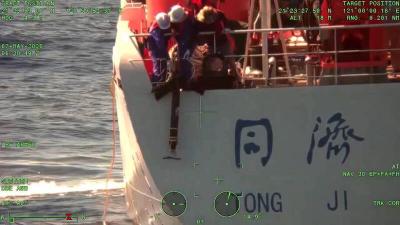
The coast guard today said that it had disrupted "illegal" operations by a Chinese research ship in waters close to the nation and driven it away, part of what Taipei sees a provocative pattern of China's stepped up maritime activities. The coast guard said that it on Thursday last week detected the Chinese ship Tongji (同濟號), which was commissioned only last year, 29 nautical miles (54km) southeast of the southern tip of Taiwan, although just outside restricted waters. The ship was observed lowering ropes into the water, suspected to be the deployment of scientific instruments for "illegal" survey operations, and the coast

A former soldier and an active-duty army officer were yesterday indicted for allegedly selling classified military training materials to a Chinese intelligence operative for a total of NT$79,440. The Taipei District Prosecutors’ Office indicted Chen Tai-yin (陳泰尹) and Lee Chun-ta (李俊達) for contravening the National Security Act (國家安全法) and the Anti-Corruption Act (貪污治罪條例). Chen left the military in September 2013 after serving alongside then-staff sergeant Lee, now an army lieutenant, at the 21st Artillery Command of the army’s Sixth Corps from 2011 to 2013, according to the indictment. Chen met a Chinese intelligence operative identified as “Wang” (王) through a friend in November


 RSS
RSS