


The Institute for National Defense and Security Research (INDSR) on Saturday said that the best tactic to counter potential Chinese amphibious warfare using barges would be to cut off their sea-supply lines.
China has in recent years been manufacturing military-standard barges that are widely believed to be used in an amphibious attack to break through Taiwan proper’s line of defense at “red beaches”— beaches that are most suitable for landing operations.
Satellite imagery from foreign news media shows the latest development of China’s amphibious assault vessel at a shipyard in Guangzhou, which is a roll-off ship connected to a barge with enhanced pillars on it.
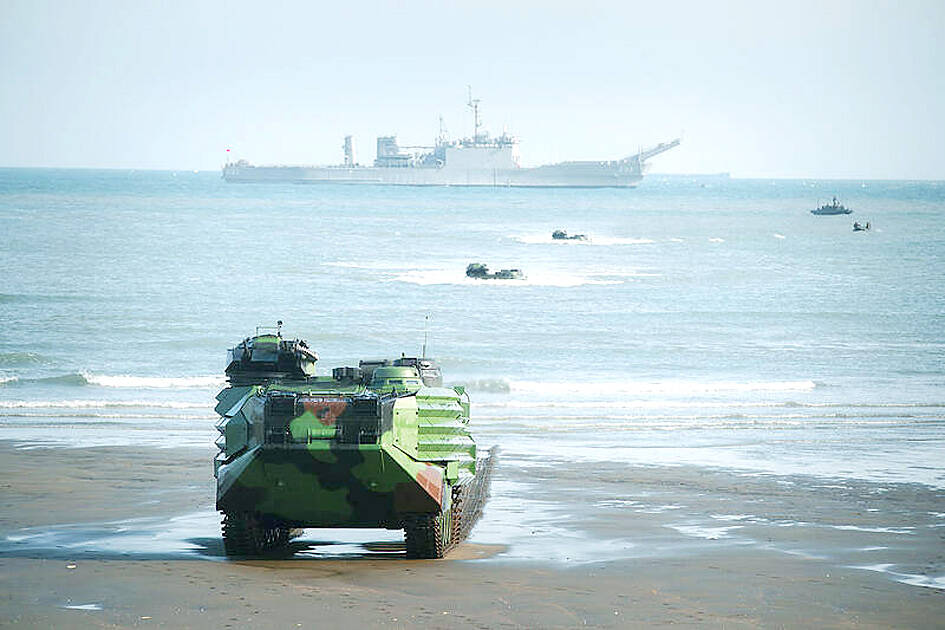
Photo: CNA
There is also a built-in road bridge that can be extended up to about 130m, the satellite imagery shows.
The Web site Naval News on Jan. 10 published an article saying that “the barge would act as a pier to allow the unloading of trucks and tanks from cargo ships.”
According to the institute’s previous evaluation, the transport capacity of such modified barges would be restricted by the complexity of amphibious operations under tough circumstances.
Cutting off sea-supply lines would be the optimal asymmetric warfare tactic, as the enemy’s first batch of landing troops would soon lose their combat capability, said the INDSR, which is affiliated with the Ministry of National Defense.
An analysis report from the Naval War College’s China Maritime Studies Institute said that Beijing has been providing technical guidelines to domestic shipyards since about a decade ago, with the aim of upgrading a large number of civilian ships to military standards.
Ray Powell, leader of Project Myoushu (South China Sea) at Stanford University, said that civilian roll-off ships are not ideal for amphibious operations, but they could still be used to transport troops at a large scale once Taiwan’s coastal defense is paralyzed.
The INDSR in a report published in 2023 said that the Chinese People’s Liberation Army (PLA) would need to construct a curved, three-dimensional landing field that consists of the red beach, seaports and airports, if Beijing decides to initiate an amphibious attack.
However, the circumstances for the PLA to cross the Taiwan Strait and engage in amphibious landing remain difficult, and their military vessels and civilian ships are not capable of transporting enough troops and supplies, the report said.
Therefore, cutting off the PLA’s sea-supply lines would be an effective tactic, it said, adding Taiwan should nevertheless be aware that the PLA has made progress in adapting civilian ships to amphibious warfare.

More than half of the bamboo vipers captured in Tainan in the past few years were found in the city’s Sinhua District (新化), while other districts had smaller catches or none at all. Every year, Tainan captures about 6,000 snakes which have made their way into people’s homes. Of the six major venomous snakes in Taiwan, the cobra, the many-banded krait, the brown-spotted pit viper and the bamboo viper are the most frequently captured. The high concentration of bamboo vipers captured in Sinhua District is puzzling. Tainan Agriculture Bureau Forestry and Nature Conservation Division head Chu Chien-ming (朱健明) earlier this week said that the

NAMING SPAT: The foreign ministry called on Denmark to propose an acceptable solution to the erroneous nationality used for Taiwanese on residence permits Taiwan has revoked some privileges for Danish diplomatic staff over a Danish permit that lists “Taiwan” as “China,” Eric Huang (黃鈞耀), head of the Ministry of Foreign Affairs’ Department of European Affairs, told a news conference in Taipei yesterday. Reporters asked Huang whether the Danish government had responded to the ministry’s request that it correct the nationality on Danish residence permits of Taiwanese, which has been listed as “China” since 2024. Taiwan’s representative office in Denmark continues to communicate with the Danish government, and the ministry has revoked some privileges previously granted to Danish representatives in Taiwan and would continue to review
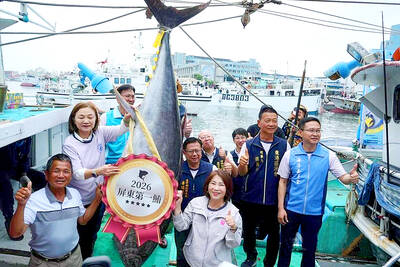
The first bluefin tuna of the season, brought to shore in Pingtung County and weighing 190kg, was yesterday auctioned for NT$10,600 (US$333.5) per kilogram, setting a record high for the local market. The auction was held at the fish market in Donggang Fishing Harbor, where the Siaoliouciou Island-registered fishing vessel Fu Yu Ching No. 2 delivered the “Pingtung First Tuna” it had caught for bidding. Bidding was intense, and the tuna was ultimately jointly purchased by a local restaurant and a local company for NT$10,600 per kilogram — NT$300 ,more than last year — for a total of NT$2.014 million. The 67-year-old skipper

BREACH OF CONTRACT: The bus operators would seek compensation and have demanded that the manufacturer replace the chips with ones that meet regulations Two bus operators found to be using buses with China-made chips are to demand that the original manufacturers replace the systems and provide compensation for breach of contract, the Veterans Affairs Council said yesterday. Democratic Progressive Party Legislator Michelle Lin (林楚茵) yesterday said that Da Nan Bus Co and Shin-Shin Bus Co Ltd have fielded a total of 82 buses that are using Chinese chips. The bus models were made by Tron-E, while the systems provider was CYE Electronics, Lin said. Lin alleged that the buses were using chips manufactured by Huawei subsidiary HiSilicon Co, which presents a national security risk if the


 RSS
RSS