


The Ministry of National Defense earlier this week said that it has proposed pay rises for volunteer enlistees amid reports of a fourfold increase in military personnel opting out of their contracts early.
The ministry’s comments came following a report in the Chinese-language United Daily News that 1,565 voluntary military personnel left the armed forces last year by invoking an opt-out clause introduced in 2009 and paying a financial penalty, compared with 401 in 2020.
With the departures, the number of serving volunteer military personnel in Taiwan stood at 152,885 in June last year, the lowest since 2018, the ministry said.
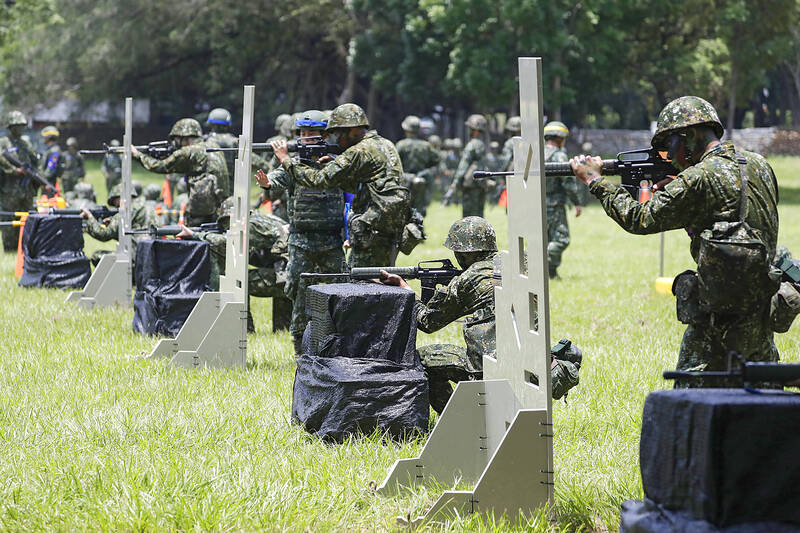
Photo: Chiang Ying-ying, AP
Major General Kao Chih-hsiung (高志雄) from the ministry’s Department of Resource Planning said that the ministry had proposed a salary raise for voluntary military personnel in the form of differential payments.
Similarly, differential payments have also been proposed for members of combat troops and non-combat personnel whose work entails technical skills, Kao said.
The proposed differential payments are pending review by the Cabinet and the amounts would be announced after the proposals are approved, he added.
Meanwhile, the recruitment rate of volunteer military personnel has fallen to 78.4 percent of the ministry’s target, from 89 percent in 2020, ministry statistics showed.
Combat troops are usually hit hardest by insufficient recruitment rates across all military units and are likely to post an even lower rate of less than 70 percent, posing a threat to the nation’s standing combat troops, said Chieh Chung (揭仲), a research fellow at the Association of Strategic Foresight.
Asked whether the ministry would work toward automating and modernizing the armed forces with technology to make up for the perceived shortfall in recruitment, ministry spokesperson Major General Sun Li-fang (孫立方) said it is not only a goal that the ministry is working toward, but an international trend.
The ministry is devising plans for automated deployments, including those relating to the military’s strike capabilities, and necessary adjustments to the outfitting of troops in light of new military equipment the country has purchased, Sun added.
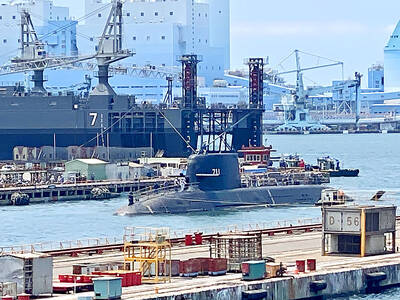
AGING: While Japan has 22 submarines, Taiwan only operates four, two of which were commissioned by the US in 1945 and 1946, and transferred to Taiwan in 1973 Taiwan would need at least 12 submarines to reach modern fleet capabilities, CSBC Corp, Taiwan chairman Chen Cheng-hung (陳政宏) said in an interview broadcast on Friday, citing a US assessment. CSBC is testing the nation’s first indigenous defense submarine, the Hai Kun (海鯤, Narwhal), which is scheduled to be delivered to the navy next month or in July. The Hai Kun has completed torpedo-firing tests and is scheduled to undergo overnight sea trials, Chen said on an SET TV military affairs program. Taiwan would require at least 12 submarines to establish a modern submarine force after assessing the nation’s operational environment and defense

A white king snake that frightened passengers and caused a stir on a Taipei MRT train on Friday evening has been claimed by its owner, who would be fined, Taipei Rapid Transit Corp (TRTC) said yesterday. A person on Threads posted that he thought he was lucky to find an empty row of seats on Friday after boarding a train on the Bannan (Blue) Line, only to spot a white snake with black stripes after sitting down. Startled, he jumped up, he wrote, describing the encounter as “terrifying.” “Taipei’s rat control plan: Release snakes on the metro,” one person wrote in reply, referring
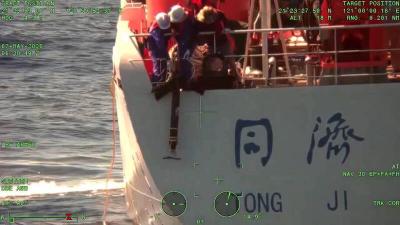
The coast guard today said that it had disrupted "illegal" operations by a Chinese research ship in waters close to the nation and driven it away, part of what Taipei sees a provocative pattern of China's stepped up maritime activities. The coast guard said that it on Thursday last week detected the Chinese ship Tongji (同濟號), which was commissioned only last year, 29 nautical miles (54km) southeast of the southern tip of Taiwan, although just outside restricted waters. The ship was observed lowering ropes into the water, suspected to be the deployment of scientific instruments for "illegal" survey operations, and the coast

Taiwan’s two cases of hantavirus so far this year are on par with previous years’ case numbers, and the government is coordinating rat extermination work, so there should not be any outbreaks, Centers for Disease Control (CDC) Director-General Philip Lo (羅一鈞) said today in an interview with the Liberty Times (the Taipei Times’ sister newspaper). An increase in rat sightings in Taipei and New Taipei City has raised concerns about the spread of hantavirus, as rats can carry the disease. In January, a man in his 70s who lived in Taipei’s Daan District (大安) tested positive posthumously for hantavirus, Taiwan’s


 RSS
RSS