


The Environment and Animal Society of Taiwan (EAST) yesterday called for companies to adopt new animal welfare policies for pigs, including banning live pig auctions.
The group also rated eight retail channels based on their friendliness to pig welfare.
Taiwan consumes 7.4 million pigs annually, but about 6 million, or 83 percent, pass through live auctions in meat markets around the country, EAST chief executive Chune Fang-chu (寸舫筑) said.
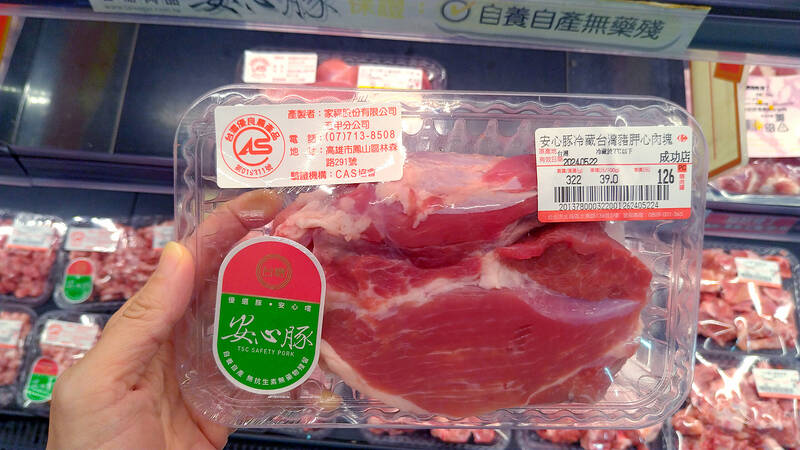
Photo: CNA
If supermarkets switch to selling pork directly transported from farms to slaughterhouses, the number of auctioned pigs could drop by 800,000 to about 72 percent, Chune said.
That could inspire food companies and restaurant chains to adopt similar policies, Chune added.
Since 2016, EAST has advocated for the government to replace the auctions with a pig carcass grading system, like in the US, Japan, South Korea and Europe.
This saves the pig from the auction process and having to pass through multiple stages of transportation, and ensures high quality, hygienic pork for consumers, Chune said.
EAST ranked eight major retailers on three factors, each worth three points for a total of nine.
The three factors were the proportion of live-auction pork to non-auction pork, policies of pork sourcing from other channels and pig welfare procurement policies.
Carrefour ranked first with four points, followed by City’super at second, and a three-way tie between Mia C’bon, Costco and Simple Mart in third place.
RT-Mart, PX Mart and A-Mart came in last place, the group said.
Only 21 of 60 surveyed pork products came from pigs not subject to live auctions, and most retailers lacked policies on avoiding live-auction pork or comprehensive animal welfare procurement policies, it said.
The group urged retailers to adopt new policies and exclude purchases of live-auction pork to help improve the welfare and treatment of millions of pigs in Taiwan.

Considering that most countries issue more than five denominations of banknotes, the central bank has decided to redesign all five denominations, the bank said as it prepares for the first major overhaul of the banknotes in more than 24 years. Central bank Governor Yang Chin-lung (楊金龍) is expected to report to the Legislative Yuan today on the bank’s operations and the redesign’s progress. The bank in a report sent to the legislature ahead of today’s meeting said it had commissioned a survey on the public’s preferences. Survey results showed that NT$100 and NT$1,000 banknotes are the most commonly used, while NT$200 and NT$2,000

The Centers for Disease Control (CDC) yesterday reported the first case of a new COVID-19 subvariant — BA.3.2 — in a 10-year-old Singaporean girl who had a fever upon arrival in Taiwan and tested positive for the disease. The girl left Taiwan on March 20 and the case did not have a direct impact on the local community, it said. The WHO added the BA.3.2 strain to its list of Variants Under Monitoring in December last year, but this was the first imported case of the COVID-19 variant in Taiwan, CDC Deputy Director-General Lin Ming-cheng (林明誠) said. The girl arrived in Taiwan on

South Korea is planning to revise its controversial electronic arrival card, a step Taiwanese officials said prompted them to hold off on planned retaliatory measures, a South Korean media report said yesterday. A Yonhap News Agency report said that the South Korean Ministry of Foreign Affairs is planning to remove the “previous departure place” and “next destination” fields from its e-arrival card system. The plan, reached after interagency consultations, is under review and aims to simplify entry procedures and align the electronic form with the paper version, a South Korean ministry official said. The fields — which appeared only on the electronic form

The Ministry of Foreign Affairs (MOFA) is suspending retaliation measures against South Korea that were set to take effect tomorrow, after Seoul said it is updating its e-arrival system, MOFA said today. The measures were to be a new round of retaliation after Taiwan on March 1 changed South Korea's designation on government-issued alien resident certificates held by South Korean nationals to "South Korea” from the "Republic of Korea," the country’s official name. The move came after months of protests to Seoul over its listing of Taiwan as "China (Taiwan)" in dropdown menus on its new online immigration entry system. MOFA last week


 RSS
RSS