


The death penalty was upheld this morning for a man convicted of raping and killing a Malaysian university student in 2020, the first such sentencing since the Constitutional Court’s ruling last year that the death penalty should only be used in the most extreme cases.
The ruling was revisited today by the High Court’s Kaohsiung branch via video conference after aspects of its previous verdict was overturned by the Supreme Court.
The court found that the case did not meet the conditions required of the Constitutional Court ruling from September last year, determining that Liang Yu-chih (梁育誌) would still be sentenced to death.
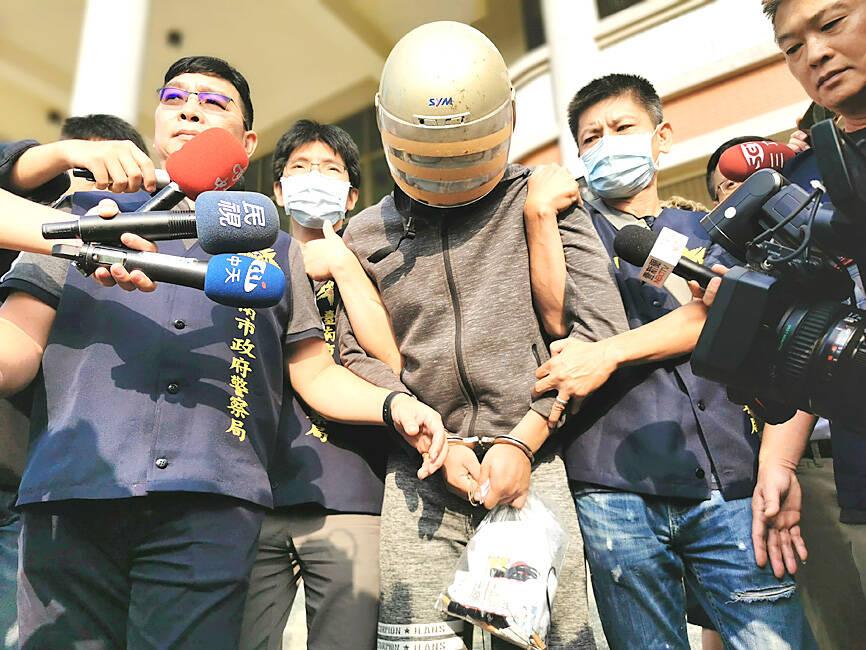
Photo: Wu Chun-feng, Taipei Times
The case has already been referred for appeal as required by law.
Lee Shu-hui (李淑惠), administrative head of the Kaohsiung branch of the High Court, gave three reasons for the ruling.
First, Lee said that the crime was premeditated for a considerable length of time.
Second, the cruelty and maliciousness of the crime meet the criteria of the “most serious circumstances” as required by the Constitutional Court ruling, Lee said.
Third, Liang found himself in financial hardship and had stated he wanted to “experience something thrilling so he would die with no regrets,” she added.
The court also found that Liang had antisocial personality disorder, which was unresponsive to treatment, and was at high risk of reoffending, especially for sexual assault, rendering him unsuitable for rehabilitation, she said.
In the first and second trials, the Ciaotou District Court and the Kaohsiung branch of the High Court sentenced Liang to death for crimes including attempted forcible sexual intercourse, forcible sexual intercourse, robbery homicide, intentional homicide and abandonment of a body.
The Supreme Court then overturned aspects of the second conviction, saying that the charge of abandoning a body was confirmed, but the sexual assault and murder charges should be retried.
Liang’s legal team had argued that the murder was not intentional, while the Supreme Court cited insufficient investigation in proving all aspects of the crime were premeditated.
The court also requested that the risk of reoffending be reassessed.
The case dates back to Oct. 28, 2020, when Liang attacked a Malaysian student walking alone through an underpass.
He used rope to tie her neck before raping her, strangling her to death and dumping her body on Dagangshan (大崗山) in Kaohsiung's Alian District (阿蓮).
Liang, who is from Alian, found the dimly lit area a 10-minute drive from his house in Tainan’s Guiren District (歸仁), where students from Chang Jung Christian University often passed by, the court found.
According to the court’s findings, Liang used a rope to strangle the woman, tying it in such a way that required both hands and considerable strength, before applying force greater than 15kg to crush the victim's jugular, carotid artery and trachea, and damaging her vocal cords, all of which constitutes intentional murder with significant force.
Moreover, the court found that Liang had inserted an unknown cylindrical object into the victim’s vagina, which forced air into her uterus causing an embolism in her heart and severe bleeding in her vagina and bladder, actions that were extreme and malicious, and justified the death sentence.
Additional reporting by CNA

SPACE VETERAN: Kjell N. Lindgren, who helps lead NASA’s human spaceflight missions, has been on two expeditions on the ISS and has spent 311 days in space Taiwan-born US astronaut Kjell N. Lindgren is to visit Taiwan to promote technological partnerships through one of the programs organized by the US for its 250th national anniversary. Lindgren would be in Taiwan from Tuesday to Saturday next week as part of the US Bureau of Educational and Cultural Affairs’ US Speaker Program, organized to celebrate the 250th anniversary of the signing of the Declaration of Independence, the American Institute in Taiwan (AIT) said in a statement yesterday. Lindgren plans to engage with key leaders across the nation “to advance cutting-edge technological partnerships and inspire the next generation of scientists and engineers,”

UNREASONABLE SURVEILLANCE: A camera targeted on an road by a neighbor captured a man’s habitual unsignaled turn into home, netting him dozens of tickets The Taichung High Administrative Court has canceled all 45 tickets given to a man for failing to use a turn signal while driving, as it considered long-term surveillance of his privacy more problematic than the traffic violations. The man, surnamed Tseng (曾), lives in Changhua County and was reported 45 times within a month for failing to signal while driving when he turned into the alley where his residence is. The reports were filed by his neighbor, who set up security cameras that constantly monitored not only the alley but also the door and yard of Tseng’s house. The surveillance occurred from July

A Japan Self-Defense Forces vessel entered the Taiwan Strait yesterday, Japanese media reported. After passing through the Taiwan Strait, the Ikazuchi was to proceed to the South China Sea to take part in a joint military exercise with the US and the Philippines, the reports said. Japan Self-Defense Force vessels were first reported to have passed through the strait in September, 2024, with two further transits taking place in February and June last year, the Asahi Shimbun reported. Yesterday’s transit also marked the first time since Japanese Prime Minister Sanae Takaichi took office that a Japanese warship has been sent through the Taiwan

‘SAME OLD TRICK’: Even if Beijing resumes individual travel to Taiwan, it would only benefit Chinese tourism companies, the Economic Democracy Union convener said China’s 10 new “incentives” are “sugar-coated poison,” an official said yesterday, adding that Taiwanese businesses see them clearly for what they are, but that Beijing would inevitably find some local collaborators to try to drums up support. The official, speaking on condition of anonymity, made the remark ahead of a news conference the General Chamber of Commerce is to hold today. The event, titled “Industry Perspectives on China’s Recent Pro-Taiwan Policies,” is expected to include representatives from industry associations — such as those in travel, hotels, food and agriculture — to request the government cooperate with China’s new measures, people familiar with


 RSS
RSS