


The legislature today voted against a motion to reconsider a Constitutional Court Act amendment bill by 62 to 51 votes after it was sent back by the Executive Yuan last week.
Democratic Progressive Party (DPP) caucus chief executive Rosalia Wu (吳思瑤) later said the party is to seek an injunction to halt the bill’s enactment and request a Constitutional interpretation.
Deputy Legislative Speaker Johnny Chiang (江啟臣) announced the result of the vote this afternoon, with 62 voting against reconsidering the bill and 51 voting in favor of reconsidering the bill. There were no invalid votes.
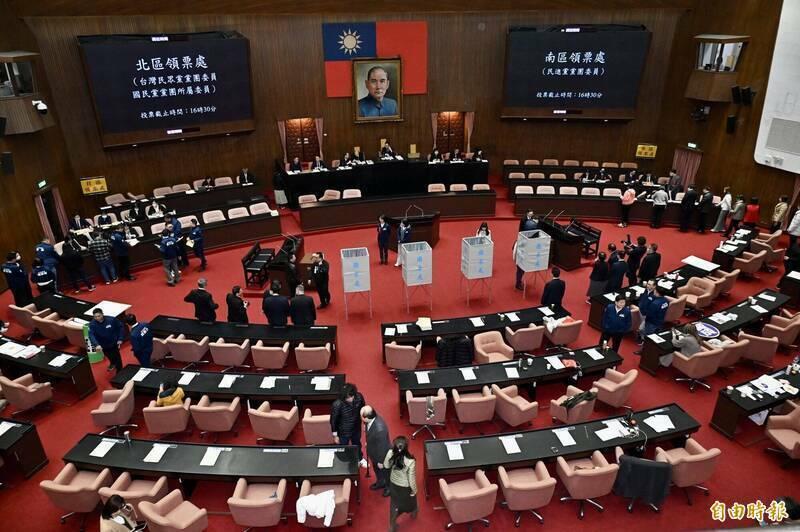
Photo: Tu Chien-jung, Taipei Times
The Chinese Nationalist Party (KMT), with the support of two independent lawmakers, holds 54 seats in the 113-seat legislature, while the Taiwan People’s Party (TPP) holds 8 seats. The ruling DPP holds 51 seats.
President William Lai (賴清德) is to evaluate all remedy options that are legal and constitutional in order to protect people’s rights, Presidential Office spokesperson Karen Kuo (郭雅慧) said.
The opposition parties had proposed that Premier Cho Jung-tai (卓榮泰) not be invited to give a report on the law to the legislature during the Committee of the Whole Yuan earlier today. The motion passed with 60 to 51 votes.
The legislature later convened the Committee of the Whole Yuan, during which the opposition lawmakers said the amendments would make legal procedures more stringent, bringing Taiwan closer to Western democratic countries.
DPP Legislator Tsai Yi-yu (蔡易餘) said the amendment, which is unconstitutional in itself, would make the Constitutional Court the most “regressive” one in history.
The Executive Yuan regrets that the legislature conducted the vote in the absence of Premier Cho, Cabinet spokesperson Michelle Lee (李慧芝) said today.
The vote came after the Executive Yuan last week submitted a formal request to the Legislative Yuan to reconsider the bill, which passed its third reading on Dec. 20.
The amendments to the Constitutional Court Procedure Act (憲法訴訟法) stipulate that at least 10 grand justices need to be present to hear a case, while nine would be needed to back a ruling of unconstitutionality.
The Constitutional Court usually has 15 justices but currently only has eight justices after seven completed their terms on Oct. 31 last year with the vacancies yet to be filled.
The previous regulations did not stipulate a minimum number of justices required to hear a case, requiring instead at least two-thirds of justices, with rulings determined by a majority vote.
The number of justices can fluctuate due to terms expiring or other events and the time it takes to replace them.
The acting president of the Judicial Yuan Shieh Ming-yan (謝銘洋) today said amendments to the act would “create problems” for the operation of the Constitutional Court.
The Executive Yuan is to consult scholars and experts to decide on the next steps to maintain the normal operation of the constitution system, Lee said.
Additional reporting by Chung Li-hua, Shih Hsiao-kuang and Lery Hiciano

The military has spotted two Chinese warships operating in waters near Penghu County in the Taiwan Strait and sent its own naval and air forces to monitor the vessels, the Ministry of National Defense (MND) said. Beijing sends warships and warplanes into the waters and skies around Taiwan on an almost daily basis, drawing condemnation from Taipei. While the ministry offers daily updates on the locations of Chinese military aircraft, it only rarely gives details of where Chinese warships are operating, generally only when it detects aircraft carriers, as happened last week. A Chinese destroyer and a frigate entered waters to the southwest
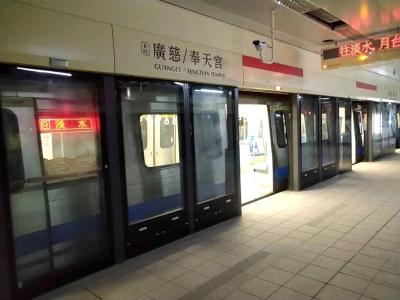
The eastern extension of the Taipei MRT Red Line could begin operations as early as late June, the Taipei Department of Rapid Transit Systems said yesterday. Taipei Rapid Transit Corp said it is considering offering one month of free rides on the new section to mark its opening. Construction progress on the 1.4km extension, which is to run from the current terminal Xiangshan Station to a new eastern terminal, Guangci/Fengtian Temple Station, was 90.6 percent complete by the end of last month, the department said in a report to the Taipei City Council's Transportation Committee. While construction began in October 2016 with an
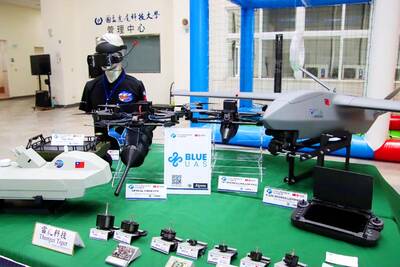
NON-RED SUPPLY: Boosting the nation’s drone industry is becoming increasingly urgent as China’s UAV dominance could become an issue in a crisis, an analyst said Taiwan’s drone exports to Europe grew 41.7-fold from 2024 to last year, with demand from Ukraine’s fight against Russian aggression the most likely driver of growth, a study showed. The Institute for Democracy, Society and Emerging Technology (DSET) in a statement on Wednesday said it found that many of Taiwan’s uncrewed aerial vehicle (UAV) sales were from Poland and the Czech Republic. These countries likely transferred the drones to Ukraine to aid it in its fight against the Russian invasion that started in 2022, it said. Despite the gains, Taiwan is not the dominant drone exporter to these markets, ranking second and fourth

Japanese Prime Minister Sanae Takaichi’s comment last year on Tokyo’s potential reaction to a Taiwan-China conflict has forced Beijing to rewrite its invasion plans, a retired Japanese general said. Takaichi told the Diet on Nov. 7 last year that a Chinese naval blockade or military attack on Taiwan could constitute a “survival-threatening situation” for Japan, potentially allowing Tokyo to exercise its right to collective self-defense. Former Japan Ground Self-Defense Force general Kiyofumi Ogawa said in a recent speech that the remark has been interpreted as meaning Japan could intervene in the early stages of a Taiwan Strait conflict, undermining China’s previous assumptions


 RSS
RSS