


The Tourism Administration yesterday said it aims to increase how much international tourists spend in Taiwan in the next three years.
Last year, the nation welcomed 7.85 million international visitors, despite the negative reports amid Chinese military exercises and a magnitude 7.2 earthquake that devastated Hualien County, it said.
However, that was short of the Tourism Administration’s goal of 10 million.
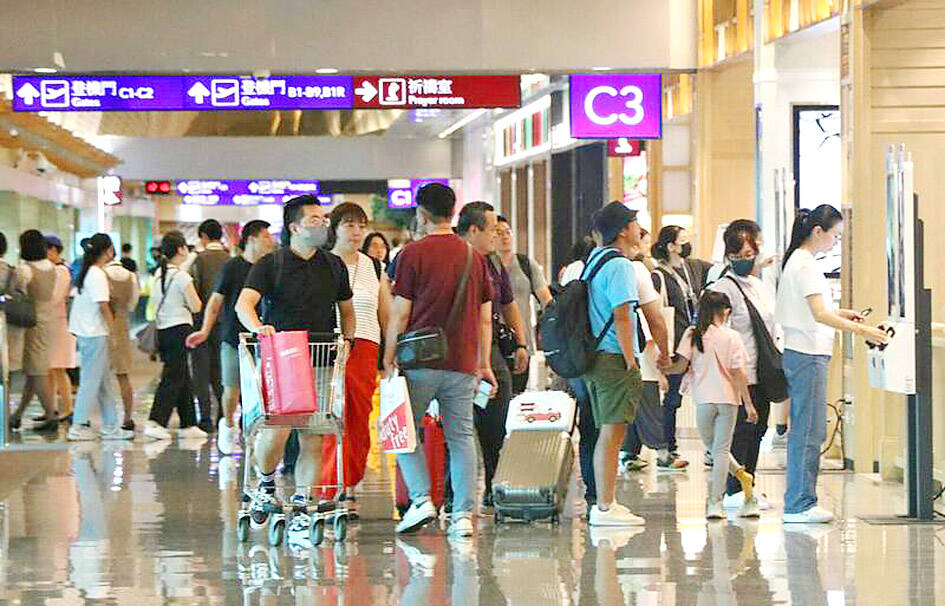
Photo: Taipei Times
The agency has set the same goal of 10 million for this year.
“That is not the only goal we hope to achieve. We also need to raise the output value generated from tourism,” Tourism Administration Director-General Chou Yung-hui (周永暉) said.
International tourists spend about US$180 per day on average, Chou said.
That figure should increase to US$185 this year, US$190 next year and US$195 in 2027, he said.
“We will discuss with the Ministry of Economic Affairs’ Administration of Commerce about supporting measures to reach the goal,” he said.
Taiwanese cuisine should be leveraged to boost the attractiveness of scenic areas, he said, adding that instead of hoodwinking tourists, vendors in scenic areas should do business honestly.
“That does not mean that they must keep prices low. A product can cost a bit more if it is one of a kind and is linked to a special part of Taiwan,” Chou said.
Public transport systems, including airlines, shipping services, the high speed rail, as well as the services of Taiwan Railway Corp, Taiwan Tourist Shuttle Service and Taiwan Tour Bus, should facilitate travel for all tourists, he said.
Artificial intelligence technology should be used to upgrade the tourism industry, Chou said.
With the Taipei International Travel Fair targeting individual travelers, the agency would expand travel fairs for industry operators and to facilitate partnerships, he said.
“We should use theme tours, such as bird-watching and railway tours, to attract European tourists to transit through Taiwan,” Chou said.
The agency is recruiting a contractor to manage the facilities at Dapeng Bay (大鵬灣) in Pingtung County’s Donggang Township (東港), Chou said.
The contractor would manage a racetrack, a dock and a hang gliding area, as well as build a golf course and a water villa resort and operate them before transferring them to the government, he said.
The golf course, once completed, would be the first in Taiwan on the coast, Chou said, adding that it would be expected to attract high-end tourists.
The government is to stop giving subsidies to domestic travelers unless there is a natural disaster, he said.
The government last year spent about NT$1.26 billion (US$38.49 million) in subsidies for people who traveled to Hualien or Taitung counties, which helped boost hotel occupancy in the counties to 50 percent in November after the earthquake on April 3, he said.
The occupancy rate slid to 20 percent when the subsidy program ended last month, agency data showed.
The Executive Yuan is to convene a meeting later this month to address challenges facing Taiwan’s tourism industry, such as shortage of workers in the hotel and accommodation services, Chou said.

Actor Darren Wang (王大陸) was sentenced to six months in prison, commutable to a fine, by the New Taipei District Court today for contravening the Personal Data Protection Act (個人資料保護法) in a case linked to an alleged draft-dodging scheme. Wang allegedly paid NT$3.6 million (US$114,380) to an illegal group to help him evade mandatory military service through falsified medical documents, prosecutors said. He transferred the funds to Chen Chih-ming (陳志明), the alleged mastermind of a draft-evasion ring, although he lost contact with him as he was already in detention on fraud charges, they said. Chen is accused of helping a

SECURITY: Starlink owner Elon Musk has taken pro-Beijing positions, and allowing pro-China companies to control Taiwan’s critical infrastructure is risky, a legislator said Starlink was reluctant to offer services in Taiwan because of the nation’s extremely high penetration rates in 4G and 5G services, the Ministry of Digital Affairs said yesterday. The ministry made the comments at a meeting of the legislature’s Transportation Committee, which reviewed amendments to Article 36 of the Telecommunications Management Act (電信管理法). Article 36 bans foreigners from holding more than 49 percent of shares in public telecommunications networks, while shares foreigners directly and indirectly hold are also capped at 60 percent of the total, unless specified otherwise by law. The amendments, sponsored by Chinese Nationalist Party (KMT) Legislator Ko

The eastern extension of the Taipei MRT Red Line could begin operations as early as late June, the Taipei Department of Rapid Transit Systems said yesterday. Taipei Rapid Transit Corp said it is considering offering one month of free rides on the new section to mark its opening. Construction progress on the 1.4km extension, which is to run from the current terminal Xiangshan Station to a new eastern terminal, Guangci/Fengtian Temple Station, was 90.6 percent complete by the end of last month, the department said in a report to the Taipei City Council's Transportation Committee. While construction began in October 2016 with an

NON-RED SUPPLY: Boosting the nation’s drone industry is becoming increasingly urgent as China’s UAV dominance could become an issue in a crisis, an analyst said Taiwan’s drone exports to Europe grew 41.7-fold from 2024 to last year, with demand from Ukraine’s fight against Russian aggression the most likely driver of growth, a study showed. The Institute for Democracy, Society and Emerging Technology (DSET) in a statement on Wednesday said it found that many of Taiwan’s uncrewed aerial vehicle (UAV) sales were from Poland and the Czech Republic. These countries likely transferred the drones to Ukraine to aid it in its fight against the Russian invasion that started in 2022, it said. Despite the gains, Taiwan is not the dominant drone exporter to these markets, ranking second and fourth


 RSS
RSS