


About half of Antai Tian-Sheng Memorial Hospital would be demolished on Jan. 14, as the structures were discovered to have been illegally built, following a fire at the hospital last year that killed nine people, the Pingtung County Government said yesterday.
The fire at the hospital in Donggang Township (東港) on Oct. 3 killed eight patients and a technician.
According to the Rules Governing the Public Safety Inspection in Buildings (建築物公共安全檢查簽證及申報辦法), hospitals should report the results of public safety inspections and verifications every year.

Photo courtesy of the Pingtung County Government
The building owner or user is required to commission a professional institution or inspector to conduct a public safety inspection and report the results to local construction authorities.
The county government yesterday said the hospital’s safety inspections have for years been done by the same institution that built it, which invariably verified the quality of its own work.
The institution was fined NT$60,000 for the false verification, while a NT$300,000 fine was imposed on the hospital for changing the use of buildings without approval, it said, adding that the hospital’s five buildings all had large-scale illegal additions.
The licensed construction area of Building D, where most of the people were killed and injured, was 10,618m2, but it was illegally expanded into a building with six floors above ground, of which 4,490m2 was illegally constructed, or 42.3 percent, the county said, citing measurements from the Donggang Land Office.
A power center next to Building D, where the fire originated, had only 65.68m2 that was legally constructed, all on the ground floor, the county government said.
However, four floors were illegally added to the structure, totalling 1,510m2 of illegal construction area, or 3,300 percent, the government said, citing data from the office.
The illegal construction area of Building D and the power center totaled 6,000m2, the county government said, adding that other illegal additions included a two-floor building rented to a convenience store and the hospital’s General Affairs Office.
The ratio of total illegal construction area (10,310m2) to total legal construction area (21,830m2) was 47.2 percent, meaning that nearly half of the hospital was illegally built, it said.
The hospital provided healthcare services on more than two illegal floors of Building D. It also installed life-sustaining systems, emergency generators and other power-supply and oxygen-supply equipment, the county government said.
Given that the large-scale illegal additions and their illegal applications have severely affected public safety, and the Pingtung District Prosecutors’ Office had conducted investigations, the county government decided to conduct a forced demolition after the patients and personnel are evacuated, it said.
The hospital yesterday said that “everything is being improved as required by the law. Thanks for everyone’s concern.”
It did not comment on whether operations would resume.
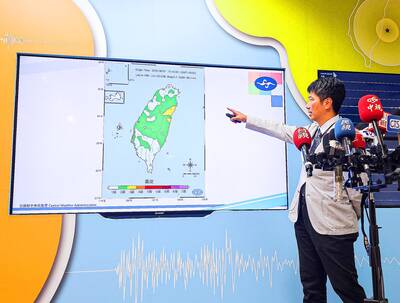
Aftershocks from a magnitude 6.2 earthquake that struck off Yilan County at 3:45pm yesterday could reach a magnitude of 5 to 5.5, the Central Weather Administration (CWA) said. Seismological Center technical officer Chiu Chun-ta (邱俊達) told a news conference that the epicenter of the temblor was more than 100km from Taiwan. Although predicted to measure between magnitude 5 and 5.5, the aftershocks would reach an intensity of 1 on Taiwan’s 7-tier scale, which gauges the actual effect of an earthquake, he said. The earthquake lasted longer in Taipei because the city is in a basin, he said. The quake’s epicenter was about 128.9km east-southeast

GENSLER SURVEY: ‘Economic infrastructure is not enough. A city needs to inspire pride, offer moments of joy and foster a sense of belonging,’ the company said Taipei was named the city with the “highest staying power” in the world by US-based design and architecture firm Gensler. The Taiwanese capital earned the top spot among 65 cities across six continents with 64 percent of Taipei respondents in a survey of 33,000 people saying they wanted to stay in the city. Rounding out the top five were Vietnam’s Ho Chi Minh City (61 percent), Singapore (59 percent), Sydney (58 percent) and Berlin (51 percent). Sixth to 10th place went to Monterrey, Mexico; Munich, Germany; Sao Paulo, Brazil; Vancouver; and Seoul. Cities in the US were ranked separately, with Minneapolis first at
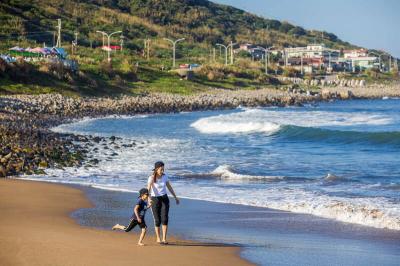
The New Taipei City Government today warned about the often-overlooked dangers of playing in water, and recommended safe swimming destinations to cool off from the summer heat. The following locations in the city as safe and fun for those looking to enjoy the water: Chienshuiwan (淺水灣), Baishawan (白沙灣), Jhongjiao Bay (中角灣), Fulong Beach Resort (福隆海水浴場) and Sansia District’s (三峽) Dabao River (大豹溪), New Taipei City Tourism and Travel Department Director-General Yang Tsung-min (楊宗珉) said. Outdoor bodies of water have variables outside of human control, such as changing currents, differing elevations and environmental hazards, all of which can lead to accidents, Yang said. Sudden
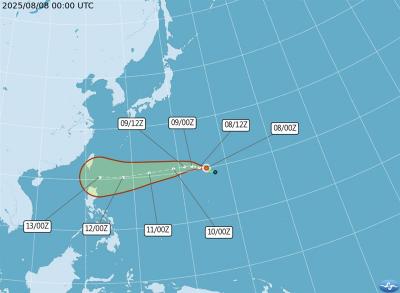
Tropical Storm Podul has formed over waters north-northeast of Guam and is expected to approach the seas southeast of Taiwan next week, the Central Weather Administration (CWA) said today. The 11th Pacific storm of the year developed at 2am over waters about 2,660km east of Oluanpi (歐鑾鼻), Pingtung County — Taiwan's southernmost tip. It is projected to move westward and could have its most significant impact on Taiwan on Wednesday and Thursday next week, the CWA said. The agency did not rule out the possibility of issuing a sea warning at that time. According to the CWA's latest update, Podul is drifting west-northwest


 RSS
RSS