


Taiwan People’s Party Chairman Ko Wen-je (柯文哲) posted bail this afternoon, along with three other suspects in a series of corruption and campaign finance cases.
Ko’s wife, Peggy Chen (陳佩琪), went to the Taipei District Court at 1:38pm to post NT$70 million (US$2.13 million) bail for the former Taipei mayor’s release.
The High Court had earlier overturned the district court’s ruling to release Ko on bail of NT$30 million, after the Taipei District Prosecutors’ Office petitioned to have him and the other suspects returned to pretrial detention.
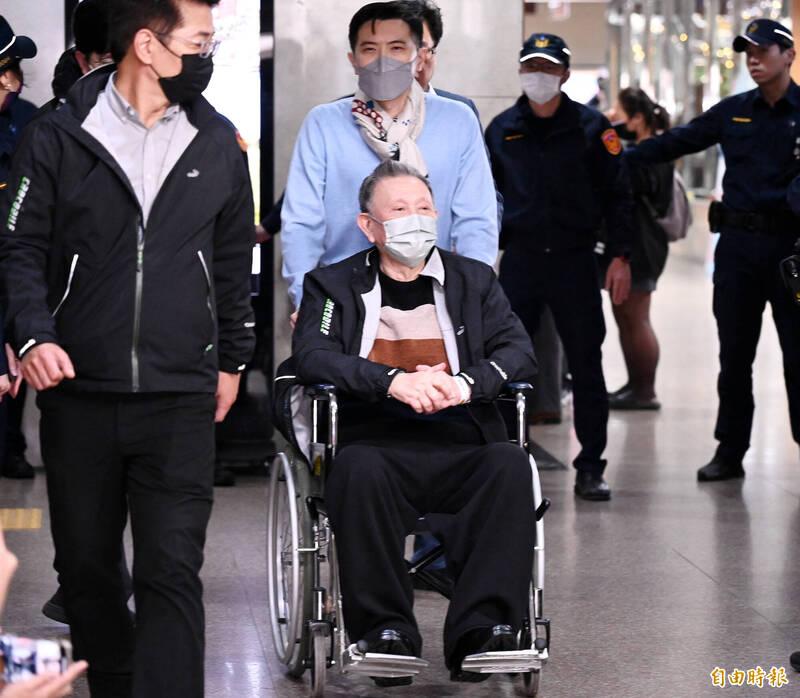
Photo: Chu Pei-hsiung, Taipei Times
In a retrial, the district court last night again rejected prosecutors’ request to continue Ko’s detention, but raised the bail amount to NT$70 million and ordered that he must wear an electronic tracking device.
The High Court also ordered the district court to reconvene bail hearings for suspects Taipei City Councilor Angela Ying (應曉薇), Core Pacific Group (威京集團) founder and chairman Sheen Ching-jing (沈慶京), and Lee Wen-tsung (李文宗), finance chief of Ko’s presidential election campaign.
They did not request a retrial for former Taipei deputy mayor Pong Cheng-sheng (彭振聲), who was released on NT$5 million bail last week, as he had admitted guilt and cooperated during the investigation.
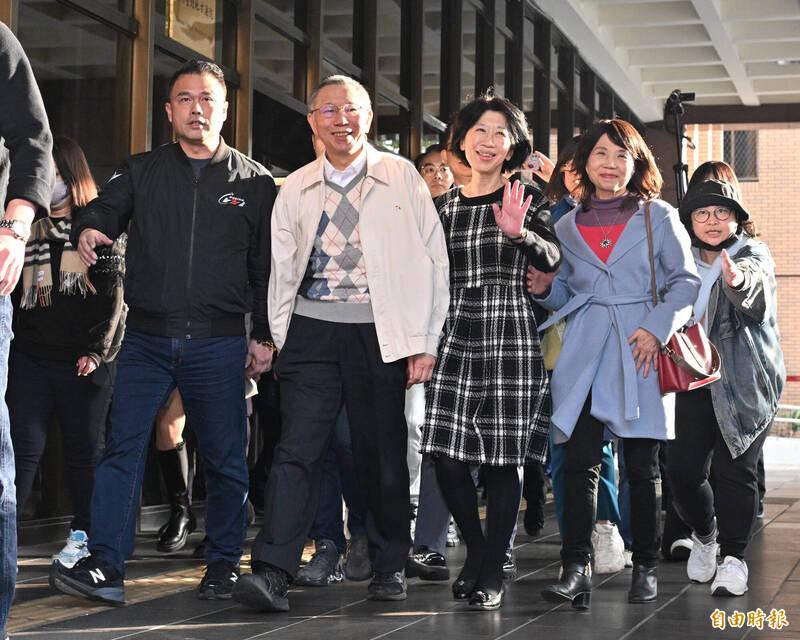
Photo: Wang Yi-sung, Taipei Times
The district court yesterday raised the bail amount for Sheen to NT$100 million, and granted Ying and Lee the same bail for a second time of NT$15 million and NT$10 million respectively.
Sheen, Ying and Lee also posted bail this afternoon, and are to be required to wear tracking devices.
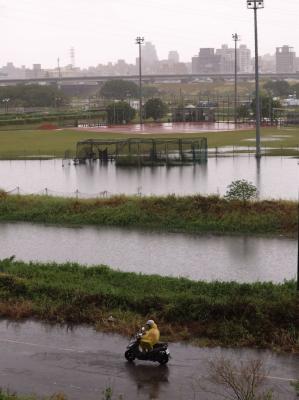
Taipei, New Taipei City, Keelung and Taoyuan would issue a decision at 8pm on whether to cancel work and school tomorrow due to forecasted heavy rain, Keelung Mayor Hsieh Kuo-liang (謝國樑) said today. Hsieh told reporters that absent some pressing reason, the four northern cities would announce the decision jointly at 8pm. Keelung is expected to receive between 300mm and 490mm of rain in the period from 2pm today through 2pm tomorrow, Central Weather Administration data showed. Keelung City Government regulations stipulate that school and work can be canceled if rain totals in mountainous or low-elevation areas are forecast to exceed 350mm in
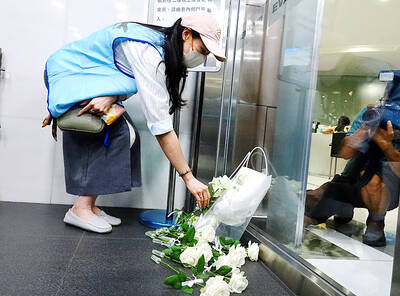
EVA Airways president Sun Chia-ming (孫嘉明) and other senior executives yesterday bowed in apology over the death of a flight attendant, saying the company has begun improving its health-reporting, review and work coordination mechanisms. “We promise to handle this matter with the utmost responsibility to ensure safer and healthier working conditions for all EVA Air employees,” Sun said. The flight attendant, a woman surnamed Sun (孫), died on Friday last week of undisclosed causes shortly after returning from a work assignment in Milan, Italy, the airline said. Chinese-language media reported that the woman fell ill working on a Taipei-to-Milan flight on Sept. 22
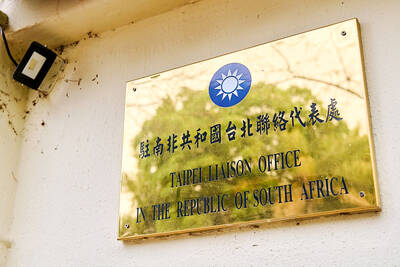
COUNTERMEASURE: Taiwan was to implement controls for 47 tech products bound for South Africa after the latter downgraded and renamed Taipei’s ‘de facto’ offices The Ministry of Foreign Affairs is still reviewing a new agreement proposed by the South African government last month to regulate the status of reciprocal representative offices, Minister of Foreign Affairs Lin Chia-lung (林佳龍) said yesterday. Asked about the latest developments in a year-long controversy over Taiwan’s de facto representative office in South Africa, Lin during a legislative session said that the ministry was consulting with legal experts on the proposed new agreement. While the new proposal offers Taiwan greater flexibility, the ministry does not find it acceptable, Lin said without elaborating. The ministry is still open to resuming retaliatory measures against South

1.4nm WAFERS: While TSMC is gearing up to expand its overseas production, it would also continue to invest in Taiwan, company chairman and CEO C.C. Wei said Taiwan Semiconductor Manufacturing Co (TSMC) has applied for permission to construct a new plant in the Central Taiwan Science Park (中部科學園區), which it would use for the production of new high-speed wafers, the National Science and Technology Council said yesterday. The council, which supervises three major science parks in Taiwan, confirmed that the Central Taiwan Science Park Bureau had received an application on Friday from TSMC, the world’s largest contract chipmaker, to commence work on the new A14 fab. A14 technology, a 1.4 nanometer (nm) process, is designed to drive artificial intelligence transformation by enabling faster computing and greater power


 RSS
RSS