


A black-faced spoonbill has broken Taiwan’s record for the most documented visits by one of the migratory species after being found to have traveled to the nation for nine straight years, an official at the Taijiang National Park Headquarters said yesterday.
The bird, identified by its leg band, T69, is a female that has returned to Tainan every October since 2015, park Conservation Research Section head Wang Chien-chih (王建智) said.
The bird habitually returns to Tainan’s watery Annan District (安南) for winter, Wang said.
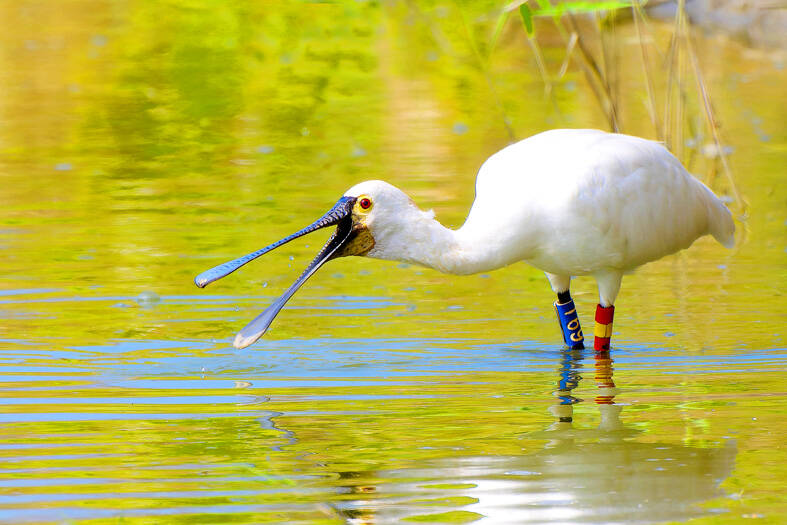
Photo courtesy of the Taijiang National Park Headquarters via CNA
T69 is a unique specimen that stands out from other black-faced spoonbills, he added.
It has yellow markings around the eyes which is uncommon among black-faced spoonbills, he said.
The migratory bird’s repeated presence has resulted in avid bird watchers such as Wang dubbing her “Daughter of Tainan” and “Daughter of Taijiang,” he said.
T69 is considered old for the species, which is prone to fatal accidents while flying across large bodies of water on top of life-threatening illnesses and injuries, which makes her visits even more valuable, he said.
T69 experienced such an incident when it traveled to Taiwan in 2015, which could explain the spoonbill’s frequent returns, he said.
T69 was in 2015 found in the wetlands in Annan District with other birds from her bowl, their necks drooping, legs limp and wings listless, classic signs of botulism, which prompted Wang and other bird-loving peers to rescue them, he said.
T69 was among the six who were nursed back to health before being released back into the wild, he added, suggesting the rescue efforts might have caused T69 to develop a connection to Taiwan.
Wang said that in his 15 years of service at the national park, he has watched T69 grow from a young chick to a senior spoonbill.
The black-faced spoonbill is an endangered species with only about 7,000 left in the world, Wang said.
Of the 4,100 birds counted in Taiwan, 2,088 were spotted in Tainan, he said.
T69’s return to Tainan’s national park could also be due to the species’ tendency to migrate together, but later breaking off to fly to their preferred locations, with the park effectively serving as T69’s nest, Wang added.
In a news release, the Taijiang National Park Headquarters said that T69’s preference of the park could also be related to the headquarters’ initiative to make the habitats within the park more friendly to animals.
The headquarters also said that it has been working with local fish farmers who operate around the watery national park to make their fish farms better suited for black-faced spoonbill visits.
While the initial phase of the project only saw the participation of three fish farmers converting 10.8 hectares into spoonbill-friendly fish farms, the initiative now has 47 participating fish farmers who have made 248.57 hectares available to the birds, the headquarters said.

Considering that most countries issue more than five denominations of banknotes, the central bank has decided to redesign all five denominations, the bank said as it prepares for the first major overhaul of the banknotes in more than 24 years. Central bank Governor Yang Chin-lung (楊金龍) is expected to report to the Legislative Yuan today on the bank’s operations and the redesign’s progress. The bank in a report sent to the legislature ahead of today’s meeting said it had commissioned a survey on the public’s preferences. Survey results showed that NT$100 and NT$1,000 banknotes are the most commonly used, while NT$200 and NT$2,000

The Centers for Disease Control (CDC) yesterday reported the first case of a new COVID-19 subvariant — BA.3.2 — in a 10-year-old Singaporean girl who had a fever upon arrival in Taiwan and tested positive for the disease. The girl left Taiwan on March 20 and the case did not have a direct impact on the local community, it said. The WHO added the BA.3.2 strain to its list of Variants Under Monitoring in December last year, but this was the first imported case of the COVID-19 variant in Taiwan, CDC Deputy Director-General Lin Ming-cheng (林明誠) said. The girl arrived in Taiwan on

South Korea is planning to revise its controversial electronic arrival card, a step Taiwanese officials said prompted them to hold off on planned retaliatory measures, a South Korean media report said yesterday. A Yonhap News Agency report said that the South Korean Ministry of Foreign Affairs is planning to remove the “previous departure place” and “next destination” fields from its e-arrival card system. The plan, reached after interagency consultations, is under review and aims to simplify entry procedures and align the electronic form with the paper version, a South Korean ministry official said. The fields — which appeared only on the electronic form

The Ministry of Foreign Affairs (MOFA) is suspending retaliation measures against South Korea that were set to take effect tomorrow, after Seoul said it is updating its e-arrival system, MOFA said today. The measures were to be a new round of retaliation after Taiwan on March 1 changed South Korea's designation on government-issued alien resident certificates held by South Korean nationals to "South Korea” from the "Republic of Korea," the country’s official name. The move came after months of protests to Seoul over its listing of Taiwan as "China (Taiwan)" in dropdown menus on its new online immigration entry system. MOFA last week


 RSS
RSS