


The Centers for Disease Control (CDC) yesterday announced that it would make 200,000 doses of a protein-based Novavax vaccine targeting the JN.1 subvariant of COVID-19 available to the public from Wednesday next week.
The vaccine was an alternative for those who previously had an adverse reaction to more common mRNA COVID-19 vaccines, the CDC said.
The Novavax JN.1 jabs would be available to those who are 12 years old or above, CDC Deputy Director-General Tseng Shu-huai (曾淑慧) said.

Photo: Taipei Times
Meanwhile, 1.7 million out of the 5.5 million doses of Moderna’s mRNA-based JN.1 COVID-19 vaccine procured by the CDC have already been administered, CDC statistics showed.
As Taiwan is well-stocked with mRNA vaccines, unvaccinated people, particularly those who are 65 or older and those with chronic illnesses, should get a shot as soon as possible to lower the chances of developing terminal symptoms due to COVID-19, Tseng said.
People should also be aware that it takes two weeks for a vaccine to begin providing protection against COVID-19, Tseng added.
In other developments, the CDC said 94,882 visits to emergency departments and outpatient clinics for flu-like symptoms were reported from Dec. 15 to Saturday last week, a 16 percent increase compared with the number of cases recorded the previous week.
Among those who visited emergency departments in that period, 10.8 percent were due to flu-like illnesses, very close to the epidemic threshold of 11 percent, it said.
CDC Deputy Director-General Tseng Shu-huai (曾淑慧) warned that in winter, viruses targeting the human respiratory system are more active, and with year-end activities such as Christmas celebrations and New Year’s gatherings, the risk of disease transmission is increasing.
She urged people who have not yet received a flu jab, especially those in high-risk groups, to get vaccinated as soon as possible.
The CDC on Tuesday last week announced that free flu vaccines would be offered to all unvaccinated residents in Taiwan aged 6 months or older starting on Jan. 1 until the vaccine supply is used up.
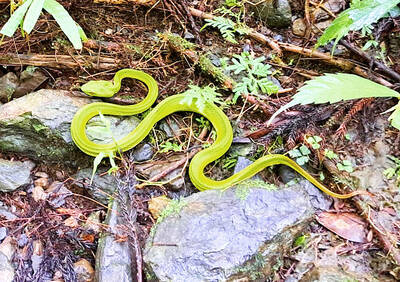
More than half of the bamboo vipers captured in Tainan in the past few years were found in the city’s Sinhua District (新化), while other districts had smaller catches or none at all. Every year, Tainan captures about 6,000 snakes which have made their way into people’s homes. Of the six major venomous snakes in Taiwan, the cobra, the many-banded krait, the brown-spotted pit viper and the bamboo viper are the most frequently captured. The high concentration of bamboo vipers captured in Sinhua District is puzzling. Tainan Agriculture Bureau Forestry and Nature Conservation Division head Chu Chien-ming (朱健明) earlier this week said that the

Kenting National Park service technician Yang Jien-fon (楊政峰) won a silver award in World Grand Prix Photography Awards Spring Season for his photograph of two male rat snakes intertwined in combat. Yang’s colleagues at Kenting National Park said he is a master of nature photography who has been held back by his job in civil service. The awards accept entries in all four seasons across six categories: architectural and urban photography, black-and-white and fine art photography, commercial and fashion photography, documentary and people photography, nature and experimental photography, and mobile photography. Awards are ranked according to scores and divided into platinum, gold and

NAMING SPAT: The foreign ministry called on Denmark to propose an acceptable solution to the erroneous nationality used for Taiwanese on residence permits Taiwan has revoked some privileges for Danish diplomatic staff over a Danish permit that lists “Taiwan” as “China,” Eric Huang (黃鈞耀), head of the Ministry of Foreign Affairs’ Department of European Affairs, told a news conference in Taipei yesterday. Reporters asked Huang whether the Danish government had responded to the ministry’s request that it correct the nationality on Danish residence permits of Taiwanese, which has been listed as “China” since 2024. Taiwan’s representative office in Denmark continues to communicate with the Danish government, and the ministry has revoked some privileges previously granted to Danish representatives in Taiwan and would continue to review
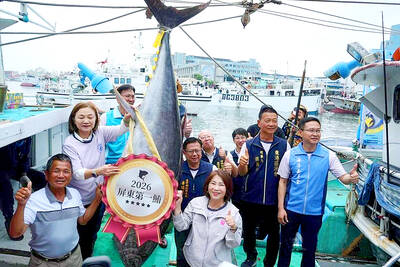
The first bluefin tuna of the season, brought to shore in Pingtung County and weighing 190kg, was yesterday auctioned for NT$10,600 (US$333.5) per kilogram, setting a record high for the local market. The auction was held at the fish market in Donggang Fishing Harbor, where the Siaoliouciou Island-registered fishing vessel Fu Yu Ching No. 2 delivered the “Pingtung First Tuna” it had caught for bidding. Bidding was intense, and the tuna was ultimately jointly purchased by a local restaurant and a local company for NT$10,600 per kilogram — NT$300 ,more than last year — for a total of NT$2.014 million. The 67-year-old skipper


 RSS
RSS