


Residents living near the Taipei Dome complained of “earthquake-like” vibrations on Saturday night that they said were caused by tens of thousands of fans jumping during a performance by pop superstar Chang Hui-mei (張惠妹), also known as A-mei (阿妹).
The 52-year-old singer, known by Taiwanese as the “Queen of Mandopop” for her highly successful career dating back to the 1990s, performed the first concert of her “ASMR Maxxx” tour at the packed 40,000-seat arena, with attendees leaping in unison as she sang crowd-pleasing numbers, including Three Days and Three Nights.
However, a hotline run by the Taipei City Government received 30 complaints between 7pm and 11:30pm, the municipality’s Research, Development and Evaluation Commission said.

Photo courtesy of Mei Entertainment via CNA
A majority of the calls came from people living in residential streets directly east of Taipei’s biggest stadium.
Ward Chief Wu Chian-te (吳建德) yesterday morning posted on Facebook videos of shaking chandeliers and other household items sent to him by residents in the community he represents.
Wu said that the vibrations had disturbed the residents and urged the city government to “immediately instruct the Taipei Dome to suspend singing and dancing activities.”
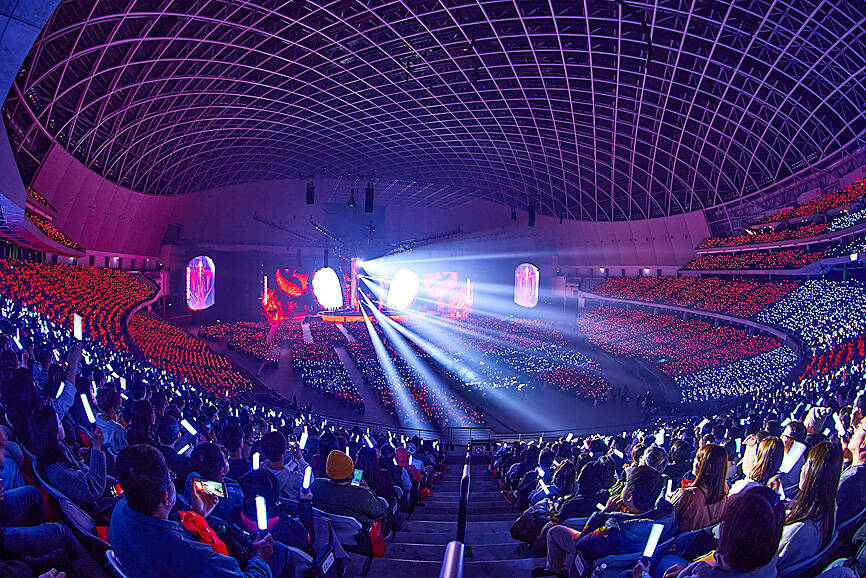
Photo courtesy of Mei Entertainment
A-mei’s performance on Saturday was not the first time complaints had been received over shaking during a concert at the recently completed Taipei Dome.
During Jay Chou’s (周杰倫) concert earlier this month, some residents living near the arena also reported unwelcome vibrations.
Farglory, the company that runs the multi-purpose indoor stadium in Taipei’s Xinyi District (信義), issued a statement yesterday saying that “objective structural certification and engineering inspection data” indicate that the venue operates “in accordance with regulations.”
The company nonetheless said it would communicate with the organizers “if the authorities have suggestions about the performance content and format.”
A-mei was scheduled to perform at the Taipei Dome four more times: yesterday, Saturday, Sunday and Tuesday next week. It remains to be seen whether enthusiastic fans of A-mei would again cause the ground to shake over the coming days.

SECURITY: Starlink owner Elon Musk has taken pro-Beijing positions, and allowing pro-China companies to control Taiwan’s critical infrastructure is risky, a legislator said Starlink was reluctant to offer services in Taiwan because of the nation’s extremely high penetration rates in 4G and 5G services, the Ministry of Digital Affairs said yesterday. The ministry made the comments at a meeting of the legislature’s Transportation Committee, which reviewed amendments to Article 36 of the Telecommunications Management Act (電信管理法). Article 36 bans foreigners from holding more than 49 percent of shares in public telecommunications networks, while shares foreigners directly and indirectly hold are also capped at 60 percent of the total, unless specified otherwise by law. The amendments, sponsored by Chinese Nationalist Party (KMT) Legislator Ko

The military has spotted two Chinese warships operating in waters near Penghu County in the Taiwan Strait and sent its own naval and air forces to monitor the vessels, the Ministry of National Defense (MND) said. Beijing sends warships and warplanes into the waters and skies around Taiwan on an almost daily basis, drawing condemnation from Taipei. While the ministry offers daily updates on the locations of Chinese military aircraft, it only rarely gives details of where Chinese warships are operating, generally only when it detects aircraft carriers, as happened last week. A Chinese destroyer and a frigate entered waters to the southwest

The eastern extension of the Taipei MRT Red Line could begin operations as early as late June, the Taipei Department of Rapid Transit Systems said yesterday. Taipei Rapid Transit Corp said it is considering offering one month of free rides on the new section to mark its opening. Construction progress on the 1.4km extension, which is to run from the current terminal Xiangshan Station to a new eastern terminal, Guangci/Fengtian Temple Station, was 90.6 percent complete by the end of last month, the department said in a report to the Taipei City Council's Transportation Committee. While construction began in October 2016 with an

NON-RED SUPPLY: Boosting the nation’s drone industry is becoming increasingly urgent as China’s UAV dominance could become an issue in a crisis, an analyst said Taiwan’s drone exports to Europe grew 41.7-fold from 2024 to last year, with demand from Ukraine’s fight against Russian aggression the most likely driver of growth, a study showed. The Institute for Democracy, Society and Emerging Technology (DSET) in a statement on Wednesday said it found that many of Taiwan’s uncrewed aerial vehicle (UAV) sales were from Poland and the Czech Republic. These countries likely transferred the drones to Ukraine to aid it in its fight against the Russian invasion that started in 2022, it said. Despite the gains, Taiwan is not the dominant drone exporter to these markets, ranking second and fourth


 RSS
RSS