


Prosecutors on Friday charged the owner and proprietors of Wagyu Emperor, a high-end grilled meat restaurant in Taichung, for allegedly having expired food products and suspicion of fraud. Consumers had filed a complaint and an investigation was launched in April.
The three indicted are Japanese nationals: Wagyu Emperor chairman Toshi Sakamoto, 35; restaurant general manager Atsuya Kubo, 25; and head chef Shohei Yamazoe, 42.
Prosecutors requested the maximum sentence, alleging that the trio was hostile to investigators, threatened media reporters for publishing news reports on the case and said they would not compensate the consumers who were allegedly victimized.
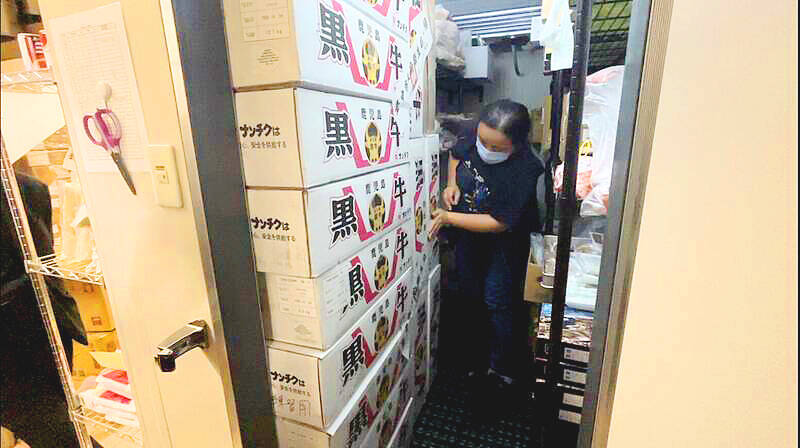
Photo provided by the Taichung City Health Bureau
Prosecutors also asked the court to seize NT$78,300 (US$2,409) profit related to the incident.
In April, consumers had filed a complaint and a “food safety alert” was raised, leading to an inspection by the Taichung City Health Bureau and a preliminary probe by prosecutors. The Ministry of Justice’s Investigation Bureau searched the restaurant, looked at its food products, and confiscated receipts, purchase order records, menus and preparation lists.
Wagyu Emperor was started by Takuya Sakamoto, who ran a food supply firm in Taiwan, in September last year. It was later handed over to his brother, Toshi Sakamoto, prosecutors said.
Sakamoto Toshi hired Kubo as the store’s general manager and Yamazoe as head chef.
“The trio knew the Kobe beef they purchased was past its due date, but they still continued to sell the meat and promoted the restaurant as ‘the highest peak of Taichung’s Japanese yakiniku restaurants,’” prosecutors said.
“From January to March, they sold to 29 customers at NT$2,900 per person. They profited NT$78,300 while causing serious health issues and contravening consumer rights,” the indictment said.
The investigation allegedly found that the Kobe beef’s “best before” date was at the start of December last year, but they continued to sell until March this year, it said.
The trio contravened the Act Governing Food Safety and Sanitation (食品安全衛生管理法) by selling food past its expiration date, the indictment said. They would also be charged with aggravated fraud and causing harm to health under the Criminal Code.
Prosecutors said that the trio did not prioritize food safety.
They sold expired items to reduce loss and gain profit, despite their promotions and advertisements saying “we use top-class wagyu beef,” “our mission is to carry on the tradition of Japanese yakiniku food culture,” “customers would feel like they are in Japan,” and “we only use the highest class of Japanese beef, for highest-class dining experience,” the filing said.
Wagyu Emperor has been bought by a Taiwanese business team and has been reopened. The restaurant’s name and address remain the same.
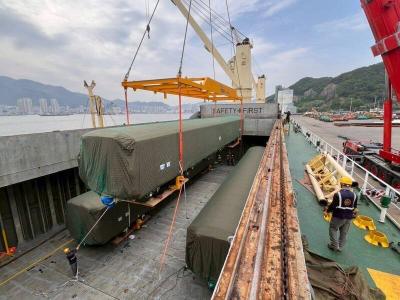
The first of 10 new high-capacity trains purchased from South Korea’s Hyundai Rotem arrived at the Port of Taipei yesterday to meet the demands of an expanding metro network, Taipei Rapid Transit Corp (TRTC) said yesterday. The train completed a three-day, 1,200km voyage from the Port of Masan in South Korea, the company said. Costing NT$590 million (US$18.79 million) each, the new six-carriage trains feature a redesigned interior based on "human-centric" transportation concepts, TRTC said. The design utilizes continuous longitudinal seating to widen the aisles and optimize passenger flow, while also upgrading passenger information displays and driving control systems for a more comfortable
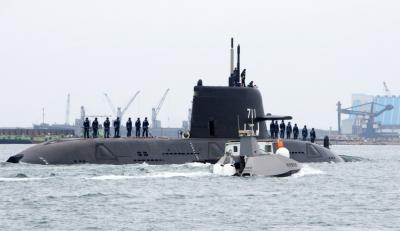
Taiwan's first indigenous defense submarine, the SS-711 Hai Kun (海鯤, or Narwhal), departed for its 13th sea trial at 7am today, marking its seventh submerged test, with delivery to the navy scheduled for July. The outing also marked its first sea deployment since President William Lai (賴清德) boarded the submarine for an inspection on March 19, drawing a crowd of military enthusiasts who gathered to show support. The submarine this morning departed port accompanied by CSBC Corp’s Endeavor Manta (奮進魔鬼魚號) uncrewed surface vessel and a navy M109 assault boat. Amid public interest in key milestones such as torpedo-launching operations and overnight submerged trials,
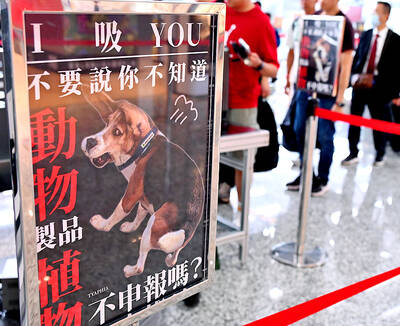
Quarantine awareness posters at Taiwan Taoyuan International Airport have gone viral for their use of wordplay. Issued by the airport branch of the Animal and Plant Health Inspection Agency, the posters feature sniffer dogs making a range of facial expressions, paired with advisory messages built around homophones. “We update the messages for holidays and campaign needs, periodically refreshing materials to attract people’s attention,” quarantine officials said. “The aim is to use the dogs’ appeal to draw focus to quarantine regulations.” A Japanese traveler visiting Taiwan has posted a photo on X of a poster showing a quarantine dog with a

Taiwan’s coffee community has launched a “one-person-one-e-mail” campaign, calling for people to send a protest-e-mail to the World Coffee Championships (WCC) urging it to redesignate Taiwanese competitors as from “Taiwan,” rather than “Chinese Taipei.” The call followed sudden action last week after the WCC changed all references to Taiwanese competitors from “Taiwan” to “Chinese Taipei,” including recent World Latte Art champion Bala (林紹興), who won the World Latte Art Championship in San Diego earlier this month. When Bala received the trophy, he was referred to as representing Taiwan, as well as in the announcement on the WCC’s Web site, until it


 RSS
RSS