


The Ministry of Health and Welfare is to allocate NT$4 billion (US$123 million) to expand a program on providing integrated medical and long-term care to senior citizens, as the nation prepares for the challenges of becoming a super-aged society next year.
The WHO defines a super-aged society as one in which more than 20 percent of the population is composed of people aged 65 or older.
The ministry operates 26 hospitals that provides integrated long-term care to elderly Taiwanese and plans to inject NT$4 billion to expand the program, said Lin Ching-feng (林慶豐), head of the Hospital and Social Welfare Organizations Administration Commission.
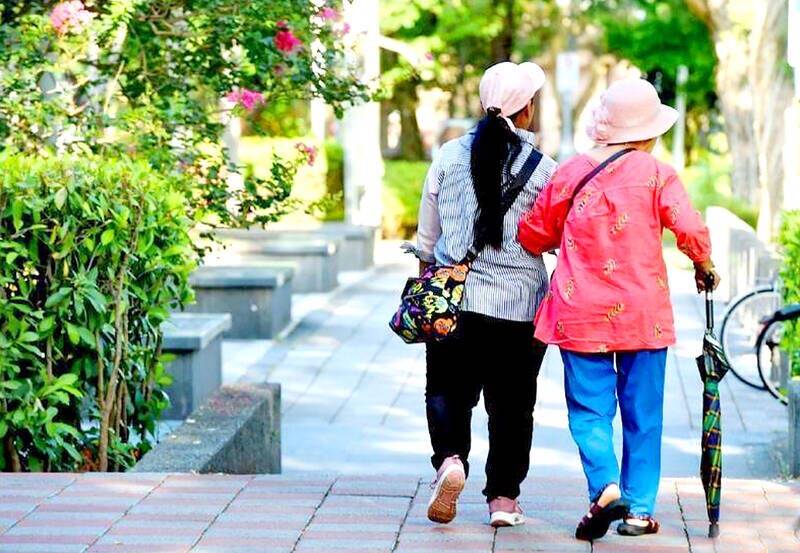
Photo: Taipei Times
The ministry-run Keelung Hospital’s long-term care residential facility is the first to be established under the program, followed by others in Taitung and Hualien, he said.
The government expects to set up 14 more facilities of the kind before 2029 to provide affordable long-term care to 2,000 more senior citizens, Lin said.
An annual report published by the ministry showed that more than 10 percent of seniors needed assistance with one or more daily living activities, with bathing topping the list.
The report, Elderly Living Report for 2022, defined daily living activities as washing, dressing, going to the toilet, getting in and out of bed or chairs, indoor movements and eating.
While only 1.71 percent of Taiwanese older than 55 needed assistance with one or more such activities, the figure rose to 11.86 percent for Taiwanese over 65 years of age and 24.4 percent of Taiwanese over 75 years of age, it said.
It showed that 11.35 percent of elderly people needed assistance to wash or shower, followed by 9.41 percent for changing clothes.
Family members remained the main source of support for elderly people, with more than 60 percent being taken care of by family, while 18 percent had help from professional carers and 6.72 percent relied on home or community-based services, the report said.
Assisted living institutions take care of 84,000 Taiwanese 65 years of age or older and 14,000 who are aged 55 to 64, it said.
These include 48.45 percent living in designated long-term care facilities, 38.35 percent in nursing homes and 6.39 percent in Veteran Affairs Council-run homes, it said.
Another 3.74 percent of elderly Taiwanese live in facilities for people with disabilities run by welfare services and 3.07 percent live in designated dementia care facilities, it said.

Considering that most countries issue more than five denominations of banknotes, the central bank has decided to redesign all five denominations, the bank said as it prepares for the first major overhaul of the banknotes in more than 24 years. Central bank Governor Yang Chin-lung (楊金龍) is expected to report to the Legislative Yuan today on the bank’s operations and the redesign’s progress. The bank in a report sent to the legislature ahead of today’s meeting said it had commissioned a survey on the public’s preferences. Survey results showed that NT$100 and NT$1,000 banknotes are the most commonly used, while NT$200 and NT$2,000

The Centers for Disease Control (CDC) yesterday reported the first case of a new COVID-19 subvariant — BA.3.2 — in a 10-year-old Singaporean girl who had a fever upon arrival in Taiwan and tested positive for the disease. The girl left Taiwan on March 20 and the case did not have a direct impact on the local community, it said. The WHO added the BA.3.2 strain to its list of Variants Under Monitoring in December last year, but this was the first imported case of the COVID-19 variant in Taiwan, CDC Deputy Director-General Lin Ming-cheng (林明誠) said. The girl arrived in Taiwan on

South Korea is planning to revise its controversial electronic arrival card, a step Taiwanese officials said prompted them to hold off on planned retaliatory measures, a South Korean media report said yesterday. A Yonhap News Agency report said that the South Korean Ministry of Foreign Affairs is planning to remove the “previous departure place” and “next destination” fields from its e-arrival card system. The plan, reached after interagency consultations, is under review and aims to simplify entry procedures and align the electronic form with the paper version, a South Korean ministry official said. The fields — which appeared only on the electronic form

The Ministry of Foreign Affairs (MOFA) is suspending retaliation measures against South Korea that were set to take effect tomorrow, after Seoul said it is updating its e-arrival system, MOFA said today. The measures were to be a new round of retaliation after Taiwan on March 1 changed South Korea's designation on government-issued alien resident certificates held by South Korean nationals to "South Korea” from the "Republic of Korea," the country’s official name. The move came after months of protests to Seoul over its listing of Taiwan as "China (Taiwan)" in dropdown menus on its new online immigration entry system. MOFA last week


 RSS
RSS