


The screening and treatment of hepatitis C infection is to be stepped up for prisoners, drug users and people with comorbid chronic diseases to meet the government’s goal of eliminating the virus by next year, Minister of Health and Welfare Chiu Tai-yuan (邱泰源) said yesterday.
The government has set the goal of eliminating the virus by next year, five years sooner than the WHO’s target deadline of 2030.
It launched a universal hepatitis B vaccination program in 1984, with each newborn inoculated against the virus starting in 1986, Chiu said.
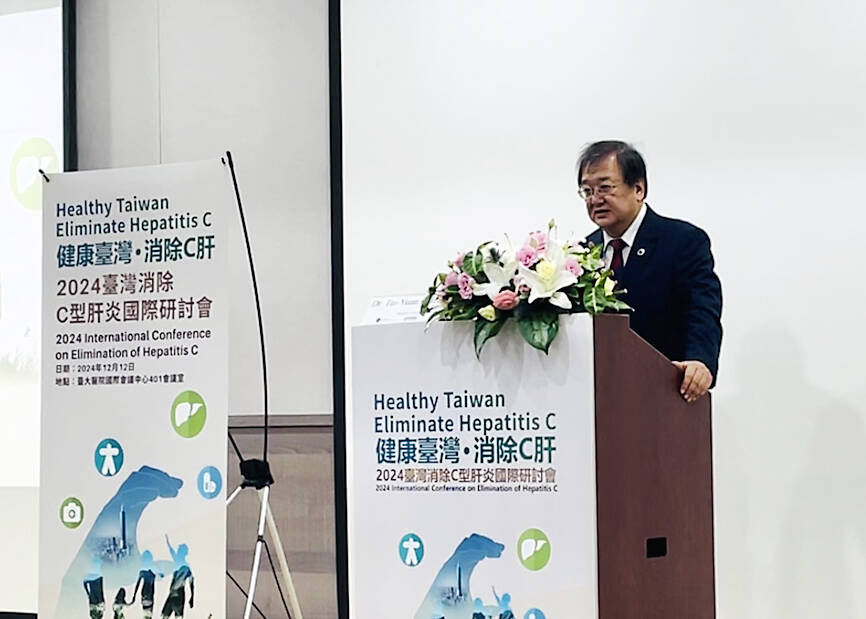
Photo: Lin Chih-yi, Taipei Times
Based on the successful experience of controlling hepatitis B, the government is confident of being awarded gold-tier certification in hepatitis C elimination, he said.
The government would “go the last mile” by enhancing the screening and treatment of hepatitis C infection for prisoners, drug users and patients with comorbid chronic diseases to boost underperforming indicators, he added.
Health Promotion Administration Director-General Wu Chao-chun (吳昭軍) said that the nation has made remarkable progress toward both the program and impact targets set by the WHO for hepatitis C elimination.
As of June, hepatitis C patients in Taiwan had a diagnostic rate of 90.6 percent and a cure rate of more than 95 percent, with standards reached in terms of blood transfusion safety and injection safety, Wu said.
The number of sterile and safe needles and syringes used by drug users averaged 292 per person per year, which was better than the goal of 300 set by the WHO and promising in earning gold-tier certification next year, he said.
Hepatitis C patients with comorbid chronic diseases such as diabetes or renal disease have come into focus, as they can enjoy better efficacy of chronic disease therapies if their hepatitis C is properly treated, he added.
As hepatitis C reinfections are not uncommon among drug addicts and prisoners, they are not subject to the restriction of only one state-reimbursed hepatitis C screening and would be monitored long term, Wu said.
Linkou Chang Gung Memorial Hospital gastroenterology division attending physician Chien Rong-nan (簡榮南) said informed consent from the patient is required prior to hepatitis C screening out of respect for human rights.
However, most drug users do not like to have blood tests, which leads to hepatitis C diagnostic rates as low as 40 to 50 percent in prisons, Chien said.
The Health Promotion Administration has introduced an at-home rapid test approach for hepatitis C — similar to blood glucose tests — to promote screenings in prisons, Chien added.

Considering that most countries issue more than five denominations of banknotes, the central bank has decided to redesign all five denominations, the bank said as it prepares for the first major overhaul of the banknotes in more than 24 years. Central bank Governor Yang Chin-lung (楊金龍) is expected to report to the Legislative Yuan today on the bank’s operations and the redesign’s progress. The bank in a report sent to the legislature ahead of today’s meeting said it had commissioned a survey on the public’s preferences. Survey results showed that NT$100 and NT$1,000 banknotes are the most commonly used, while NT$200 and NT$2,000

The Centers for Disease Control (CDC) yesterday reported the first case of a new COVID-19 subvariant — BA.3.2 — in a 10-year-old Singaporean girl who had a fever upon arrival in Taiwan and tested positive for the disease. The girl left Taiwan on March 20 and the case did not have a direct impact on the local community, it said. The WHO added the BA.3.2 strain to its list of Variants Under Monitoring in December last year, but this was the first imported case of the COVID-19 variant in Taiwan, CDC Deputy Director-General Lin Ming-cheng (林明誠) said. The girl arrived in Taiwan on

South Korea is planning to revise its controversial electronic arrival card, a step Taiwanese officials said prompted them to hold off on planned retaliatory measures, a South Korean media report said yesterday. A Yonhap News Agency report said that the South Korean Ministry of Foreign Affairs is planning to remove the “previous departure place” and “next destination” fields from its e-arrival card system. The plan, reached after interagency consultations, is under review and aims to simplify entry procedures and align the electronic form with the paper version, a South Korean ministry official said. The fields — which appeared only on the electronic form

The Ministry of Foreign Affairs (MOFA) is suspending retaliation measures against South Korea that were set to take effect tomorrow, after Seoul said it is updating its e-arrival system, MOFA said today. The measures were to be a new round of retaliation after Taiwan on March 1 changed South Korea's designation on government-issued alien resident certificates held by South Korean nationals to "South Korea” from the "Republic of Korea," the country’s official name. The move came after months of protests to Seoul over its listing of Taiwan as "China (Taiwan)" in dropdown menus on its new online immigration entry system. MOFA last week


 RSS
RSS