


Rising prices and a growing wealth gap are the top concerns of the Taiwanese public regarding the zero-emission policy, according to the findings of a survey conducted by the National Taiwan University’s Risk Society and Policy Research Center.
The Survey on Awareness of Just Transition of High-Carbon Industries was conducted between Oct. 17 and 25 this year, with 1,102 people across the country interviewed by phone.
Taiwan has adopted an energy transition policy that aims to achieve net zero emissions by 2050.
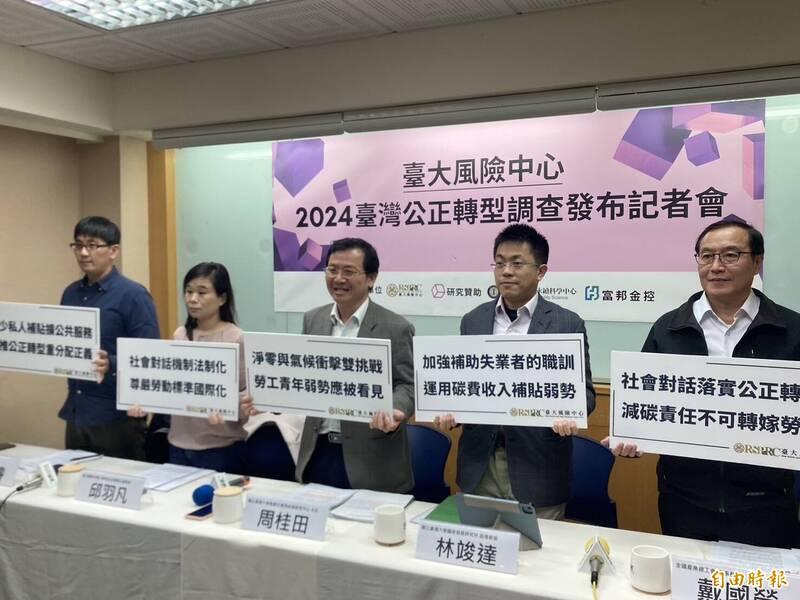
Photo: Yang Mien-chieh, Taipei Times
The survey is part of a series of opinion polls concerning climate change policies that has been conducted in the past three consecutive years.
In the survey, 86.5 percent of respondents said income inequality is a “serious” problem in Taiwan, 61.1 percent are worried about rising prices and 46.5 percent expressed concerns over the country's growing wealth gap.
However, 80.9 percent of respondents said they are “worried” about global warming, with 45.5 percent saying they are “very worried.”
Meanwhile, 79.9 percent said they believe extreme climate, such as heavy rain, drought and extreme heat, would have a “serious” negative impact on labor, while 71 percent thought low-income groups would also be similarly affected.
Ninety percent agreed the government should provide these groups with more resources to cope with extreme climate.
However, 62.1 percent of people said they had little understanding about the government’s carbon reduction policy, while 59.8 percent said the government has not properly taken public opinions into account.
As the government is to commence carbon fee collection, 78.7 percent said they support the policy, while 64.6 percent said the pressure to reduce carbon emission would be transferred to employees.
Meanwhile, 57.1 percent said carbon fee collection would have a negative impact on the economy and employment, and 62.3 percent said it would harm low-income groups.
There should be a fairer social distribution between the market, businesses and the country, while negotiations and communication between the government, businesses and labor should be strengthened, said center director Chou Kuei-tien (周桂田).
The youth, workers, and small and medium enterprises should have more ways of taking part in policy-making concerning zero-emissions, he said, adding that workers should receive subsidies to get on-the-job training, while low-income groups should also receive subsidies for living expenses.
The government should enact policies that are in line with the Just Transition Mechanism in the global community, said Chiu Yu-fan (邱羽凡), an associate professor of law at National Chiao Tung University, referring to a policy framework developed by the EU.
Taiwan Confederation of Trade Unions secretary-general Tai Kuo-jung (戴國榮) said the government should strengthen policy promotion and social dialogue, encourage energy transition in high-emitting industries and subsidize enterprises and underprivileged groups.
Youth Labor Union 95 director Ray Cheng (鄭中睿) said the government should prioritize financing public services to serve the housing and transport needs of ordinary citizens instead of subsidizing the private sector to avoid an “unjust” transition.

Considering that most countries issue more than five denominations of banknotes, the central bank has decided to redesign all five denominations, the bank said as it prepares for the first major overhaul of the banknotes in more than 24 years. Central bank Governor Yang Chin-lung (楊金龍) is expected to report to the Legislative Yuan today on the bank’s operations and the redesign’s progress. The bank in a report sent to the legislature ahead of today’s meeting said it had commissioned a survey on the public’s preferences. Survey results showed that NT$100 and NT$1,000 banknotes are the most commonly used, while NT$200 and NT$2,000

The Centers for Disease Control (CDC) yesterday reported the first case of a new COVID-19 subvariant — BA.3.2 — in a 10-year-old Singaporean girl who had a fever upon arrival in Taiwan and tested positive for the disease. The girl left Taiwan on March 20 and the case did not have a direct impact on the local community, it said. The WHO added the BA.3.2 strain to its list of Variants Under Monitoring in December last year, but this was the first imported case of the COVID-19 variant in Taiwan, CDC Deputy Director-General Lin Ming-cheng (林明誠) said. The girl arrived in Taiwan on

South Korea is planning to revise its controversial electronic arrival card, a step Taiwanese officials said prompted them to hold off on planned retaliatory measures, a South Korean media report said yesterday. A Yonhap News Agency report said that the South Korean Ministry of Foreign Affairs is planning to remove the “previous departure place” and “next destination” fields from its e-arrival card system. The plan, reached after interagency consultations, is under review and aims to simplify entry procedures and align the electronic form with the paper version, a South Korean ministry official said. The fields — which appeared only on the electronic form

The Ministry of Foreign Affairs (MOFA) is suspending retaliation measures against South Korea that were set to take effect tomorrow, after Seoul said it is updating its e-arrival system, MOFA said today. The measures were to be a new round of retaliation after Taiwan on March 1 changed South Korea's designation on government-issued alien resident certificates held by South Korean nationals to "South Korea” from the "Republic of Korea," the country’s official name. The move came after months of protests to Seoul over its listing of Taiwan as "China (Taiwan)" in dropdown menus on its new online immigration entry system. MOFA last week


 RSS
RSS